
In vivo dosimetry using an electronic portal imaging device for pediatric myeloablative Total body irradiation with volumetric modulated arc therapy

IF 3.2 Q2 ONCOLOGY
Francesca Greco, Matteo Galetto, Maria Vaccaro, Marco De Spirito, Andrea Fidanzio, Elisa Placidi, Enrico Rosa, Gerardina Stimato, Stefania Teodoli, Silvia Mariani, Nicola Dinapoli, Vincenzo Frascino, Maria Antonietta Gambacorta, Silvia Chiesa, Elisa Meldolesi
{"title":"In vivo dosimetry using an electronic portal imaging device for pediatric myeloablative Total body irradiation with volumetric modulated arc therapy","authors":"Francesca Greco,&nbsp;Matteo Galetto,&nbsp;Maria Vaccaro,&nbsp;Marco De Spirito,&nbsp;Andrea Fidanzio,&nbsp;Elisa Placidi,&nbsp;Enrico Rosa,&nbsp;Gerardina Stimato,&nbsp;Stefania Teodoli,&nbsp;Silvia Mariani,&nbsp;Nicola Dinapoli,&nbsp;Vincenzo Frascino,&nbsp;Maria Antonietta Gambacorta,&nbsp;Silvia Chiesa,&nbsp;Elisa Meldolesi","doi":"10.1016/j.phro.2026.101025","DOIUrl":null,"url":null,"abstract":"<div><h3>Background and Purpose</h3><div>Volumetric Modulated Arc Therapy (VMAT) has enabled highly conformal Total Body Irradiation (TBI), improving dose homogeneity and sparing of organs-of-interest. However, the increased complexity of VMAT-based TBI requires robust quality assurance strategies. This study evaluated the feasibility, accuracy, and reproducibility of Electronic Portal Imaging Device (EPID)-based in-vivo dosimetry (IVD) for VMAT TBI treatments.</div></div><div><h3>Materials and Methods</h3><div>Forty pediatric patients treated with VMAT-based TBI were retrospectively analyzed with two prescription schemes: 12 Gy/six fractions and 9.99 Gy/three fractions. EPID transmission images were acquired during each VMAT arc and analyzed using a gamma passing rate (Pγ) of 5%/2 mm, 10% threshold. IVD was evaluated across different anatomical regions. The impact of inter-fraction anatomical variations (weight loss, abdominal swelling, gastrointestinal air) was assessed through dose recalculations on modified CT datasets. Phantom measurements were performed to validate the sensitivity of EPID-based IVD to clinically relevant perturbations.</div></div><div><h3>Results</h3><div>IVD measurements showed median Pγ of 97.3 ± 3.2%. Across the forty patients, a mean Pγ of 99.3 ± 0.8% and 99.0 ± 0.4% was observed in the head and thoracic regions respectively, lower values (96.5 ± 3.4% and 94.3 ± 3.6%) were found in the lumbar and pelvic regions respectively. Simulated abdominal swelling ≥1.5 cm reduced target coverage, while weight loss and gastrointestinal air had limited dosimetric impact. Phantom tests confirmed IVD sensitivity to significant anatomical changes.</div></div><div><h3>Conclusions</h3><div>EPID-based IVD was a feasible tool for verifying VMAT-based TBI, enabling detection of clinically relevant inter-fraction anatomical variations and supporting safe treatment delivery.</div></div>","PeriodicalId":36850,"journal":{"name":"Physics and Imaging in Radiation Oncology","volume":"40 ","pages":"Article 101025"},"PeriodicalIF":3.2000,"publicationDate":"2026-07-01","publicationTypes":"Journal Article","fieldsOfStudy":null,"isOpenAccess":false,"openAccessPdf":"https://www.ncbi.nlm.nih.gov/pmc/articles/PMC13331980/pdf/","citationCount":"0","resultStr":null,"platform":"Semanticscholar","paperid":null,"PeriodicalName":"Physics and Imaging in Radiation Oncology","FirstCategoryId":"1085","ListUrlMain":"https://www.sciencedirect.com/science/article/pii/S2405631626001259","RegionNum":0,"RegionCategory":null,"ArticlePicture":[],"TitleCN":null,"AbstractTextCN":null,"PMCID":null,"EPubDate":"2026/6/19 0:00:00","PubModel":"Epub","JCR":"Q2","JCRName":"ONCOLOGY","Score":null,"Total":0}
引用次数: 0

Abstract

Background and Purpose

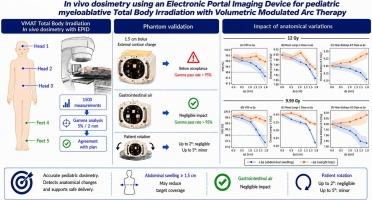
Volumetric Modulated Arc Therapy (VMAT) has enabled highly conformal Total Body Irradiation (TBI), improving dose homogeneity and sparing of organs-of-interest. However, the increased complexity of VMAT-based TBI requires robust quality assurance strategies. This study evaluated the feasibility, accuracy, and reproducibility of Electronic Portal Imaging Device (EPID)-based in-vivo dosimetry (IVD) for VMAT TBI treatments.

Materials and Methods

Forty pediatric patients treated with VMAT-based TBI were retrospectively analyzed with two prescription schemes: 12 Gy/six fractions and 9.99 Gy/three fractions. EPID transmission images were acquired during each VMAT arc and analyzed using a gamma passing rate (Pγ) of 5%/2 mm, 10% threshold. IVD was evaluated across different anatomical regions. The impact of inter-fraction anatomical variations (weight loss, abdominal swelling, gastrointestinal air) was assessed through dose recalculations on modified CT datasets. Phantom measurements were performed to validate the sensitivity of EPID-based IVD to clinically relevant perturbations.

Results

IVD measurements showed median Pγ of 97.3 ± 3.2%. Across the forty patients, a mean Pγ of 99.3 ± 0.8% and 99.0 ± 0.4% was observed in the head and thoracic regions respectively, lower values (96.5 ± 3.4% and 94.3 ± 3.6%) were found in the lumbar and pelvic regions respectively. Simulated abdominal swelling ≥1.5 cm reduced target coverage, while weight loss and gastrointestinal air had limited dosimetric impact. Phantom tests confirmed IVD sensitivity to significant anatomical changes.

Conclusions

EPID-based IVD was a feasible tool for verifying VMAT-based TBI, enabling detection of clinically relevant inter-fraction anatomical variations and supporting safe treatment delivery.
Abstract Image

使用电子门静脉成像装置进行小儿清髓性全身照射与体积调节弧线治疗的体内剂量测定。
背景和目的:体积调制弧线疗法(VMAT)实现了高度适形的全身照射(TBI),改善了剂量均匀性并保留了相关器官。然而,基于vmat的TBI的复杂性的增加需要健壮的质量保证策略。本研究评估了基于电子门静脉成像设备(EPID)的体内剂量测定(IVD)用于VMAT TBI治疗的可行性、准确性和可重复性。材料与方法:回顾性分析40例基于vmat的TBI患儿,采用12 Gy/ 6分和9.99 Gy/ 3分两种处方方案。在每个VMAT弧期间获取EPID传输图像,并使用5%/ 2mm的伽马通过率(Pγ)进行分析,阈值为10%。IVD在不同解剖区域进行评估。通过在修改后的CT数据集上重新计算剂量来评估分数间解剖变化(体重减轻、腹部肿胀、胃肠道空气)的影响。通过幻影测量来验证基于epid的IVD对临床相关扰动的敏感性。结果:IVD测量显示中位Pγ为97.3±3.2%。在40例患者中,头部和胸部的Pγ平均值分别为99.3±0.8%和99.0±0.4%,腰椎和骨盆的Pγ平均值分别为96.5±3.4%和94.3±3.6%。模拟腹部肿胀≥1.5 cm降低了目标覆盖范围,而体重减轻和胃肠道空气对剂量学的影响有限。幻影试验证实了IVD对显著解剖变化的敏感性。结论:基于epid的IVD是验证基于vmat的TBI的可行工具,可以检测临床相关的碎片间解剖变异,并支持安全的治疗交付。
本文章由计算机程序翻译,如有差异,请以英文原文为准。
求助全文
约1分钟内获得全文 求助全文
来源期刊
Physics and Imaging in Radiation Oncology
Physics and Imaging in Radiation Oncology Physics and Astronomy-Radiation
CiteScore
5.30
自引率
18.90%
发文量
93
审稿时长
6 weeks

×
引用
GB/T 7714-2015
复制
MLA
复制
APA
复制
导出至
BibTeX EndNote RefMan NoteFirst NoteExpress
×
提示
您的信息不完整,为了账户安全,请先补充。
现在去补充
×
提示
您因"违规操作"
具体请查看互助需知
我知道了
×
提示
确定
请完成安全验证×
copy
已复制链接
快去分享给好友吧!
我知道了
右上角分享
点击右上角分享
0
联系我们:info@booksci.cn Book学术提供免费学术资源搜索服务,方便国内外学者检索中英文文献。致力于提供最便捷和优质的服务体验。 Copyright © 2023 布克学术 All rights reserved.
京ICP备2023020795号-1
ghs 京公网安备 11010802042870号
Book学术文献互助
Book学术文献互助群
群 号:604180095
Book学术官方微信
小红书


