
Computed tomography-based prediction of early recurrence risks with estimating individual times to recurrence for lung cancer patients prior to radiotherapy
IF 3.2
Q2 ONCOLOGY
Physics and Imaging in Radiation Oncology
Pub Date : 2026-07-01
Epub Date: 2026-06-13
DOI:10.1016/j.phro.2026.101021
引用次数: 0
Abstract
Background and Purpose
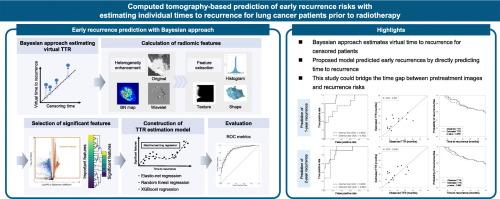
Current radiomics approaches have limitations in predicting recurrence with the time gap between radiomic features prior to treatment and individual recurrence risks following treatment. This study aimed to develop computed tomography (CT)-based prediction models of early recurrence risks by estimating individual times to recurrence (TTRs) in patients with non-small cell lung cancer (NSCLC) prior to stereotactic ablative radiotherapy (SABR).
Materials and methods
A total of 143 patients with stage I-II NSCLC treated with SABR were enrolled. Planning CT images were used to construct internal (n = 125; 43 recurrent, 56 censored, and 26 recurrence-free within 5 years) and external (n = 18; 15 recurrent and 3 recurrence-free) datasets. Reference TTR data from 124 recurrent patients were used to estimate virtual TTRs of 56 censored patients using a Bayesian approach with the Markov chain Monte Carlo algorithm. Three types of regression models were developed to estimate the TTR based on significant CT image features associated with early recurrences. The predictions of 1-year and 2-year recurrences based on the estimated TTRs were evaluated using the areas under the receiver operating characteristic curves (AUCs).
Results
The best prediction models achieved AUCs of 0.926 and 0.763 for 1-year and 0.869 and 0.883 for 2-year recurrence in the internal and external tests, respectively.
Conclusion
The proposed CT-based model demonstrated improved performance for predicting 1- and 2-year recurrences by directly predicting TTRs. This study could bridge the time gap between pretreatment radiomic features and individual recurrence risks.
基于计算机断层扫描的肺癌患者放疗前早期复发风险预测及个体复发时间估算。
背景与目的:目前的放射组学方法在预测复发方面存在局限性,治疗前放射组学特征与治疗后个体复发风险之间存在时间差距。本研究旨在通过估计非小细胞肺癌(NSCLC)患者在立体定向消融放疗(SABR)前的个体复发时间(trs),建立基于计算机断层扫描(CT)的早期复发风险预测模型。材料和方法:共纳入143例接受SABR治疗的I-II期NSCLC患者。计划CT图像用于构建内部(n = 125; 5年内复发43例,删除56例,无复发26例)和外部(n = 18;复发15例,无复发3例)数据集。使用124例复发患者的参考TTR数据,使用贝叶斯方法和马尔可夫链蒙特卡罗算法估计56例切除患者的虚拟TTR。基于与早期复发相关的重要CT图像特征,开发了三种类型的回归模型来估计TTR。利用受试者工作特征曲线(auc)下的面积评估基于估计trs的1年和2年复发预测。结果:最佳预测模型1年auc分别为0.926和0.763,2年auc分别为0.869和0.883。结论:提出的基于ct的模型通过直接预测TTRs,在预测1年和2年复发方面表现出更好的性能。这项研究可以弥补放疗前的放射学特征与个体复发风险之间的时间差距。
本文章由计算机程序翻译,如有差异,请以英文原文为准。
求助全文
约1分钟内获得全文
求助全文
来源期刊
Physics and Imaging in Radiation Oncology
Physics and Astronomy-Radiation
CiteScore
5.30
自引率
18.90%
发文量
93
审稿时长
6 weeks
 求助内容:
求助内容: 应助结果提醒方式:

 京公网安备 11010802042870号


