
Collaborative Multimodal Optimization Control for Coupling Subprocesses in WWTP
IF 9.8
1区 计算机科学
Q1 AUTOMATION & CONTROL SYSTEMS
IEEE Transactions on Industrial Informatics
Pub Date : 2026-10-01
Epub Date: 2026-07-02
DOI:10.1109/TII.2026.3696649
引用次数: 0
Abstract
The optimization control technique has been extensively applied in wastewater treatment processes (WWTPs) to improve efficiency and reduce emissions during anaerobic and aerobic subprocesses. However, coupling between anaerobic and aerobic subprocesses creates an intertwined relationship between control variables and their optimization objectives, resulting in difficulties in quantifying the impact of control variables and reducing operation feasibility. To solve this problem, a collaborative multimodal optimization control (CMOC) method is proposed for coupling subprocesses in WWTPs. First, the collaborative objective mapping strategy is proposed to construct the multimodal optimization objectives of anaerobic and aerobic subprocesses. Then, the subprocess optimization objectives are mapped to the unified multimodal functions without weighting. Second, a multimodal particle swarm optimization with a attention mechanism is designed to obtain optimal states of subprocesses. Then, the particles are attracted by learning from the neighborhood best positions to improve multimodal optimization performance. Third, a heuristic-based model predictive control (H-MPC) is proposed to realize collaborative optimization control of anaerobic and aerobic subprocesses. Then, the subprocess optimization objectives are tradeoff in unison with optimal control based on heuristic functions in H-MPC. Finally, the proposed CMOC is applied to the Benchmark Simulation Model No. 1, and the experimental results demonstrate that the proposed method can effectively improve the optimization control performance of WWTPs .污水处理厂耦合子过程的协同多模态优化控制
优化控制技术已广泛应用于污水处理过程中,以提高厌氧和好氧子过程的效率和减少排放。然而,厌氧和好氧子过程之间的耦合导致控制变量与其优化目标之间的关系交织在一起,导致控制变量的影响难以量化,降低了操作的可行性。为解决这一问题,提出了一种用于污水处理厂子过程耦合的协同多模态优化控制方法。首先,提出了协同目标映射策略,构建厌氧和好氧子过程的多模态优化目标。然后,将子过程优化目标不加权重地映射到统一的多模态函数中。其次,设计了一种带有注意机制的多模态粒子群优化算法,以获得子进程的最优状态。然后,通过学习邻域最优位置来吸引粒子,提高多模态优化性能。第三,提出了一种基于启发式的模型预测控制(H-MPC),实现厌氧和好氧子过程的协同优化控制。然后,在H-MPC中对子过程优化目标与基于启发式函数的最优控制进行协调权衡。最后,将所提出的CMOC应用于1号基准仿真模型,实验结果表明,所提出的方法可以有效地提高污水处理厂的优化控制性能。
本文章由计算机程序翻译,如有差异,请以英文原文为准。
求助全文
约1分钟内获得全文
求助全文
来源期刊
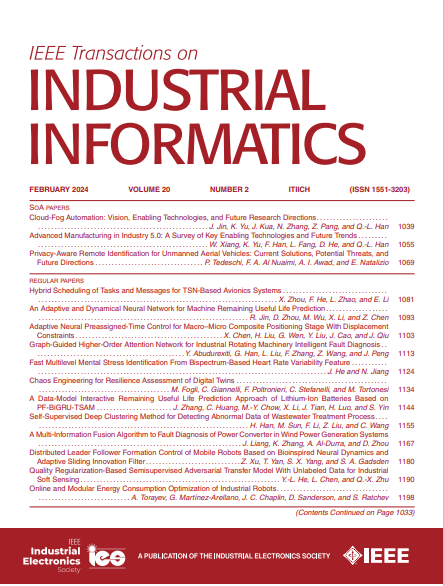
IEEE Transactions on Industrial Informatics
工程技术-工程:工业
CiteScore
24.10
自引率
8.90%
发文量
1202
审稿时长
5.1 months
期刊介绍:
The IEEE Transactions on Industrial Informatics is a multidisciplinary journal dedicated to publishing technical papers that connect theory with practical applications of informatics in industrial settings. It focuses on the utilization of information in intelligent, distributed, and agile industrial automation and control systems. The scope includes topics such as knowledge-based and AI-enhanced automation, intelligent computer control systems, flexible and collaborative manufacturing, industrial informatics in software-defined vehicles and robotics, computer vision, industrial cyber-physical and industrial IoT systems, real-time and networked embedded systems, security in industrial processes, industrial communications, systems interoperability, and human-machine interaction.
 求助内容:
 应助结果提醒方式:


 京公网安备 11010802042870号


