
Uniformly Deployable Kirigami on Arbitrary Planar Graphs

IF 13 1区 计算机科学 Q1 COMPUTER SCIENCE, SOFTWARE ENGINEERING
Aviv Segall, Jing Ren, Olga Sorkine-Hornung
{"title":"Uniformly Deployable Kirigami on Arbitrary Planar Graphs","authors":"Aviv Segall, Jing Ren, Olga Sorkine-Hornung","doi":"10.1145/3811326","DOIUrl":null,"url":null,"abstract":"We present an analytical framework for exploring the design space of hinged kirigami structures that deploy rigidly and uniformly. A hinged kirigami structure consists of rigid planar faces connected by hinges, and is deployable if the faces can rotate about the hinges without deformation. Such deployability depends on both the topology and the geometry, i.e., the combinatorial connectivity of the faces and their spatial embedding. Prior work studies geometric constraints for uniform deployability in restricted settings, most notably quadrilateral kirigami patterns and structures derived from 2-colorable planar graphs. However, existing analysis does not readily generalize to arbitrary kirigami structures, nor does it provide a systematic approach for constructing deployable kirigami from non-2-colorable planar graphs (e.g., graphs with non-manifold embeddings). Moreover, while geometric conditions for deployability have been partially investigated, the structure of the full deployable design space and its associated degrees of freedom remain largely unexplored. In this work, we propose a new framework that enables the derivation of hinged kirigami structures from arbitrary planar graphs, with the key feature that multiple distinct kirigami structures can be generated from the same graph. We derive geometric constraints that ensure uniform rigid deployability and analytically characterize the full design space of deployable embeddings, including its associated degrees of freedom. This characterization allows continuous navigation of the design space and provides a systematic foundation for the design of kirigami-based mechanical metamaterials.","PeriodicalId":50913,"journal":{"name":"ACM Transactions on Graphics","volume":"17 1","pages":""},"PeriodicalIF":13.0000,"publicationDate":"2026-07-03","publicationTypes":"Journal Article","fieldsOfStudy":null,"isOpenAccess":false,"openAccessPdf":"","citationCount":"0","resultStr":null,"platform":"Semanticscholar","paperid":null,"PeriodicalName":"ACM Transactions on Graphics","FirstCategoryId":"94","ListUrlMain":"https://doi.org/10.1145/3811326","RegionNum":1,"RegionCategory":"计算机科学","ArticlePicture":[],"TitleCN":null,"AbstractTextCN":null,"PMCID":null,"EPubDate":"","PubModel":"","JCR":"Q1","JCRName":"COMPUTER SCIENCE, SOFTWARE ENGINEERING","Score":null,"Total":0}
引用次数: 0

Abstract

We present an analytical framework for exploring the design space of hinged kirigami structures that deploy rigidly and uniformly. A hinged kirigami structure consists of rigid planar faces connected by hinges, and is deployable if the faces can rotate about the hinges without deformation. Such deployability depends on both the topology and the geometry, i.e., the combinatorial connectivity of the faces and their spatial embedding. Prior work studies geometric constraints for uniform deployability in restricted settings, most notably quadrilateral kirigami patterns and structures derived from 2-colorable planar graphs. However, existing analysis does not readily generalize to arbitrary kirigami structures, nor does it provide a systematic approach for constructing deployable kirigami from non-2-colorable planar graphs (e.g., graphs with non-manifold embeddings). Moreover, while geometric conditions for deployability have been partially investigated, the structure of the full deployable design space and its associated degrees of freedom remain largely unexplored. In this work, we propose a new framework that enables the derivation of hinged kirigami structures from arbitrary planar graphs, with the key feature that multiple distinct kirigami structures can be generated from the same graph. We derive geometric constraints that ensure uniform rigid deployability and analytically characterize the full design space of deployable embeddings, including its associated degrees of freedom. This characterization allows continuous navigation of the design space and provides a systematic foundation for the design of kirigami-based mechanical metamaterials.
任意平面图上的可均匀展开基里伽米
我们提出了一个分析框架,用于探索铰接基里伽米结构的设计空间,这些结构具有刚性和均匀性。铰接基里格米结构由铰链连接的刚性平面组成,如果面可以绕铰链旋转而不变形,则可展开。这种可部署性取决于拓扑结构和几何结构,即面的组合连通性及其空间嵌入。先前的工作研究了限制条件下均匀展开的几何约束,最引人注目的是来自2色平面图形的四边形kirigami图案和结构。然而,现有的分析并不能很容易地推广到任意的kirigami结构,也没有提供一个系统的方法来从非2色的平面图(例如,具有非流形嵌入的图)构建可部署的kirigami。此外,虽然对可部署性的几何条件进行了部分研究,但完全可部署设计空间的结构及其相关自由度在很大程度上仍未被探索。在这项工作中,我们提出了一个新的框架,可以从任意平面图中推导铰链基里格米结构,其关键特征是可以从同一图中生成多个不同的基里格米结构。我们推导了几何约束,以确保统一的刚性可部署性,并分析表征了可部署嵌入的完整设计空间,包括其相关的自由度。这种特性使得设计空间的连续导航成为可能,并为基里伽米机械超材料的设计提供了系统的基础。
本文章由计算机程序翻译,如有差异,请以英文原文为准。
求助全文
约1分钟内获得全文 求助全文
来源期刊
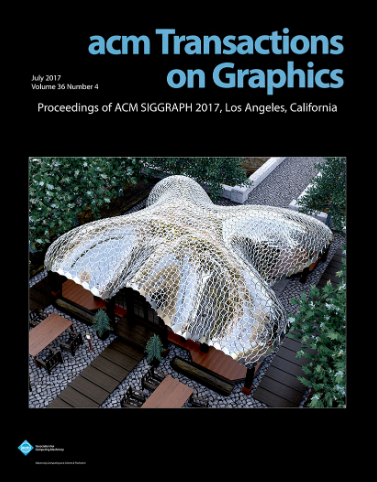
ACM Transactions on Graphics
ACM Transactions on Graphics 工程技术-计算机:软件工程
CiteScore
14.30
自引率
25.80%
发文量
193
审稿时长
12 months
期刊介绍: ACM Transactions on Graphics (TOG) is a peer-reviewed scientific journal that aims to disseminate the latest findings of note in the field of computer graphics. It has been published since 1982 by the Association for Computing Machinery. Starting in 2003, all papers accepted for presentation at the annual SIGGRAPH conference are printed in a special summer issue of the journal.

×
引用
GB/T 7714-2015
复制
MLA
复制
APA
复制
导出至
BibTeX EndNote RefMan NoteFirst NoteExpress
×
提示
您的信息不完整,为了账户安全,请先补充。
现在去补充
×
提示
您因"违规操作"
具体请查看互助需知
我知道了
×
提示
确定
请完成安全验证×
copy
已复制链接
快去分享给好友吧!
我知道了
右上角分享
点击右上角分享
0
联系我们:info@booksci.cn Book学术提供免费学术资源搜索服务,方便国内外学者检索中英文文献。致力于提供最便捷和优质的服务体验。 Copyright © 2023 布克学术 All rights reserved.
京ICP备2023020795号-1
ghs 京公网安备 11010802042870号
Book学术文献互助
Book学术文献互助群
群 号:604180095
Book学术官方微信
小红书


