
Stress-Aware Panelization of Freeform Surfaces

IF 13 1区 计算机科学 Q1 COMPUTER SCIENCE, SOFTWARE ENGINEERING
Xinzhuo Hu, Roi Poranne, Julian Panetta
{"title":"Stress-Aware Panelization of Freeform Surfaces","authors":"Xinzhuo Hu, Roi Poranne, Julian Panetta","doi":"10.1145/3811387","DOIUrl":null,"url":null,"abstract":"Freeform surfaces are popular in architectural design for their expressive aesthetics, yet they remain challenging to fabricate. A common strategy is to approximate them with assemblies of planar polygonal panels in a process we term panelization, enabling cost-effective fabrication from sheet materials such as wood, metal, or glass. Our goal is to compute panelizations that are both geometrically faithful and structurally robust. A two-stage pipeline, <jats:italic toggle=\"yes\">i.e.</jats:italic> geometric panelization followed by structural optimization, can be effective, but joint optimization may yield better outcomes by letting mechanics influence the panelization itself. The challenges are that the panelization task is inherently combinatorial, and structural objectives depend on stresses that have a complex, global dependence on the geometry and are costly to evaluate. Moreover, improving structural performance must be balanced against preserving the input surface's design intent. To address these challenges, we formulate panelization as a continuous surface flow coupled to stress analysis, by modeling candidates as creased elastic shells. We define a global objective by integrating an arbitrary function of stress over the shell and derive efficient gradients with respect to the surface shape to enable optimization. We further introduce flow terms that better preserve the input shape and show that running BFGS in a Sobolev space substantially outperforms standard BFGS and Sobolev gradient descent. We evaluate our method on architectural models, showing that incorporating stress during panelization yields substantial stress reductions and more robust designs compared to optimizing stress after fixing the panelization.","PeriodicalId":50913,"journal":{"name":"ACM Transactions on Graphics","volume":"25 1","pages":""},"PeriodicalIF":13.0000,"publicationDate":"2026-07-03","publicationTypes":"Journal Article","fieldsOfStudy":null,"isOpenAccess":false,"openAccessPdf":"","citationCount":"0","resultStr":null,"platform":"Semanticscholar","paperid":null,"PeriodicalName":"ACM Transactions on Graphics","FirstCategoryId":"94","ListUrlMain":"https://doi.org/10.1145/3811387","RegionNum":1,"RegionCategory":"计算机科学","ArticlePicture":[],"TitleCN":null,"AbstractTextCN":null,"PMCID":null,"EPubDate":"","PubModel":"","JCR":"Q1","JCRName":"COMPUTER SCIENCE, SOFTWARE ENGINEERING","Score":null,"Total":0}
引用次数: 0

Abstract

Freeform surfaces are popular in architectural design for their expressive aesthetics, yet they remain challenging to fabricate. A common strategy is to approximate them with assemblies of planar polygonal panels in a process we term panelization, enabling cost-effective fabrication from sheet materials such as wood, metal, or glass. Our goal is to compute panelizations that are both geometrically faithful and structurally robust. A two-stage pipeline, i.e. geometric panelization followed by structural optimization, can be effective, but joint optimization may yield better outcomes by letting mechanics influence the panelization itself. The challenges are that the panelization task is inherently combinatorial, and structural objectives depend on stresses that have a complex, global dependence on the geometry and are costly to evaluate. Moreover, improving structural performance must be balanced against preserving the input surface's design intent. To address these challenges, we formulate panelization as a continuous surface flow coupled to stress analysis, by modeling candidates as creased elastic shells. We define a global objective by integrating an arbitrary function of stress over the shell and derive efficient gradients with respect to the surface shape to enable optimization. We further introduce flow terms that better preserve the input shape and show that running BFGS in a Sobolev space substantially outperforms standard BFGS and Sobolev gradient descent. We evaluate our method on architectural models, showing that incorporating stress during panelization yields substantial stress reductions and more robust designs compared to optimizing stress after fixing the panelization.
自由曲面的应力感知面板化
自由曲面因其富有表现力的美学在建筑设计中很受欢迎,但它们的制造仍然具有挑战性。一种常见的策略是在我们称之为面板化的过程中,用平面多边形面板的组装来近似它们,从而使板材(如木材、金属或玻璃)的制造具有成本效益。我们的目标是计算几何上忠实和结构上坚固的面板。两阶段的管道,即几何面板化之后的结构优化,是有效的,但连接优化可能会产生更好的结果,让力学影响面板化本身。挑战在于,面板化任务本质上是组合的,结构目标依赖于应力,这些应力对几何形状具有复杂的全局依赖性,并且评估成本很高。此外,提高结构性能必须与保持输入表面的设计意图相平衡。为了应对这些挑战,我们通过将候选面板建模为皱褶弹性壳,将面板设计为连续的表面流动,并与应力分析相结合。我们通过对壳体上的任意应力函数进行积分来定义一个全局目标,并推导出关于表面形状的有效梯度,以实现优化。我们进一步引入了更好地保持输入形状的流项,并表明在Sobolev空间中运行BFGS大大优于标准BFGS和Sobolev梯度下降。我们在建筑模型上评估了我们的方法,结果表明,与固定面板后优化应力相比,在面板化过程中加入应力可以产生大量的应力减少和更稳健的设计。
本文章由计算机程序翻译,如有差异,请以英文原文为准。
求助全文
约1分钟内获得全文 求助全文
来源期刊
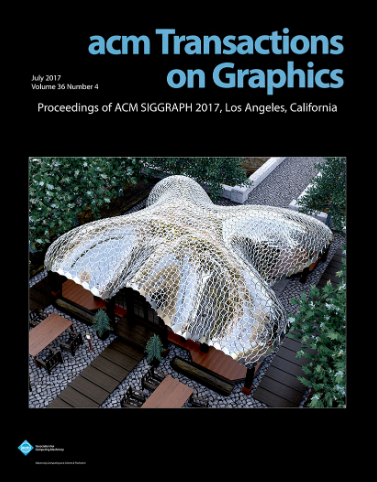
ACM Transactions on Graphics
ACM Transactions on Graphics 工程技术-计算机:软件工程
CiteScore
14.30
自引率
25.80%
发文量
193
审稿时长
12 months
期刊介绍: ACM Transactions on Graphics (TOG) is a peer-reviewed scientific journal that aims to disseminate the latest findings of note in the field of computer graphics. It has been published since 1982 by the Association for Computing Machinery. Starting in 2003, all papers accepted for presentation at the annual SIGGRAPH conference are printed in a special summer issue of the journal.

×
引用
GB/T 7714-2015
复制
MLA
复制
APA
复制
导出至
BibTeX EndNote RefMan NoteFirst NoteExpress
×
提示
您的信息不完整,为了账户安全,请先补充。
现在去补充
×
提示
您因"违规操作"
具体请查看互助需知
我知道了
×
提示
确定
请完成安全验证×
copy
已复制链接
快去分享给好友吧!
我知道了
右上角分享
点击右上角分享
0
联系我们:info@booksci.cn Book学术提供免费学术资源搜索服务,方便国内外学者检索中英文文献。致力于提供最便捷和优质的服务体验。 Copyright © 2023 布克学术 All rights reserved.
京ICP备2023020795号-1
ghs 京公网安备 11010802042870号
Book学术文献互助
Book学术文献互助群
群 号:604180095
Book学术官方微信
小红书


