{"title":"pH-Dependent Modulation of Structural and Functional Properties of Safflower (Carthamus tinctorius L.) Protein Induced by Ultrasonic Treatment","authors":"Burak Göroğlu, Fatma Korkmaz","doi":"10.1007/s11483-026-10177-x","DOIUrl":null,"url":null,"abstract":"<div><p>This study aimed to evaluate the effects of ultrasonic and pH shift treatments (pH 2 and 12), applied both individually and in combination, on the structural and functional properties of safflower protein. Ultrasonic treatment at pH 7 significantly reduced particle size (from 457.60 to 144.14 nm) and surface hydrophobicity (from 38.93 to 33.93 µg), while enhancing solubility (from 15.32 to 26.04%) and foaming capacity (from 22.50 to 26.67%). Acidic pH shift (pH 2) increased particle size by up to 78%, accompanied by marked improvements in water holding capacity (up to 114%) and foaming capacity (up to 59%). Conversely, alkaline pH shift (pH 12) led to a substantial reduction in particle size (up to 74%) and a pronounced increase in surface hydrophobicity (up to 50%), resulting in the highest emulsion activity (14.62 m²/g) and emulsion stability (5.50 min) indexes. The combined application of pH shift with ultrasonic treatments reduced particle size by up to 40% while increasing the absolute ζ-potential and surface hydrophobicity by 24% and 20%, respectively. These changes contributed to increases of up to 45% in solubility, 28% in water holding capacity, and 30% in foaming stability. However, reductions in emulsifying properties were observed, with the emulsion activity and emulsion stability indexes decreasing by up to 3.64 m²/g and 0.88 min, respectively. Overall, the findings demonstrate that safflower protein functionality is highly pH-dependent and that the strategic combination of ultrasonic and pH shift treatments represents an effective approach to modulate its structural and functional properties for food applications.</p></div>","PeriodicalId":564,"journal":{"name":"Food Biophysics","volume":"21 3","pages":""},"PeriodicalIF":3.9000,"publicationDate":"2026-06-23","publicationTypes":"Journal Article","fieldsOfStudy":null,"isOpenAccess":false,"openAccessPdf":"https://link.springer.com/content/pdf/10.1007/s11483-026-10177-x.pdf","citationCount":"0","resultStr":null,"platform":"Semanticscholar","paperid":null,"PeriodicalName":"Food Biophysics","FirstCategoryId":"97","ListUrlMain":"https://link.springer.com/article/10.1007/s11483-026-10177-x","RegionNum":4,"RegionCategory":"农林科学","ArticlePicture":[],"TitleCN":null,"AbstractTextCN":null,"PMCID":null,"EPubDate":"","PubModel":"","JCR":"Q2","JCRName":"FOOD SCIENCE & TECHNOLOGY","Score":null,"Total":0}
引用次数: 0
Abstract
This study aimed to evaluate the effects of ultrasonic and pH shift treatments (pH 2 and 12), applied both individually and in combination, on the structural and functional properties of safflower protein. Ultrasonic treatment at pH 7 significantly reduced particle size (from 457.60 to 144.14 nm) and surface hydrophobicity (from 38.93 to 33.93 µg), while enhancing solubility (from 15.32 to 26.04%) and foaming capacity (from 22.50 to 26.67%). Acidic pH shift (pH 2) increased particle size by up to 78%, accompanied by marked improvements in water holding capacity (up to 114%) and foaming capacity (up to 59%). Conversely, alkaline pH shift (pH 12) led to a substantial reduction in particle size (up to 74%) and a pronounced increase in surface hydrophobicity (up to 50%), resulting in the highest emulsion activity (14.62 m²/g) and emulsion stability (5.50 min) indexes. The combined application of pH shift with ultrasonic treatments reduced particle size by up to 40% while increasing the absolute ζ-potential and surface hydrophobicity by 24% and 20%, respectively. These changes contributed to increases of up to 45% in solubility, 28% in water holding capacity, and 30% in foaming stability. However, reductions in emulsifying properties were observed, with the emulsion activity and emulsion stability indexes decreasing by up to 3.64 m²/g and 0.88 min, respectively. Overall, the findings demonstrate that safflower protein functionality is highly pH-dependent and that the strategic combination of ultrasonic and pH shift treatments represents an effective approach to modulate its structural and functional properties for food applications.
期刊介绍:
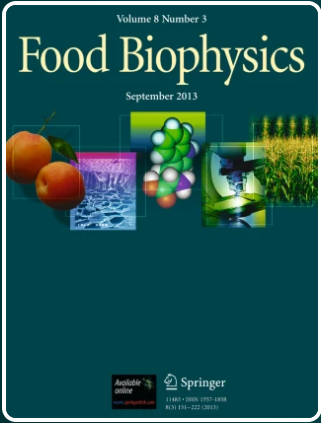
Biophysical studies of foods and agricultural products involve research at the interface of chemistry, biology, and engineering, as well as the new interdisciplinary areas of materials science and nanotechnology. Such studies include but are certainly not limited to research in the following areas: the structure of food molecules, biopolymers, and biomaterials on the molecular, microscopic, and mesoscopic scales; the molecular basis of structure generation and maintenance in specific foods, feeds, food processing operations, and agricultural products; the mechanisms of microbial growth, death and antimicrobial action; structure/function relationships in food and agricultural biopolymers; novel biophysical techniques (spectroscopic, microscopic, thermal, rheological, etc.) for structural and dynamical characterization of food and agricultural materials and products; the properties of amorphous biomaterials and their influence on chemical reaction rate, microbial growth, or sensory properties; and molecular mechanisms of taste and smell.
A hallmark of such research is a dependence on various methods of instrumental analysis that provide information on the molecular level, on various physical and chemical theories used to understand the interrelations among biological molecules, and an attempt to relate macroscopic chemical and physical properties and biological functions to the molecular structure and microscopic organization of the biological material.


 求助内容:
 应助结果提醒方式:


 京公网安备 11010802042870号


