Long-Xiang Li, Bo-Yang Wei, Lei Jin, Yu Wu, Ze-Yu Yang, Can Li, Jia-Ming Zhou, Yu Song, Wen-Zhi Gong, Yuan-Hao Ou-Yang, Hao Huang, Xin Feng, Shen-Quan Guo, Wen-Ping Cheng, Ran Li, Shu-Yin Liang, Shi-Xing Su, Fa Jin, Xin Zhang, Yan-Chao Liu, Chuan-Zhi Duan, Wen-Chao Liu, Xi-Feng Li
{"title":"Clemastine alleviates cognitive dysfunction after SAH by targeting neuronal CNTN1 to regulate the ADA-adenosine pathway.","authors":"Long-Xiang Li, Bo-Yang Wei, Lei Jin, Yu Wu, Ze-Yu Yang, Can Li, Jia-Ming Zhou, Yu Song, Wen-Zhi Gong, Yuan-Hao Ou-Yang, Hao Huang, Xin Feng, Shen-Quan Guo, Wen-Ping Cheng, Ran Li, Shu-Yin Liang, Shi-Xing Su, Fa Jin, Xin Zhang, Yan-Chao Liu, Chuan-Zhi Duan, Wen-Chao Liu, Xi-Feng Li","doi":"10.1038/s41401-026-01852-3","DOIUrl":null,"url":null,"abstract":"<p><p>Demyelination following subarachnoid hemorrhage (SAH) is an important cause of cognitive impairment in patients. However, its underlying mechanisms remain unclear. This study aimed to elucidate the molecular basis of SAH-related demyelination and identify potential treatments. Contactin-1 (CNTN1) levels in the cerebrospinal fluid were significantly decreased in patients following SAH. Higher levels of CNTN1 expression correlated positively with Montreal Cognitive Assessment (MoCA) scores. However, whether and in which specific cell types CNTN1 expression is downregulated in the SAH brain parenchyma remains unknown. Our single-cell RNA sequencing revealed that Cntn1 was downregulated specifically in neurons, but not in oligodendrocytes. Then knockdown of Cntn1 in neurons via adeno-associated virus (AAV) significantly exacerbated cognitive impairment in mice with SAH. To investigate the mechanisms by which CNTN1 downregulation contributes to cognitive impairment, we performed transcriptome sequencing. This analysis revealed a significant decline in Ada, Plp1, and Mbp following CNTN1 knockdown in neurons. We therefore hypothesized that CNTN1 regulates neuronal ADA and existence of CNTN1-ADA-ADORA2B signaling axis. Through this axis, downregulation of CNTN1 after SAH might lead to demyelination. To validate our hypothesis, we overexpressed Cntn1 in murine neurons using AAV. Results demonstrated that Cntn1 overexpression effectively improved SAH-induced cognitive dysfunction, which can be blocked by ADA enzyme inhibitor. Furthermore, clemastine administration significantly attenuated cognitive impairment following SAH, by mitigating demyelination. Collectively, our results identify neuronal CNTN1 as a critical regulator. Its downregulation exacerbates demyelination through ADA after SAH. Importantly, clemastine might be potential drug used in SAH patients.</p>","PeriodicalId":6942,"journal":{"name":"Acta Pharmacologica Sinica","volume":" ","pages":"2862-2878"},"PeriodicalIF":10.4000,"publicationDate":"2026-10-01","publicationTypes":"Journal Article","fieldsOfStudy":null,"isOpenAccess":false,"openAccessPdf":"https://www.ncbi.nlm.nih.gov/pmc/articles/PMC13586266/pdf/","citationCount":"0","resultStr":null,"platform":"Semanticscholar","paperid":null,"PeriodicalName":"Acta Pharmacologica Sinica","FirstCategoryId":"3","ListUrlMain":"https://doi.org/10.1038/s41401-026-01852-3","RegionNum":1,"RegionCategory":"医学","ArticlePicture":[],"TitleCN":null,"AbstractTextCN":null,"PMCID":null,"EPubDate":"2026/6/23 0:00:00","PubModel":"Epub","JCR":"Q1","JCRName":"CHEMISTRY, MULTIDISCIPLINARY","Score":null,"Total":0}
引用次数: 0
Abstract
Demyelination following subarachnoid hemorrhage (SAH) is an important cause of cognitive impairment in patients. However, its underlying mechanisms remain unclear. This study aimed to elucidate the molecular basis of SAH-related demyelination and identify potential treatments. Contactin-1 (CNTN1) levels in the cerebrospinal fluid were significantly decreased in patients following SAH. Higher levels of CNTN1 expression correlated positively with Montreal Cognitive Assessment (MoCA) scores. However, whether and in which specific cell types CNTN1 expression is downregulated in the SAH brain parenchyma remains unknown. Our single-cell RNA sequencing revealed that Cntn1 was downregulated specifically in neurons, but not in oligodendrocytes. Then knockdown of Cntn1 in neurons via adeno-associated virus (AAV) significantly exacerbated cognitive impairment in mice with SAH. To investigate the mechanisms by which CNTN1 downregulation contributes to cognitive impairment, we performed transcriptome sequencing. This analysis revealed a significant decline in Ada, Plp1, and Mbp following CNTN1 knockdown in neurons. We therefore hypothesized that CNTN1 regulates neuronal ADA and existence of CNTN1-ADA-ADORA2B signaling axis. Through this axis, downregulation of CNTN1 after SAH might lead to demyelination. To validate our hypothesis, we overexpressed Cntn1 in murine neurons using AAV. Results demonstrated that Cntn1 overexpression effectively improved SAH-induced cognitive dysfunction, which can be blocked by ADA enzyme inhibitor. Furthermore, clemastine administration significantly attenuated cognitive impairment following SAH, by mitigating demyelination. Collectively, our results identify neuronal CNTN1 as a critical regulator. Its downregulation exacerbates demyelination through ADA after SAH. Importantly, clemastine might be potential drug used in SAH patients.
期刊介绍:
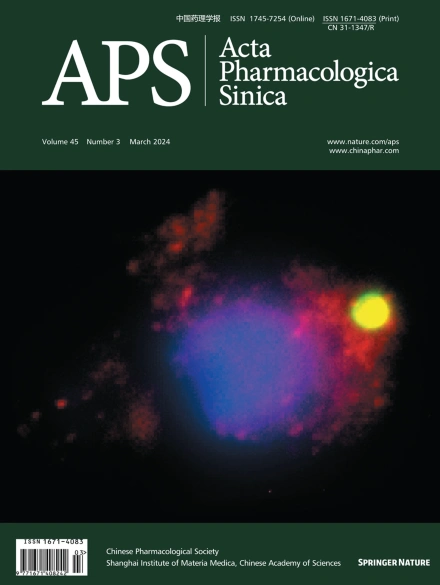
APS (Acta Pharmacologica Sinica) welcomes submissions from diverse areas of pharmacology and the life sciences. While we encourage contributions across a broad spectrum, topics of particular interest include, but are not limited to: anticancer pharmacology, cardiovascular and pulmonary pharmacology, clinical pharmacology, drug discovery, gastrointestinal and hepatic pharmacology, genitourinary, renal, and endocrine pharmacology, immunopharmacology and inflammation, molecular and cellular pharmacology, neuropharmacology, pharmaceutics, and pharmacokinetics. Join us in sharing your research and insights in pharmacology and the life sciences.

 求助内容:
 应助结果提醒方式:


 京公网安备 11010802042870号


