
Preparation, comparison and its antioxidant activity of different curcumin solid dispersions
Q3 Medicine
Journal of Traditional Chinese Medical Sciences
Pub Date : 2026-06-01
DOI:10.1016/j.jtcms.2026.06.001
引用次数: 0
Abstract
ABSTRACT Objective To compare three different curcumin-loaded solid dispersions, assess their solubility, and conduct antioxidant and biological safety assays. Methods Three different curcumin-loaded solid dispersions were prepared using the solvent, solvent melting, and melting methods, and characterized using a scanning electron microscope, differential scanning calorimeter, and X-ray diffractometer. Additionally, the drug content, equilibrium solubility, dissolution, 1,1-diphenyl-2-picrylhydrazyl, 2,2ʹ-Azinobis-(3-ethylbenzthiazoline-6-sulphonate) scavenging ability, and biological safety were investigated. Results X-ray diffractometer and differential scanning calorimetry analyses confirmed that curcumin existed in an amorphous state in the solid dispersion, while Fourier-transform infrared spectroscopy suggested intermolecular interactions between curcumin and polyvinylpyrrolidone K29/32, and scanning electron microscope showed the disappearance of crystalline morphology and formation of a homogeneous matrix. The optimized solid dispersion significantly improved the aqueous solubility of curcumin. Rapid drug release was observed, with more than 70% of curcumin released within 20 min, whereas free curcumin exhibited very limited dissolution. The solubility of the solid dispersion was potential of hydrogen-dependent, with higher solubility under weakly acidic to near-neutral conditions and a marked decrease under alkaline conditions. In antioxidant assays, the solid dispersion exhibited stronger free radical scavenging activity than curcumin alone in a concentration-dependent manner. In addition, the solid dispersion showed reduced cytotoxicity, with improved cell viability compared with free curcumin at higher concentrations. Conclusion Solid dispersions supported by polyvinylpyrrolidone K29/32 showed significantly increased solubility of curcumin, and had higher antioxidant activity and biological safety than those of curcumin alone.不同姜黄素固体分散体的制备、比较及其抗氧化活性
【摘要】目的比较三种不同的姜黄素固体分散体,评估其溶解度,并进行抗氧化和生物安全性试验。方法采用溶剂法、溶剂熔融法和熔融法制备了3种不同的姜黄素负载固体分散体,并用扫描电镜、差示扫描量热仪和x射线衍射仪对其进行了表征。此外,还考察了药物含量、平衡溶解度、溶出度、1,1-二苯基-2-吡啶肼基、2,2 -偶氮唑-(3-乙基苯并噻唑-6-磺酸盐)清除能力和生物安全性。结果x射线衍射和差示扫描量热分析证实姜黄素在固体分散中以无定形存在,傅里叶变换红外光谱显示姜黄素与聚乙烯吡咯烷酮K29/32分子间相互作用,扫描电镜显示姜黄素晶体形态消失,形成均匀基质。优化后的固体分散体显著提高了姜黄素的水溶性。观察到药物快速释放,超过70%的姜黄素在20分钟内释放,而游离姜黄素的溶解非常有限。固体分散体的溶解度与氢电位有关,在弱酸性至近中性条件下溶解度较高,在碱性条件下溶解度明显降低。在抗氧化试验中,固体分散体表现出比姜黄素更强的自由基清除活性,且呈浓度依赖性。此外,与高浓度的游离姜黄素相比,固体分散体的细胞毒性降低,细胞活力提高。结论聚乙烯吡咯烷酮K29/32支持的固体分散体能显著提高姜黄素的溶解度,具有较高的抗氧化活性和生物安全性。
本文章由计算机程序翻译,如有差异,请以英文原文为准。
求助全文
约1分钟内获得全文
求助全文
来源期刊
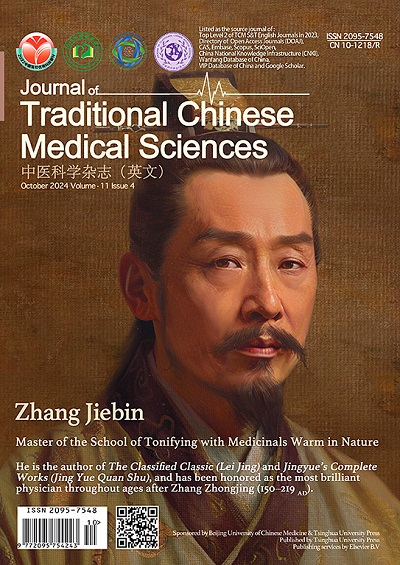
Journal of Traditional Chinese Medical Sciences
Medicine-Complementary and Alternative Medicine
CiteScore
1.90
自引率
0.00%
发文量
53
审稿时长
36 weeks
期刊介绍:
Production and Hosting by Elsevier B.V. on behalf of Beijing University of Chinese Medicine Peer review under the responsibility of Beijing University of Chinese Medicine. Journal of Traditional Chinese Medical Sciences is an international, peer-reviewed publication featuring advanced scientific research in Traditional Chinese medicine (TCM). The journal is sponsored by Beijing University of Chinese Medicine and Tsinghua University Press, and supervised by the Ministry of Education of China. The goal of the journal is to serve as an authoritative platform to present state-of-the-art research results. The journal is published quarterly. We welcome submissions of original papers on experimental and clinical studies on TCM, herbs and acupuncture that apply modern scientific research methods. The journal also publishes case reports, reviews, and articles on TCM theory and policy.
文献相关原料
原料信息
原料厂家

 求助内容:
 应助结果提醒方式:


 京公网安备 11010802042870号


