
Design and Analysis of a Three-Port Bidirectional DC--DC Converter With Low-Voltage Stress and Flexible Power Flow Control for DC Microgrid Applications
IF 5.7
2区 工程技术
Q1 ENGINEERING, ELECTRICAL & ELECTRONIC
IEEE Journal of Emerging and Selected Topics in Power Electronics
Pub Date : 2026-10-01
Epub Date: 2026-06-01
DOI:10.1109/JESTPE.2026.3698587
引用次数: 0
Abstract
Nonisolated bidirectional DC–DC converters (BDCs) are widely used for power flow management in energy storage systems, DC microgrids (DC-MGs), and electric vehicles (EVs); however, many existing topologies suffer from limited voltage gain, narrow duty-cycle range, high component count, bulky structure, and high-voltage stress on power devices. To overcome these limitations, this article proposes a nonisolated three-port high-gain BDC for the integration of renewable energy sources (RESs), energy storage units (ESUs), and DC-MGs. The proposed converter supports multiple power flow paths, including battery-to-DC-MG, photovoltaics (PVs)-to-DC-MG, and DC-MG-to-battery operation. It operates in boost mode for power transfer from Port-A to Port-B and in buck mode for reverse power flow. A wide voltage conversion ratio with reduced voltage stress across most switches is achieved, improving efficiency and reliability. A 200-W SiC MOSFET-based prototype was developed and experimentally validated. The converter achieves a peak efficiency of 96% and exhibits stable operation under both open-loop and closed-loop control. Moreover, operation in both continuous conduction mode (CCM) and discontinuous conduction mode (DCM) demonstrates the flexibility and robustness of the proposed topology across a wide operating range.一种用于直流微电网的低电压应力和灵活潮流控制的三端口双向DC - DC变换器设计与分析
非隔离型双向DC- DC转换器(bdc)广泛应用于储能系统、直流微电网(DC- mg)和电动汽车(ev)的潮流管理;然而,许多现有的拓扑结构存在电压增益有限、占空比范围窄、元件数量高、结构笨重以及功率器件的高压应力大等问题。为了克服这些限制,本文提出了一种非隔离的三端口高增益BDC,用于集成可再生能源(RESs),储能单元(esu)和dc - mg。该转换器支持多种功率流路径,包括电池到dc - mg、光伏(pv)到dc - mg和dc - mg到电池运行。它在升压模式下工作,用于从端口a到端口b的功率传输,在降压模式下工作,用于反向功率流。实现了宽电压转换比,降低了大多数开关的电压应力,提高了效率和可靠性。开发了一个基于200 w SiC mosfet的原型,并进行了实验验证。该变换器在开环和闭环控制下均能达到96%的峰值效率,运行稳定。此外,在连续导通模式(CCM)和不连续导通模式(DCM)下的运行证明了所提出的拓扑在宽工作范围内的灵活性和鲁棒性。
本文章由计算机程序翻译,如有差异,请以英文原文为准。
求助全文
约1分钟内获得全文
求助全文
来源期刊
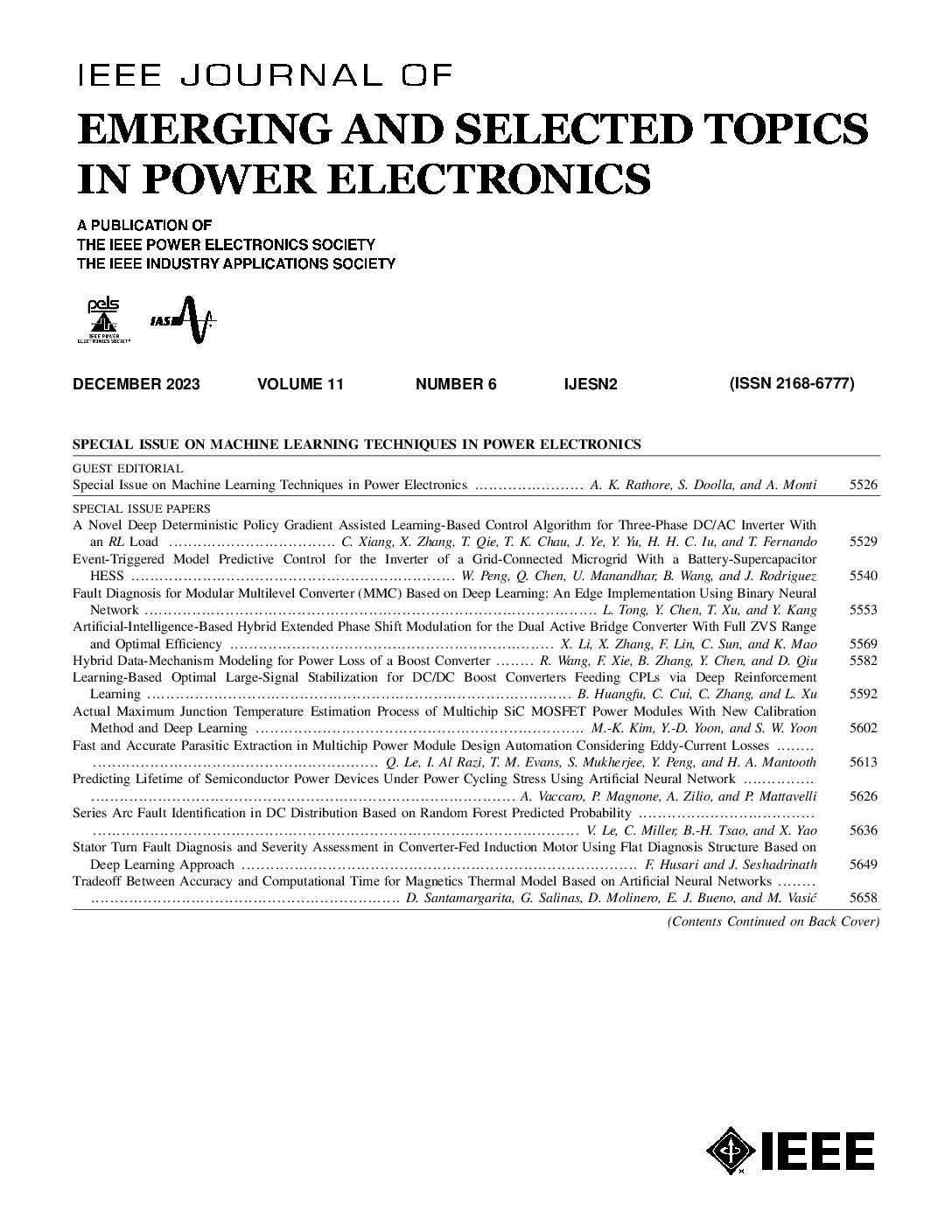
IEEE Journal of Emerging and Selected Topics in Power Electronics
ENGINEERING, ELECTRICAL & ELECTRONIC-
CiteScore
12.50
自引率
9.10%
发文量
547
审稿时长
3 months
期刊介绍:
The aim of the journal is to enable the power electronics community to address the emerging and selected topics in power electronics in an agile fashion. It is a forum where multidisciplinary and discriminating technologies and applications are discussed by and for both practitioners and researchers on timely topics in power electronics from components to systems.
 求助内容:
 应助结果提醒方式:


 京公网安备 11010802042870号


