
ROSOMP: Coordinated Scheduling of OpenMP Parallel Regions in ROS 2 Executor
IF 9.8
1区 计算机科学
Q1 AUTOMATION & CONTROL SYSTEMS
IEEE Transactions on Industrial Informatics
Pub Date : 2026-10-01
Epub Date: 2026-06-09
DOI:10.1109/TII.2026.3695353
引用次数: 0
Abstract
The Robot Operating System (ROS 2) is widely adopted for modular robotic applications. OpenMP provides an approach for parallelizing CPU-bound workloads, and is commonly used in ROS-based applications for perception and control. However, integrating OpenMP into the ROS 2 executor introduces semantic mismatches: OpenMP threads are managed independently by the OS scheduler, breaking ROS-level priority semantics and leading to priority inversion, thread oversubscription, and timing unpredictability. This article presents ROSOMP, a unified framework that enables priority-driven scheduling and bounded execution of OpenMP parallel regions within the ROS 2 runtime. By converting OpenMP constructs into schedulable units and executing them within the existing ROS 2 executor thread pool, ROSOMP enforces global priority consistency while preserving the default programming model of ROS 2 and OpenMP. Furthermore, we develop a response time analysis to formally establish the predictability of ROSOMP. Experimental results demonstrate that ROSOMP significantly improves timing determinism and reduces system overhead compared to conventional OpenMP integration in ROS 2.ROSOMP: ROS 2执行器中OpenMP并行区域的协调调度
机器人操作系统(ROS 2)被广泛应用于模块化机器人应用。OpenMP提供了一种并行化cpu负载的方法,通常用于基于ros的应用程序的感知和控制。然而,将OpenMP集成到ROS 2执行器中会引入语义不匹配:OpenMP线程由OS调度器独立管理,破坏了ROS级优先级语义,导致优先级反转、线程超订阅和时间不可预测性。本文介绍了ROSOMP,这是一个统一的框架,它支持在ROS 2运行时内优先级驱动的调度和OpenMP并行区域的有界执行。通过将OpenMP构造转换为可调度单元并在现有的ROS 2执行器线程池中执行它们,ROSOMP在保留ROS 2和OpenMP的默认编程模型的同时,加强了全局优先级一致性。此外,我们开发了响应时间分析,以正式建立ROSOMP的可预测性。实验结果表明,与传统的OpenMP集成相比,ROSOMP显著提高了时间确定性,降低了系统开销。
本文章由计算机程序翻译,如有差异,请以英文原文为准。
求助全文
约1分钟内获得全文
求助全文
来源期刊
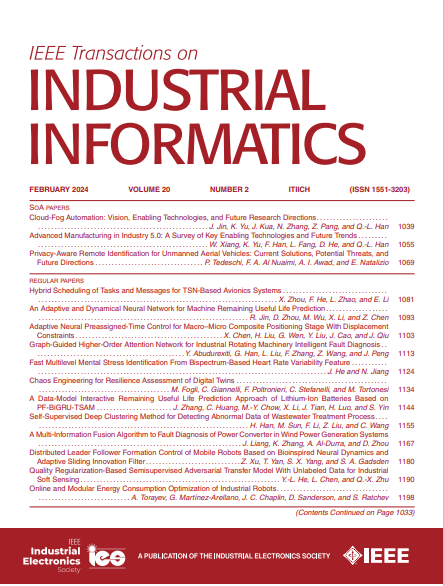
IEEE Transactions on Industrial Informatics
工程技术-工程:工业
CiteScore
24.10
自引率
8.90%
发文量
1202
审稿时长
5.1 months
期刊介绍:
The IEEE Transactions on Industrial Informatics is a multidisciplinary journal dedicated to publishing technical papers that connect theory with practical applications of informatics in industrial settings. It focuses on the utilization of information in intelligent, distributed, and agile industrial automation and control systems. The scope includes topics such as knowledge-based and AI-enhanced automation, intelligent computer control systems, flexible and collaborative manufacturing, industrial informatics in software-defined vehicles and robotics, computer vision, industrial cyber-physical and industrial IoT systems, real-time and networked embedded systems, security in industrial processes, industrial communications, systems interoperability, and human-machine interaction.
 求助内容:
 应助结果提醒方式:


 京公网安备 11010802042870号


