
Dual Pd2+ and Pd0 sites on CeO2 for selective oxidative cleavage of C–C bonds in lignin β-O-4 ketones
IF 4
3区 化学
Q2 CHEMISTRY, PHYSICAL
引用次数: 0
Abstract
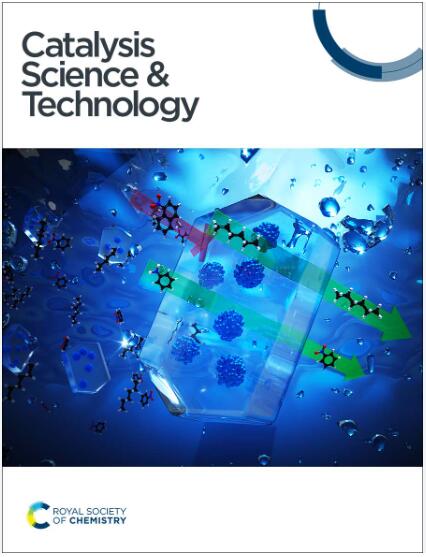
Selective C–C bond cleavage in lignin is a pivotal step toward its efficient utilization, enabling the production of diverse and valuable chemicals from this abundant and renewable resource. Among the catalysts reported for the oxidative cleavage of C–C bonds in lignin β-O-4 ketones, CeO2-supported Pd catalysts have demonstrated outstanding activity. However, the exact nature of the active Pd sites responsible for the C–C bond cleavage remains poorly understood, limiting mechanistic insights into this transformation. In this study, CeO2 supports with four distinct morphologies including rods (R), spheres (S), cubes (C), and polyhedrons (P) were synthesized to investigate their influence on the catalytic activity of Pd/CeO2 catalysts in the oxidative cleavage of β-O-4 ketones. The catalytic performance was found to depend strongly on the morphology of CeO2, with Pd/CeO2-P exhibiting the highest activity for the C–C bond cleavage. This catalyst possessed the lowest Pd4+ content and the highest Pd0/Pd2+ ratio among the series. By systematically tuning this ratio, a volcano-type relationship between the Pd0/Pd2+ ratio and catalytic activity was established, indicating a dual-site mechanism in which Pd0 facilitates the formation of reactive oxygen species, while Pd2+ serves as the active center for the C–C bond cleavage.

木质素β-O-4酮的C-C键选择性氧化裂解在CeO2上的双Pd2+和Pd0位点
木质素中C-C键的选择性裂解是实现其高效利用的关键一步,使这种丰富的可再生资源能够生产出多种有价值的化学品。在已报道的木质素β-O-4酮C-C键氧化裂解催化剂中,ceo2负载的Pd催化剂表现出优异的活性。然而,负责C-C键裂解的活性Pd位点的确切性质仍然知之甚少,限制了对这种转化的机制见解。本研究合成了棒状(R)、球状(S)、立方体(C)和多面体(P)四种不同形态的CeO2载体,研究了它们对Pd/CeO2催化剂氧化裂解β-O-4酮催化活性的影响。催化性能与CeO2的形态密切相关,其中Pd/CeO2- p对C-C键的裂解活性最高。该催化剂具有最低的Pd4+含量和最高的Pd0/Pd2+比。通过系统调整该比值,建立了Pd0/Pd2+比值与催化活性之间的火山型关系,表明Pd0促进活性氧的形成,而Pd2+则是C-C键裂解的活性中心。
本文章由计算机程序翻译,如有差异,请以英文原文为准。
求助全文
约1分钟内获得全文
求助全文
来源期刊
Catalysis Science & Technology
CHEMISTRY, PHYSICAL-
CiteScore
8.70
自引率
6.00%
发文量
587
审稿时长
1.5 months
期刊介绍:
A multidisciplinary journal focusing on cutting edge research across all fundamental science and technological aspects of catalysis.
Editor-in-chief: Bert Weckhuysen
Impact factor: 5.0
Time to first decision (peer reviewed only): 31 days
 求助内容:
 应助结果提醒方式:


 京公网安备 11010802042870号


