
Activation of isocyanates with gold: towards Au-catalyzed C–H amidation of pyrroles

IF 4 3区 化学 Q2 CHEMISTRY, PHYSICAL
Catalysis Science & Technology Pub Date : 2026-06-22 Epub Date: 2026-05-12 DOI:10.1039/d6cy00297h
Francesco Ravera, Alessandro Bortoli, Juan José Gamboa-Carballo, Sonia Mallet-Ladeira, Karinne Miqueu, Didier Bourissou, Andrea Biffis
{"title":"Activation of isocyanates with gold: towards Au-catalyzed C–H amidation of pyrroles","authors":"Francesco Ravera,&nbsp;Alessandro Bortoli,&nbsp;Juan José Gamboa-Carballo,&nbsp;Sonia Mallet-Ladeira,&nbsp;Karinne Miqueu,&nbsp;Didier Bourissou,&nbsp;Andrea Biffis","doi":"10.1039/d6cy00297h","DOIUrl":null,"url":null,"abstract":"<div><div>The intermolecular hydroarylation of isocyanates with pyrroles was found to be efficiently catalyzed by the Au(<span>i</span>) complex IPrAuNTf<sub>2</sub> (IPr = <em>N</em>,<em>N</em>′-bis(2,6-diisopropylphenyl)-imidazol-2-ylidene). The transformation tolerates electron-withdrawing and electron-donating substituents both at the heterocycle and the isocyanate. It affords secondary aromatic amides in a single step under mild conditions with catalyst loadings down to 0.5 mol%. The reaction proceeds <em>via</em> coordination of the isocyanate to gold and outer-sphere nucleophilic attack of the heterocycle. Several gold(<span>i</span>) isocyanate adducts were authenticated by multinuclear NMR spectroscopy at low temperatures. <sup>15</sup>N-labeling of the organic fragment allowed us to observe a deshielding of the <sup>13</sup>C NMR NCO signal and a decrease of the associated <sup>1</sup><em>J</em><sub>CN</sub> coupling constant upon coordination to gold. With further support from density functional theory (DFT) calculations, the ground state was assigned to an η<sup>1</sup>-<em>N</em>-coordination isomer. The corresponding η<sup>1</sup>-<em>O</em>-adduct lies <em>ca.</em> 8–11 kcal mol<sup>−1</sup> higher in energy. A gold(<span>i</span>) π-adduct involving <em>N</em>-methyl pyrrole as the substrate was also authenticated experimentally, including by X-ray crystallography. The latter species is involved as an off-cycle resting state in the catalytic transformation.</div></div>","PeriodicalId":66,"journal":{"name":"Catalysis Science & Technology","volume":"16 12","pages":"Pages 4103-4113"},"PeriodicalIF":4.0000,"publicationDate":"2026-06-22","publicationTypes":"Journal Article","fieldsOfStudy":null,"isOpenAccess":false,"openAccessPdf":"","citationCount":"0","resultStr":null,"platform":"Semanticscholar","paperid":null,"PeriodicalName":"Catalysis Science & Technology","FirstCategoryId":"92","ListUrlMain":"https://www.sciencedirect.com/org/science/article/pii/S204447532600239X","RegionNum":3,"RegionCategory":"化学","ArticlePicture":[],"TitleCN":null,"AbstractTextCN":null,"PMCID":null,"EPubDate":"2026/5/12 0:00:00","PubModel":"Epub","JCR":"Q2","JCRName":"CHEMISTRY, PHYSICAL","Score":null,"Total":0}
引用次数: 0

Abstract

The intermolecular hydroarylation of isocyanates with pyrroles was found to be efficiently catalyzed by the Au(i) complex IPrAuNTf2 (IPr = N,N′-bis(2,6-diisopropylphenyl)-imidazol-2-ylidene). The transformation tolerates electron-withdrawing and electron-donating substituents both at the heterocycle and the isocyanate. It affords secondary aromatic amides in a single step under mild conditions with catalyst loadings down to 0.5 mol%. The reaction proceeds via coordination of the isocyanate to gold and outer-sphere nucleophilic attack of the heterocycle. Several gold(i) isocyanate adducts were authenticated by multinuclear NMR spectroscopy at low temperatures. 15N-labeling of the organic fragment allowed us to observe a deshielding of the 13C NMR NCO signal and a decrease of the associated 1JCN coupling constant upon coordination to gold. With further support from density functional theory (DFT) calculations, the ground state was assigned to an η1-N-coordination isomer. The corresponding η1-O-adduct lies ca. 8–11 kcal mol−1 higher in energy. A gold(i) π-adduct involving N-methyl pyrrole as the substrate was also authenticated experimentally, including by X-ray crystallography. The latter species is involved as an off-cycle resting state in the catalytic transformation.

Abstract Image

金活化异氰酸酯:对金催化的吡咯C-H酰胺化反应
发现Au(I)配合物IPrAuNTf2 (IPr = N,N ' -双(2,6-二异丙基苯基)-咪唑-2-乙基)可有效催化异氰酸酯与吡咯的分子间氢芳基化反应。该转化可以在杂环和异氰酸酯上同时耐受吸电子和供电子取代基。在温和的条件下,催化剂负载低至0.5 mol%,一步合成二级芳香族酰胺。反应通过异氰酸酯与金的配位和杂环的外球亲核攻击进行。几种金(I)异氰酸酯加合物经低温多核磁共振鉴定。有机片段的15n标记使我们观察到13C NMR NCO信号的去屏蔽,以及与金配位后相关的1JCN耦合常数的降低。在密度泛函理论(DFT)计算的进一步支持下,基态归属于一个η - 1- n配位异构体。相应的η - 1- o加成物的能量约为8-11千卡mol−1。以n -甲基吡咯为底物的金(I) π加合物也通过实验(包括x射线晶体学)进行了验证。后一种物质在催化转化过程中处于非循环静止状态。
本文章由计算机程序翻译,如有差异,请以英文原文为准。
求助全文
约1分钟内获得全文 求助全文
来源期刊
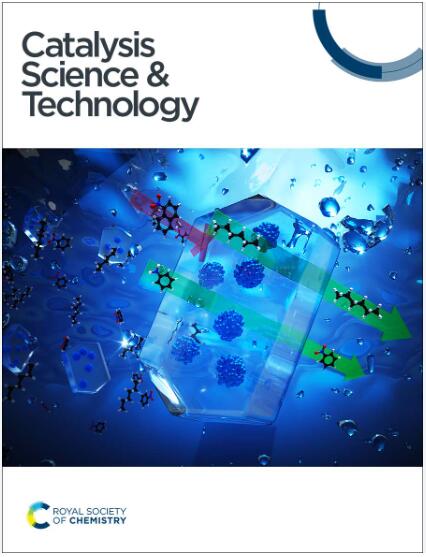
Catalysis Science & Technology
Catalysis Science & Technology CHEMISTRY, PHYSICAL-
CiteScore
8.70
自引率
6.00%
发文量
587
审稿时长
1.5 months
期刊介绍: A multidisciplinary journal focusing on cutting edge research across all fundamental science and technological aspects of catalysis. Editor-in-chief: Bert Weckhuysen Impact factor: 5.0 Time to first decision (peer reviewed only): 31 days

×
引用
GB/T 7714-2015
复制
MLA
复制
APA
复制
导出至
BibTeX EndNote RefMan NoteFirst NoteExpress
×
提示
您的信息不完整,为了账户安全,请先补充。
现在去补充
×
提示
您因"违规操作"
具体请查看互助需知
我知道了
×
提示
确定
请完成安全验证×
copy
已复制链接
快去分享给好友吧!
我知道了
右上角分享
点击右上角分享
0
联系我们:info@booksci.cn Book学术提供免费学术资源搜索服务,方便国内外学者检索中英文文献。致力于提供最便捷和优质的服务体验。 Copyright © 2023 布克学术 All rights reserved.
京ICP备2023020795号-1
ghs 京公网安备 11010802042870号
Book学术文献互助
Book学术文献互助群
群 号:604180095
Book学术官方微信
小红书


