
Operando exsolved FeNi3 nanoparticles for boosting ethanol internal reforming in solid oxide fuel cells

IF 4 3区 化学 Q2 CHEMISTRY, PHYSICAL
Catalysis Science & Technology Pub Date : 2026-06-22 Epub Date: 2026-05-12 DOI:10.1039/d5cy01572c
J. Roelf F. Maring, Emerson L. dos Santos Veiga, Francisco F. Tabuti, Majid Ahmadi, Fabio C. Fonseca, Vasileios Kyriakou
{"title":"Operando exsolved FeNi3 nanoparticles for boosting ethanol internal reforming in solid oxide fuel cells","authors":"J. Roelf F. Maring,&nbsp;Emerson L. dos Santos Veiga,&nbsp;Francisco F. Tabuti,&nbsp;Majid Ahmadi,&nbsp;Fabio C. Fonseca,&nbsp;Vasileios Kyriakou","doi":"10.1039/d5cy01572c","DOIUrl":null,"url":null,"abstract":"<div><div>Direct ethanol solid oxide fuel cells (SOFCs) are considered promising for power generation with high efficiency and flexibility from sustainable sources. Among their major challenges is the choice of catalytically active, chemically stable and coking tolerant fuel electrodes (anodes) for the internal reforming and oxidation of ethanol. Here, we <em>operando</em> exsolved FeNi<sub>3</sub> nanoparticles from a Ni-doped SFM (Sr<sub>2</sub>Fe<sub>1.3</sub>Mo<sub>0.5</sub>Ni<sub>0.2</sub>O<sub>6±<em>δ</em></sub>, SFMNi) fuel electrode that significantly enhanced the power output. Our analysis confirmed that Ni doping increased surface basicity and oxygen vacancy concentration which are linked to ethanol steam reforming selectivity toward dehydrogenation pathways over the undesired dehydration observed for the undoped SFM sample. The thermocatalytic studies revealed the high ethanol reforming activity of FeNi<sub>3</sub> nanoparticles with intriguing coking tolerance properties as confirmed by crystallographic and Raman analyses. This resulted in a &gt;30% enhancement in the peak power density with adequate stability. Our findings highlight the strong coupling between reforming activity and electrochemical performance, positioning the use of nanoparticle-functionalized perovskite electrodes as a promising strategy for efficient and flexible SOFCs operating on renewable fuels.</div></div>","PeriodicalId":66,"journal":{"name":"Catalysis Science & Technology","volume":"16 12","pages":"Pages 4220-4231"},"PeriodicalIF":4.0000,"publicationDate":"2026-06-22","publicationTypes":"Journal Article","fieldsOfStudy":null,"isOpenAccess":false,"openAccessPdf":"","citationCount":"0","resultStr":null,"platform":"Semanticscholar","paperid":null,"PeriodicalName":"Catalysis Science & Technology","FirstCategoryId":"92","ListUrlMain":"https://www.sciencedirect.com/org/science/article/pii/S2044475326002364","RegionNum":3,"RegionCategory":"化学","ArticlePicture":[],"TitleCN":null,"AbstractTextCN":null,"PMCID":null,"EPubDate":"2026/5/12 0:00:00","PubModel":"Epub","JCR":"Q2","JCRName":"CHEMISTRY, PHYSICAL","Score":null,"Total":0}
引用次数: 0

Abstract

Direct ethanol solid oxide fuel cells (SOFCs) are considered promising for power generation with high efficiency and flexibility from sustainable sources. Among their major challenges is the choice of catalytically active, chemically stable and coking tolerant fuel electrodes (anodes) for the internal reforming and oxidation of ethanol. Here, we operando exsolved FeNi3 nanoparticles from a Ni-doped SFM (Sr2Fe1.3Mo0.5Ni0.2O6±δ, SFMNi) fuel electrode that significantly enhanced the power output. Our analysis confirmed that Ni doping increased surface basicity and oxygen vacancy concentration which are linked to ethanol steam reforming selectivity toward dehydrogenation pathways over the undesired dehydration observed for the undoped SFM sample. The thermocatalytic studies revealed the high ethanol reforming activity of FeNi3 nanoparticles with intriguing coking tolerance properties as confirmed by crystallographic and Raman analyses. This resulted in a >30% enhancement in the peak power density with adequate stability. Our findings highlight the strong coupling between reforming activity and electrochemical performance, positioning the use of nanoparticle-functionalized perovskite electrodes as a promising strategy for efficient and flexible SOFCs operating on renewable fuels.

Abstract Image

Operando溶解FeNi3纳米颗粒促进固体氧化物燃料电池中乙醇的内部重整
直接乙醇固体氧化物燃料电池(SOFCs)被认为是有前途的发电效率和灵活性的可持续来源。他们面临的主要挑战之一是为乙醇的内部重整和氧化选择具有催化活性、化学稳定性和耐焦化的燃料电极(阳极)。在这里,我们从ni掺杂的SFM (sr2fe1.3 mo0.5 ni0.2 2o6±δ, SFMNi)燃料电极中分离出FeNi3纳米粒子,显著提高了功率输出。我们的分析证实,Ni掺杂增加了表面碱度和氧空位浓度,这与乙醇蒸汽重整对脱氢途径的选择性有关,而不是未掺杂的SFM样品所观察到的不希望的脱水。热催化研究表明,FeNi3纳米颗粒具有较高的乙醇重整活性,并通过晶体学和拉曼分析证实了其耐焦性。这使得峰值功率密度提高了30%,并具有足够的稳定性。我们的研究结果强调了重整活性和电化学性能之间的强耦合,将纳米颗粒功能化钙钛矿电极的使用定位为一种有前途的策略,用于在可再生燃料上运行的高效灵活的sofc。
本文章由计算机程序翻译,如有差异,请以英文原文为准。
求助全文
约1分钟内获得全文 求助全文
来源期刊
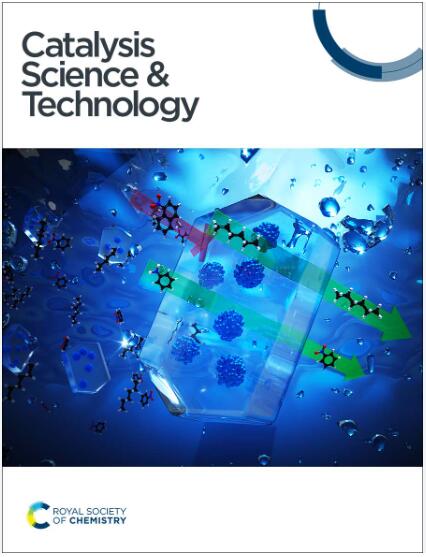
Catalysis Science & Technology
Catalysis Science & Technology CHEMISTRY, PHYSICAL-
CiteScore
8.70
自引率
6.00%
发文量
587
审稿时长
1.5 months
期刊介绍: A multidisciplinary journal focusing on cutting edge research across all fundamental science and technological aspects of catalysis. Editor-in-chief: Bert Weckhuysen Impact factor: 5.0 Time to first decision (peer reviewed only): 31 days

×
引用
GB/T 7714-2015
复制
MLA
复制
APA
复制
导出至
BibTeX EndNote RefMan NoteFirst NoteExpress
×
提示
您的信息不完整,为了账户安全,请先补充。
现在去补充
×
提示
您因"违规操作"
具体请查看互助需知
我知道了
×
提示
确定
请完成安全验证×
copy
已复制链接
快去分享给好友吧!
我知道了
右上角分享
点击右上角分享
0
联系我们:info@booksci.cn Book学术提供免费学术资源搜索服务,方便国内外学者检索中英文文献。致力于提供最便捷和优质的服务体验。 Copyright © 2023 布克学术 All rights reserved.
京ICP备2023020795号-1
ghs 京公网安备 11010802042870号
Book学术文献互助
Book学术文献互助群
群 号:604180095
Book学术官方微信
小红书


