
Achieving stable syngas production during the photothermal synergistic dry reforming of methane over layered double hydroxide-based catalysts with anti-coking performance

IF 4 3区 化学 Q2 CHEMISTRY, PHYSICAL
Catalysis Science & Technology Pub Date : 2026-06-22 Epub Date: 2026-05-11 DOI:10.1039/d6cy00289g
Juntao Li, Tengfei Li, Yuhao Liu, Yang Guo, Lingzhao Kong, Pengjie Miao
{"title":"Achieving stable syngas production during the photothermal synergistic dry reforming of methane over layered double hydroxide-based catalysts with anti-coking performance","authors":"Juntao Li,&nbsp;Tengfei Li,&nbsp;Yuhao Liu,&nbsp;Yang Guo,&nbsp;Lingzhao Kong,&nbsp;Pengjie Miao","doi":"10.1039/d6cy00289g","DOIUrl":null,"url":null,"abstract":"<div><div>Dry reforming of methane (DRM) offers a promising route to convert CH<sub>4</sub> and CO<sub>2</sub> into syngas, addressing both greenhouse gas mitigation and carbon resource utilization. However, its practical application is hindered by high energy consumption and severe catalyst deactivation due to coking. Leveraging the structural tunability of layered double hydroxides (LDH), we synthesized three LDH-derived spinel-supported Ni-based catalysts (Ni/XAl<sub>2</sub>O<sub>4</sub>, X = Mg, Co, and Cu) and evaluated them in photothermal synergistic catalytic DRM (PTSC-DRM). Substituting Cu with Mg in the support markedly increased the specific surface area from 44.81 to 181.29 m<sup>2</sup> g<sup>−1</sup>, significantly enhanced CO<sub>2</sub> adsorption capacity, and strengthened the metal–support interactions. At 600 °C and under 2.91 W cm<sup>−2</sup> illumination, Ni/MgAl<sub>2</sub>O<sub>4</sub> achieved CH<sub>4</sub> and CO<sub>2</sub> conversions of 38.49% and 42.13%, respectively, and maintained stable performance over 45.5 h of continuous operation. The coking rate was drastically reduced from 5.00 mgC g<sub>cat</sub><sup>−1</sup> h<sup>−1</sup> (for Ni/CoAl<sub>2</sub>O<sub>4</sub>) to 0.98 mgC g<sub>cat</sub><sup>−1</sup> h<sup>−1</sup>, with no reactor clogging observed. Mechanistically, light irradiation continuously promotes CO<sub>2</sub> activation through photogenerated electron–hole pairs, synergistically enhancing coking resistance alongside the thermal catalytic pathway. This work capitalizes on the structural versatility of LDH materials and provides a new strategy for designing low-cost, high-stability, and coke-resistant catalysts for PTSC-DRM.</div></div>","PeriodicalId":66,"journal":{"name":"Catalysis Science & Technology","volume":"16 12","pages":"Pages 4134-4148"},"PeriodicalIF":4.0000,"publicationDate":"2026-06-22","publicationTypes":"Journal Article","fieldsOfStudy":null,"isOpenAccess":false,"openAccessPdf":"","citationCount":"0","resultStr":null,"platform":"Semanticscholar","paperid":null,"PeriodicalName":"Catalysis Science & Technology","FirstCategoryId":"92","ListUrlMain":"https://www.sciencedirect.com/org/science/article/pii/S2044475326002315","RegionNum":3,"RegionCategory":"化学","ArticlePicture":[],"TitleCN":null,"AbstractTextCN":null,"PMCID":null,"EPubDate":"2026/5/11 0:00:00","PubModel":"Epub","JCR":"Q2","JCRName":"CHEMISTRY, PHYSICAL","Score":null,"Total":0}
引用次数: 0

Abstract

Dry reforming of methane (DRM) offers a promising route to convert CH4 and CO2 into syngas, addressing both greenhouse gas mitigation and carbon resource utilization. However, its practical application is hindered by high energy consumption and severe catalyst deactivation due to coking. Leveraging the structural tunability of layered double hydroxides (LDH), we synthesized three LDH-derived spinel-supported Ni-based catalysts (Ni/XAl2O4, X = Mg, Co, and Cu) and evaluated them in photothermal synergistic catalytic DRM (PTSC-DRM). Substituting Cu with Mg in the support markedly increased the specific surface area from 44.81 to 181.29 m2 g−1, significantly enhanced CO2 adsorption capacity, and strengthened the metal–support interactions. At 600 °C and under 2.91 W cm−2 illumination, Ni/MgAl2O4 achieved CH4 and CO2 conversions of 38.49% and 42.13%, respectively, and maintained stable performance over 45.5 h of continuous operation. The coking rate was drastically reduced from 5.00 mgC gcat−1 h−1 (for Ni/CoAl2O4) to 0.98 mgC gcat−1 h−1, with no reactor clogging observed. Mechanistically, light irradiation continuously promotes CO2 activation through photogenerated electron–hole pairs, synergistically enhancing coking resistance alongside the thermal catalytic pathway. This work capitalizes on the structural versatility of LDH materials and provides a new strategy for designing low-cost, high-stability, and coke-resistant catalysts for PTSC-DRM.

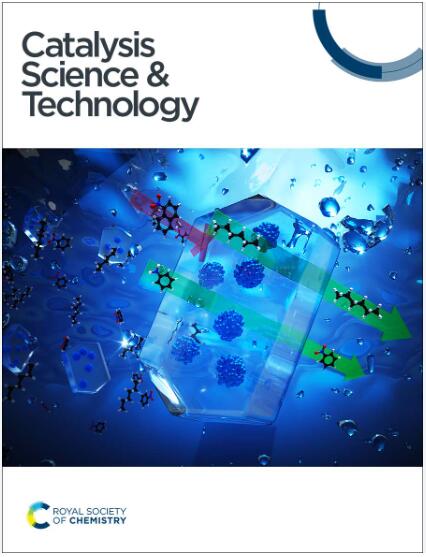
Abstract Image

在具有抗结焦性能的层状双氧水基催化剂上实现甲烷光热协同干重整过程中稳定的合成气生产
甲烷干重整(DRM)是将CH4和CO2转化为合成气的一种有前途的途径,既能缓解温室气体排放,又能利用碳资源。但其能耗高,焦化导致催化剂失活严重,阻碍了其实际应用。利用层状双氢氧化物(LDH)的结构可调性,我们合成了三种由LDH衍生的尖晶石负载的Ni基催化剂(Ni/XAl2O4, X = Mg, Co和Cu),并在光热协同催化DRM (PTSC-DRM)中对它们进行了评价。在载体中以Mg取代Cu后,比表面积由44.81增加到181.29 m2 g−1,吸附CO2能力显著增强,金属-载体相互作用增强。在600℃和2.91 W cm−2光照条件下,Ni/MgAl2O4的CH4和CO2转化率分别达到38.49%和42.13%,并在45.5 h的连续工作时间内保持稳定的性能。结焦速率从5.00 mgC gcat−1 h−1 (Ni/CoAl2O4)大幅降低至0.98 mgC gcat−1 h−1,且未观察到反应器堵塞现象。从机理上讲,光照射通过光产生的电子-空穴对不断促进CO2活化,在热催化途径的同时协同增强抗焦化能力。这项工作充分利用了LDH材料的结构通用性,为PTSC-DRM设计低成本、高稳定性和抗焦性催化剂提供了一种新策略。
本文章由计算机程序翻译,如有差异,请以英文原文为准。
求助全文
约1分钟内获得全文 求助全文
来源期刊
Catalysis Science & Technology
Catalysis Science & Technology CHEMISTRY, PHYSICAL-
CiteScore
8.70
自引率
6.00%
发文量
587
审稿时长
1.5 months
期刊介绍: A multidisciplinary journal focusing on cutting edge research across all fundamental science and technological aspects of catalysis. Editor-in-chief: Bert Weckhuysen Impact factor: 5.0 Time to first decision (peer reviewed only): 31 days

×
引用
GB/T 7714-2015
复制
MLA
复制
APA
复制
导出至
BibTeX EndNote RefMan NoteFirst NoteExpress
×
提示
您的信息不完整,为了账户安全,请先补充。
现在去补充
×
提示
您因"违规操作"
具体请查看互助需知
我知道了
×
提示
确定
请完成安全验证×
copy
已复制链接
快去分享给好友吧!
我知道了
右上角分享
点击右上角分享
0
联系我们:info@booksci.cn Book学术提供免费学术资源搜索服务,方便国内外学者检索中英文文献。致力于提供最便捷和优质的服务体验。 Copyright © 2023 布克学术 All rights reserved.
京ICP备2023020795号-1
ghs 京公网安备 11010802042870号
Book学术文献互助
Book学术文献互助群
群 号:604180095
Book学术官方微信
小红书


