{"title":"[Xia Yingtang: his life and medical activities in the Republican era].","authors":"J Y Zhou, S S Zhu, L Shang","doi":"10.3760/cma.j.cn112155-20250910-00152","DOIUrl":null,"url":null,"abstract":"<p><p>Xia Yingtang, a representative figure of the Shanghai school in traditional Chinese medicine during the Republic of China, was renowned with Ding Ganren as \"Ding in the North, Xia in the South\". With exceptional medical expertise, he founded the Xia-style of internal medicine lineage and actively engaged in public medical affairs. He established charitable institutions such as the Hucheng Branch of the China Red Cross Society and the Hucheng Branch Hospital, organizing and participating relief efforts in wartime and epidemic prevention and control. His contributions profoundly influenced the construction and development of China's public health system and professional education. He was dedicated to the reform and advancement of TCM education by establishing the Shanghai Traditional Chinese Medicine School and the Shanghai Women's School of Traditional Chinese Medicine. In particular, he bravely confronted the danger of traditional Chinese medicine extinction, actively participated in the opposition to the \"Proposal to Abolish Traditional Chinese Medicine\", promoted the promulgation of the <i>Traditional Chinese Medicine Regulations,</i> and advocated for the establishment of the National Traditional Chinese Medicine Day, playing a key role in securing the legitimate status of traditional Chinese medicine. This paper analysed the historical newspapers, archives, and other relevant materials and examined the life of Xia Yingtang and his medical activities, It attempts to elucidate his contributions to traditional Chinese medicine and public health, restore his historical position in the modern development of traditional Chinese medicine, and call for broader academic attention and further research on this 'overlooked' physician.</p>","PeriodicalId":35995,"journal":{"name":"中华医史杂志","volume":"56 3","pages":"164-172"},"PeriodicalIF":0.0000,"publicationDate":"2026-05-28","publicationTypes":"Journal Article","fieldsOfStudy":null,"isOpenAccess":false,"openAccessPdf":"","citationCount":"0","resultStr":null,"platform":"Semanticscholar","paperid":null,"PeriodicalName":"中华医史杂志","FirstCategoryId":"1090","ListUrlMain":"https://doi.org/10.3760/cma.j.cn112155-20250910-00152","RegionNum":0,"RegionCategory":null,"ArticlePicture":[],"TitleCN":null,"AbstractTextCN":null,"PMCID":null,"EPubDate":"","PubModel":"","JCR":"Q4","JCRName":"Medicine","Score":null,"Total":0}
引用次数: 0
Abstract
Xia Yingtang, a representative figure of the Shanghai school in traditional Chinese medicine during the Republic of China, was renowned with Ding Ganren as "Ding in the North, Xia in the South". With exceptional medical expertise, he founded the Xia-style of internal medicine lineage and actively engaged in public medical affairs. He established charitable institutions such as the Hucheng Branch of the China Red Cross Society and the Hucheng Branch Hospital, organizing and participating relief efforts in wartime and epidemic prevention and control. His contributions profoundly influenced the construction and development of China's public health system and professional education. He was dedicated to the reform and advancement of TCM education by establishing the Shanghai Traditional Chinese Medicine School and the Shanghai Women's School of Traditional Chinese Medicine. In particular, he bravely confronted the danger of traditional Chinese medicine extinction, actively participated in the opposition to the "Proposal to Abolish Traditional Chinese Medicine", promoted the promulgation of the Traditional Chinese Medicine Regulations, and advocated for the establishment of the National Traditional Chinese Medicine Day, playing a key role in securing the legitimate status of traditional Chinese medicine. This paper analysed the historical newspapers, archives, and other relevant materials and examined the life of Xia Yingtang and his medical activities, It attempts to elucidate his contributions to traditional Chinese medicine and public health, restore his historical position in the modern development of traditional Chinese medicine, and call for broader academic attention and further research on this 'overlooked' physician.
期刊介绍:
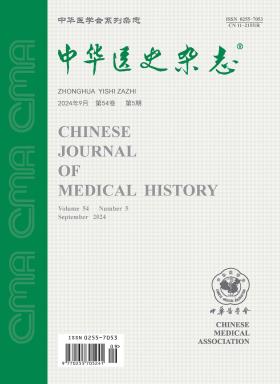
The Chinese Journal of Medical History is the only professional academic journal on medical history in the country. The first publication was named "Journal of Medical History" and was designated as a quarterly publication. In 2009, it was changed from quarterly to bimonthly.
The Chinese Journal of Medical History has columns such as special articles, reviews, expert talks, medical history treatises, literature research, forums and debates, historical accounts, figures, short essays, graduate forums, lectures, historical materials, medical history, and book reviews.
Chinese Journal of Medical History has been included in the US Medline online database.

 求助内容:
 应助结果提醒方式:


 京公网安备 11010802042870号


