
Effects of sulfur on dehydrogenation of methylcyclohexane over platinum catalysts

IF 4 3区 化学 Q2 CHEMISTRY, PHYSICAL
Catalysis Science & Technology Pub Date : 2026-06-08 Epub Date: 2026-04-24 DOI:10.1039/d6cy00183a
Felicia Zaar , Alvaro Posada-Borbón , Henrik Grönbeck
{"title":"Effects of sulfur on dehydrogenation of methylcyclohexane over platinum catalysts","authors":"Felicia Zaar ,&nbsp;Alvaro Posada-Borbón ,&nbsp;Henrik Grönbeck","doi":"10.1039/d6cy00183a","DOIUrl":null,"url":null,"abstract":"<div><div>Liquid organic hydrogen carriers (LOHCs) enable storage and transport of H<sub>2</sub> using existing liquid fuel infrastructure, through reversible catalytic hydrogenation and dehydrogenation of organic molecules. A viable, commercially deployed LOHC system is the methylcyclohexane (C<sub>7</sub>H<sub>14</sub>)/toluene (C<sub>7</sub>H<sub>8</sub>) system. However, Pt-based catalysts, which are used for both hydrogenation of C<sub>7</sub>H<sub>8</sub> and dehydrogenation of C<sub>7</sub>H<sub>14</sub>, also promote unwanted C–C bond scission, leading to demethylation and LOHC degradation. One route to prevent C–C bond scission over Pt catalysts is to mildly poison the catalyst with sulfur. Using density functional theory (DFT) calculations and mean-field microkinetic modeling, we show that the presence of sulfur, besides suppressing demethylation, also improves the C<sub>7</sub>H<sub>14</sub> dehydrogenation activity. The enhanced performance is a result of sulfur destabilizing neighboring co-adsorbates, which promotes C<sub>7</sub>H<sub>8</sub> desorption. The computational results for dehydrogenation over Pt surfaces reproduce experimental trends for alumina-supported Pt nanoparticles, suggesting that controlled, moderate sulfur poisoning is a universal means to improve the overall performance of Pt catalysts for LOHC dehydrogenation.</div></div>","PeriodicalId":66,"journal":{"name":"Catalysis Science & Technology","volume":"16 11","pages":"Pages 3898-3907"},"PeriodicalIF":4.0000,"publicationDate":"2026-06-08","publicationTypes":"Journal Article","fieldsOfStudy":null,"isOpenAccess":false,"openAccessPdf":"","citationCount":"0","resultStr":null,"platform":"Semanticscholar","paperid":null,"PeriodicalName":"Catalysis Science & Technology","FirstCategoryId":"92","ListUrlMain":"https://www.sciencedirect.com/org/science/article/pii/S2044475326002091","RegionNum":3,"RegionCategory":"化学","ArticlePicture":[],"TitleCN":null,"AbstractTextCN":null,"PMCID":null,"EPubDate":"2026/4/24 0:00:00","PubModel":"Epub","JCR":"Q2","JCRName":"CHEMISTRY, PHYSICAL","Score":null,"Total":0}
引用次数: 0

Abstract

Liquid organic hydrogen carriers (LOHCs) enable storage and transport of H2 using existing liquid fuel infrastructure, through reversible catalytic hydrogenation and dehydrogenation of organic molecules. A viable, commercially deployed LOHC system is the methylcyclohexane (C7H14)/toluene (C7H8) system. However, Pt-based catalysts, which are used for both hydrogenation of C7H8 and dehydrogenation of C7H14, also promote unwanted C–C bond scission, leading to demethylation and LOHC degradation. One route to prevent C–C bond scission over Pt catalysts is to mildly poison the catalyst with sulfur. Using density functional theory (DFT) calculations and mean-field microkinetic modeling, we show that the presence of sulfur, besides suppressing demethylation, also improves the C7H14 dehydrogenation activity. The enhanced performance is a result of sulfur destabilizing neighboring co-adsorbates, which promotes C7H8 desorption. The computational results for dehydrogenation over Pt surfaces reproduce experimental trends for alumina-supported Pt nanoparticles, suggesting that controlled, moderate sulfur poisoning is a universal means to improve the overall performance of Pt catalysts for LOHC dehydrogenation.

Abstract Image

硫对甲基环己烷在铂催化剂上脱氢的影响
液态有机氢载体(lohc)利用现有的液体燃料基础设施,通过有机分子的可逆催化加氢和脱氢,实现氢的储存和运输。甲基环己烷(C7H14)/甲苯(C7H8)体系是一种可行的、商业化部署的LOHC体系。然而,同时用于C7H8加氢和C7H14脱氢的pt基催化剂也会促进不必要的C-C键断裂,导致去甲基化和LOHC降解。防止铂催化剂上C-C键断裂的一种途径是用硫对催化剂进行轻度毒害。利用密度泛函理论(DFT)计算和平均场微动力学模型,我们发现硫的存在除了抑制去甲基化外,还提高了C7H14的脱氢活性。性能的增强是由于硫破坏了邻近共吸附,促进了C7H8的脱附。Pt表面脱氢的计算结果再现了氧化铝负载的Pt纳米颗粒的实验趋势,表明控制适度的硫中毒是提高LOHC脱氢Pt催化剂整体性能的普遍手段。
本文章由计算机程序翻译,如有差异,请以英文原文为准。
求助全文
约1分钟内获得全文 求助全文
来源期刊
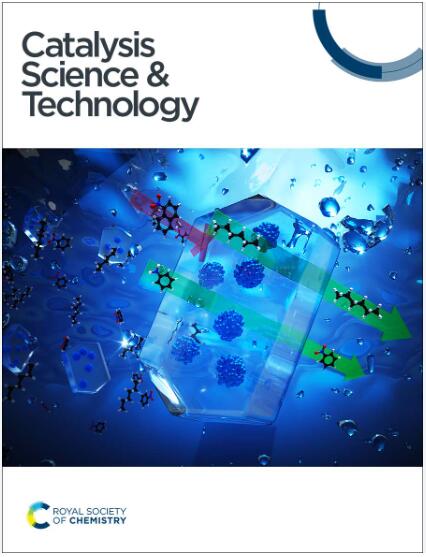
Catalysis Science & Technology
Catalysis Science & Technology CHEMISTRY, PHYSICAL-
CiteScore
8.70
自引率
6.00%
发文量
587
审稿时长
1.5 months
期刊介绍: A multidisciplinary journal focusing on cutting edge research across all fundamental science and technological aspects of catalysis. Editor-in-chief: Bert Weckhuysen Impact factor: 5.0 Time to first decision (peer reviewed only): 31 days

×
引用
GB/T 7714-2015
复制
MLA
复制
APA
复制
导出至
BibTeX EndNote RefMan NoteFirst NoteExpress
×
提示
您的信息不完整,为了账户安全,请先补充。
现在去补充
×
提示
您因"违规操作"
具体请查看互助需知
我知道了
×
提示
确定
请完成安全验证×
copy
已复制链接
快去分享给好友吧!
我知道了
右上角分享
点击右上角分享
0
联系我们:info@booksci.cn Book学术提供免费学术资源搜索服务,方便国内外学者检索中英文文献。致力于提供最便捷和优质的服务体验。 Copyright © 2023 布克学术 All rights reserved.
京ICP备2023020795号-1
ghs 京公网安备 11010802042870号
Book学术文献互助
Book学术文献互助群
群 号:604180095
Book学术官方微信
小红书


