
Multivariate analysis coupled to infrared spectroscopy unravels the diversity of adsorption sites and strengths of a zeolite surface

IF 4 3区 化学 Q2 CHEMISTRY, PHYSICAL
Catalysis Science & Technology Pub Date : 2026-06-08 Epub Date: 2026-04-09 DOI:10.1039/d6cy00101g
Reda Aboulayt , Eleonora Vottero , Alexandre Vimont , Philippe Bazin , Emily Bloch , Sandrine Bourrelly , Sylvie Maury , Céline Chizallet , Arnaud Travert
{"title":"Multivariate analysis coupled to infrared spectroscopy unravels the diversity of adsorption sites and strengths of a zeolite surface","authors":"Reda Aboulayt ,&nbsp;Eleonora Vottero ,&nbsp;Alexandre Vimont ,&nbsp;Philippe Bazin ,&nbsp;Emily Bloch ,&nbsp;Sandrine Bourrelly ,&nbsp;Sylvie Maury ,&nbsp;Céline Chizallet ,&nbsp;Arnaud Travert","doi":"10.1039/d6cy00101g","DOIUrl":null,"url":null,"abstract":"<div><div>Quantifying adsorption thermodynamics on heterogeneous catalysts remains challenging because macroscopic techniques yield averaged parameters, while vibrational spectra often contain strongly overlapping contributions from multiple adsorbed species. Here we introduce an infrared (IR)-chemometric framework that extracts site-specific adsorption thermodynamics directly from experimental IR isotherms and we benchmark it against independent microcalorimetry and density functional theory (DFT) calculations. Difference IR spectra recorded for isobutanol adsorption on H-ZSM-5 (MFI) were analysed by principal component analysis and multivariate curve resolution (MCR-ALS) under soft constraints (monotonic concentration profiles, spectral normalisation), and further refined using a hard–soft strategy in which concentration profiles are constrained by an adsorption model. The analysis reveals three adsorption modes associated with bridging Brønsted OH groups, extra-framework Al–OH species, and silanols, providing representative pure-component spectra and site-resolved adsorption isotherms. The thermodynamic trends and site hierarchy obtained from IR–MCR-ALS are consistent with independent microcalorimetry measurements and density functional theory calculations, validating the approach. More broadly, IR–MCR-ALS offers a transferable route to quantitative, site-resolved adsorption thermodynamics in complex catalysts.</div></div>","PeriodicalId":66,"journal":{"name":"Catalysis Science & Technology","volume":"16 11","pages":"Pages 3843-3854"},"PeriodicalIF":4.0000,"publicationDate":"2026-06-08","publicationTypes":"Journal Article","fieldsOfStudy":null,"isOpenAccess":false,"openAccessPdf":"","citationCount":"0","resultStr":null,"platform":"Semanticscholar","paperid":null,"PeriodicalName":"Catalysis Science & Technology","FirstCategoryId":"92","ListUrlMain":"https://www.sciencedirect.com/org/science/article/pii/S2044475326002200","RegionNum":3,"RegionCategory":"化学","ArticlePicture":[],"TitleCN":null,"AbstractTextCN":null,"PMCID":null,"EPubDate":"2026/4/9 0:00:00","PubModel":"Epub","JCR":"Q2","JCRName":"CHEMISTRY, PHYSICAL","Score":null,"Total":0}
引用次数: 0

Abstract

Quantifying adsorption thermodynamics on heterogeneous catalysts remains challenging because macroscopic techniques yield averaged parameters, while vibrational spectra often contain strongly overlapping contributions from multiple adsorbed species. Here we introduce an infrared (IR)-chemometric framework that extracts site-specific adsorption thermodynamics directly from experimental IR isotherms and we benchmark it against independent microcalorimetry and density functional theory (DFT) calculations. Difference IR spectra recorded for isobutanol adsorption on H-ZSM-5 (MFI) were analysed by principal component analysis and multivariate curve resolution (MCR-ALS) under soft constraints (monotonic concentration profiles, spectral normalisation), and further refined using a hard–soft strategy in which concentration profiles are constrained by an adsorption model. The analysis reveals three adsorption modes associated with bridging Brønsted OH groups, extra-framework Al–OH species, and silanols, providing representative pure-component spectra and site-resolved adsorption isotherms. The thermodynamic trends and site hierarchy obtained from IR–MCR-ALS are consistent with independent microcalorimetry measurements and density functional theory calculations, validating the approach. More broadly, IR–MCR-ALS offers a transferable route to quantitative, site-resolved adsorption thermodynamics in complex catalysts.

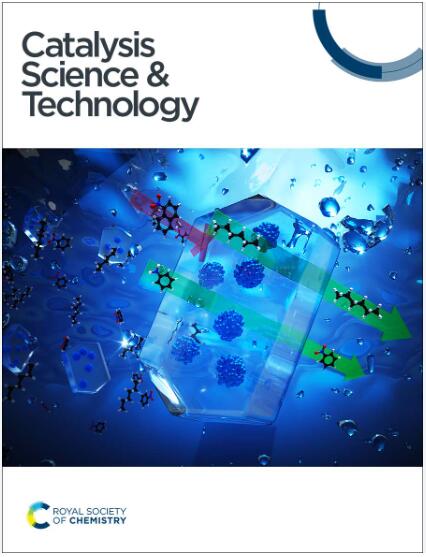
Abstract Image

多变量分析与红外光谱相结合揭示了沸石表面吸附位点和强度的多样性
量化多相催化剂的吸附热力学仍然具有挑战性,因为宏观技术只能得到平均参数,而振动光谱通常包含多种吸附物质的强烈重叠贡献。在这里,我们介绍了一个红外(IR)-化学计量框架,它直接从实验红外等温线中提取特定位置的吸附热力学,并将其与独立的微热量法和密度泛函理论(DFT)计算相比较。采用主成分分析和多元曲线分辨率(MCR-ALS)对H-ZSM-5 (MFI)吸附异丁醇的不同红外光谱进行分析,并在软约束条件下(单调浓度曲线、光谱标准化),进一步采用吸附模型约束浓度曲线的软硬策略进行细化。分析揭示了三种与桥接Brønsted OH基团、框架外Al-OH基团和硅烷醇相关的吸附模式,提供了具有代表性的纯组分光谱和位置分辨吸附等温线。由IR-MCR-ALS得到的热力学趋势和位点层次与独立的微热测量和密度泛函理论计算一致,验证了该方法的有效性。更广泛地说,IR-MCR-ALS提供了一种可转移的路线,用于复杂催化剂的定量,位点分解吸附热力学。
本文章由计算机程序翻译,如有差异,请以英文原文为准。
求助全文
约1分钟内获得全文 求助全文
来源期刊
Catalysis Science & Technology
Catalysis Science & Technology CHEMISTRY, PHYSICAL-
CiteScore
8.70
自引率
6.00%
发文量
587
审稿时长
1.5 months
期刊介绍: A multidisciplinary journal focusing on cutting edge research across all fundamental science and technological aspects of catalysis. Editor-in-chief: Bert Weckhuysen Impact factor: 5.0 Time to first decision (peer reviewed only): 31 days

×
引用
GB/T 7714-2015
复制
MLA
复制
APA
复制
导出至
BibTeX EndNote RefMan NoteFirst NoteExpress
×
提示
您的信息不完整,为了账户安全,请先补充。
现在去补充
×
提示
您因"违规操作"
具体请查看互助需知
我知道了
×
提示
确定
请完成安全验证×
copy
已复制链接
快去分享给好友吧!
我知道了
右上角分享
点击右上角分享
0
联系我们:info@booksci.cn Book学术提供免费学术资源搜索服务,方便国内外学者检索中英文文献。致力于提供最便捷和优质的服务体验。 Copyright © 2023 布克学术 All rights reserved.
京ICP备2023020795号-1
ghs 京公网安备 11010802042870号
Book学术文献互助
Book学术文献互助群
群 号:604180095
Book学术官方微信
小红书


