
Transformer-based cardiac substructure segmentation from contrast and non-contrast computed tomography for radiotherapy planning
IF 3.2
Q2 ONCOLOGY
Physics and Imaging in Radiation Oncology
Pub Date : 2026-05-01
Epub Date: 2026-06-02
DOI:10.1016/j.phro.2026.101011
引用次数: 0
Abstract
Background and Purpose
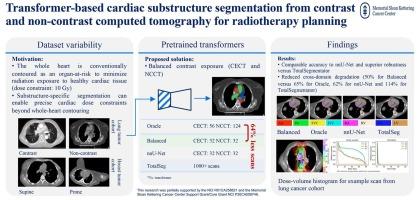
Accurate segmentation of cardiac substructures on computed tomography (CT) scans is essential for radiotherapy planning. This study evaluated whether pretrained transformers enabled data-efficient training using a fixed architecture with balanced curriculum learning while achieving robust generalization to imaging and patient variations.
Materials and Methods
A hybrid pretrained transformer-convolutional network, self-distilled masked image transformer (SMIT), was fine-tuned using lung cancer patient scans (Cohort I, training N = 180) and tested on held-out Cohort I lung cancer scans (testing N = 60) and breast cancer scans (Cohort II, N = 65). Two configurations were evaluated: SMIT-Balanced (32 contrast-enhanced CTs, 32 non-contrast CTs) and SMIT-Oracle (180 CTs). Performance was compared with nnU-Net and TotalSegmentator. Segmentation accuracy was assessed primarily using the 95th percentile Hausdorff distance (HD95), along with radiation dose and overlap-based metrics as secondary endpoints.
Results
SMIT-Balanced approached SMIT-Oracle performance despite using 64% fewer training scans, with mean HD95 of 6.6 versus 5.4 mm in Cohort I and 10.0 versus 9.4 mm in Cohort II. On the Cohort I held-out test set, SMIT-Balanced mean HD95 was within 1.0 mm of nnU-Net. Cross-cohort testing showed larger accuracy degradation with nnU-Net than SMIT-Balanced (62% versus 50%, absolute change 4.5 mm versus 3.4 mm). Dose metrics derived from SMIT-Balanced were equivalent to manual delineations.
Conclusions
Balanced curriculum training reduced labeled data requirements within the SMIT architecture. SMIT-Balanced was comparable to nnU-Net on Cohort I held-out data and showed smaller cross-cohort HD95 degradation.
基于对比和非对比计算机断层扫描的基于变压器的心脏亚结构分割用于放疗计划
背景与目的计算机断层扫描(CT)对心脏亚结构的准确分割对放疗计划至关重要。本研究评估了预训练变压器是否能够使用平衡课程学习的固定架构实现数据高效训练,同时实现对成像和患者变化的鲁棒泛化。材料与方法使用肺癌患者扫描(队列I,训练N = 180)对混合预训练变压器-卷积网络(SMIT)进行微调,并在未完成队列I肺癌扫描(测试N = 60)和乳腺癌扫描(队列II, N = 65)上进行测试。评估了两种配置:SMIT-Balanced(32个增强ct, 32个非对比ct)和SMIT-Oracle(180个ct)。性能与nnU-Net和TotalSegmentator进行了比较。分割精度的评估主要使用第95百分位豪斯多夫距离(HD95),以及辐射剂量和基于重叠的指标作为次要终点。结果smit - balanced接近SMIT-Oracle性能,尽管使用64%的训练扫描,在队列I中平均HD95为6.6比5.4 mm,在队列II中为10.0比9.4 mm。在队列1中,smit平衡的平均HD95与nnU-Net相差在1.0 mm以内。交叉队列测试显示,与SMIT-Balanced相比,nnU-Net的准确性下降幅度更大(62%对50%,绝对变化4.5 mm对3.4 mm)。SMIT-Balanced得出的剂量指标等同于人工划定。结论:平衡的课程培训减少了SMIT体系结构中标记数据的需求。在队列I中,SMIT-Balanced与nnU-Net的数据相当,并且显示出较小的跨队列HD95降解。
本文章由计算机程序翻译,如有差异,请以英文原文为准。
求助全文
约1分钟内获得全文
求助全文
来源期刊
Physics and Imaging in Radiation Oncology
Physics and Astronomy-Radiation
CiteScore
5.30
自引率
18.90%
发文量
93
审稿时长
6 weeks
 求助内容:
求助内容: 应助结果提醒方式:

 京公网安备 11010802042870号


