Annesha Sengupta, Gopal Reddy Ramidi, Disni Gunasekera, Mia Beaudoin, Shiqing Xu, Xin Yan
{"title":"Mild and efficient coupling reactions enabled by <i>in situ</i> electrolytically generated Cu(i) cation catalyst in nanoelectrospray.","authors":"Annesha Sengupta, Gopal Reddy Ramidi, Disni Gunasekera, Mia Beaudoin, Shiqing Xu, Xin Yan","doi":"10.1039/d6cy00473c","DOIUrl":null,"url":null,"abstract":"<p><p>Copper (Cu) catalysis merged with electrochemistry offers efficient transformations under mild conditions, yet <i>in situ</i> generation of active Cu species remains challenging. Here, we introduce a novel source of catalytically active Cu(i) cations that operates without strong additives, oxidants, high concentrations of Cu salts, bases, or elevated temperatures. These Cu(i) species are integrated into a nanoelectrospray ionization (nanoESI)-based electrocatalytic platform, in which a Cu wire replaces the conventional inert electrode. Under applied voltage, anodic corrosion releases Cu(i) directly into the reaction solution inside the emitter, providing (i) <i>in situ</i> generation of active Cu cations, (ii) electrocatalysis under additive-free mild conditions, and (iii) online reaction monitoring by high-resolution mass spectrometry (MS). The Cu electrode serves a dual role: as a sacrificial anode supplying Cu(i) without competing counteranions, enhancing reaction efficiency and minimizing MS signal suppression, and as a voltage source generating a stable electrospray for real-time analysis. Using this platform, we demonstrate efficient Cu-catalyzed (i) C-H amination of arenes, (ii) intermolecular N-N homocoupling of <i>o</i>-phenylenediamine, and (iii) intramolecular dehydrogenative N-N coupling of anthranilamide. The scalability of the electrochemical microreactor concept was demonstrated through the successful translation of the <i>in situ</i> Cu-catalyzed electrochemical C-H amination to a bulk electrochemical cell. This synergistic approach enables rapid reaction screening, discovery of mild conditions, and continuous capture of transient intermediates, providing novel mechanistic insight and advancing sustainable Cu electrocatalysis.</p>","PeriodicalId":66,"journal":{"name":"Catalysis Science & Technology","volume":" ","pages":"4444-4454"},"PeriodicalIF":4.0000,"publicationDate":"2026-05-22","publicationTypes":"Journal Article","fieldsOfStudy":null,"isOpenAccess":false,"openAccessPdf":"https://www.ncbi.nlm.nih.gov/pmc/articles/PMC13231250/pdf/","citationCount":"0","resultStr":null,"platform":"Semanticscholar","paperid":null,"PeriodicalName":"Catalysis Science & Technology","FirstCategoryId":"92","ListUrlMain":"https://doi.org/10.1039/d6cy00473c","RegionNum":3,"RegionCategory":"化学","ArticlePicture":[],"TitleCN":null,"AbstractTextCN":null,"PMCID":null,"EPubDate":"2026/7/8 0:00:00","PubModel":"eCollection","JCR":"Q2","JCRName":"CHEMISTRY, PHYSICAL","Score":null,"Total":0}
引用次数: 0
Abstract
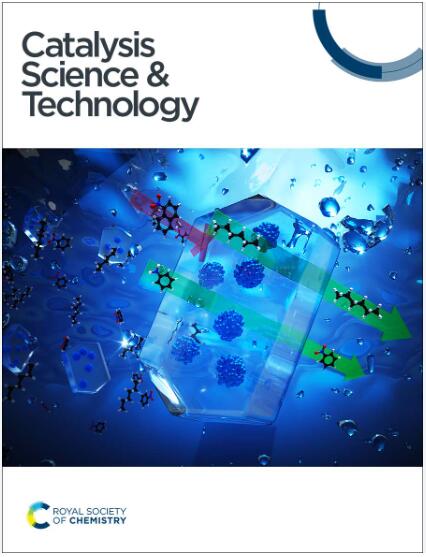
Copper (Cu) catalysis merged with electrochemistry offers efficient transformations under mild conditions, yet in situ generation of active Cu species remains challenging. Here, we introduce a novel source of catalytically active Cu(i) cations that operates without strong additives, oxidants, high concentrations of Cu salts, bases, or elevated temperatures. These Cu(i) species are integrated into a nanoelectrospray ionization (nanoESI)-based electrocatalytic platform, in which a Cu wire replaces the conventional inert electrode. Under applied voltage, anodic corrosion releases Cu(i) directly into the reaction solution inside the emitter, providing (i) in situ generation of active Cu cations, (ii) electrocatalysis under additive-free mild conditions, and (iii) online reaction monitoring by high-resolution mass spectrometry (MS). The Cu electrode serves a dual role: as a sacrificial anode supplying Cu(i) without competing counteranions, enhancing reaction efficiency and minimizing MS signal suppression, and as a voltage source generating a stable electrospray for real-time analysis. Using this platform, we demonstrate efficient Cu-catalyzed (i) C-H amination of arenes, (ii) intermolecular N-N homocoupling of o-phenylenediamine, and (iii) intramolecular dehydrogenative N-N coupling of anthranilamide. The scalability of the electrochemical microreactor concept was demonstrated through the successful translation of the in situ Cu-catalyzed electrochemical C-H amination to a bulk electrochemical cell. This synergistic approach enables rapid reaction screening, discovery of mild conditions, and continuous capture of transient intermediates, providing novel mechanistic insight and advancing sustainable Cu electrocatalysis.
期刊介绍:
A multidisciplinary journal focusing on cutting edge research across all fundamental science and technological aspects of catalysis.
Editor-in-chief: Bert Weckhuysen
Impact factor: 5.0
Time to first decision (peer reviewed only): 31 days

 求助内容:
 应助结果提醒方式:


 京公网安备 11010802042870号


