
Feasibility of longitudinal relaxation rate mapping with non-Cartesian sampling and compressed sensing on a 1.5 T magnetic resonance linear accelerator

IF 3.2 Q2 ONCOLOGY
Lucas McCullum , Michael J. van Rijssel , Ken-Pin Hwang , Yao Ding , Chad Tang , Comron Hassanzadeh , Jinzhong Yang , Peter A. Balter , Jihong Wang , Clifton D. Fuller , Ergys D. Subashi
{"title":"Feasibility of longitudinal relaxation rate mapping with non-Cartesian sampling and compressed sensing on a 1.5 T magnetic resonance linear accelerator","authors":"Lucas McCullum ,&nbsp;Michael J. van Rijssel ,&nbsp;Ken-Pin Hwang ,&nbsp;Yao Ding ,&nbsp;Chad Tang ,&nbsp;Comron Hassanzadeh ,&nbsp;Jinzhong Yang ,&nbsp;Peter A. Balter ,&nbsp;Jihong Wang ,&nbsp;Clifton D. Fuller ,&nbsp;Ergys D. Subashi","doi":"10.1016/j.phro.2026.101002","DOIUrl":null,"url":null,"abstract":"<div><h3>Background and purpose</h3><div>Quantitative T1 mapping is a major building block in several multiparametric magnetic resonance imaging (MRI) protocols intended for adaptive radiation therapy. The implementation of these protocols is challenging in anatomical sites that experience large physiological motion. The purpose of this study was to implement and validate motion-resolved quantitative T1 mapping on a 1.5 T MRI linear accelerator (MR-Linac) combining non-Cartesian k-space sampling trajectories with compressed sensing (CS) reconstruction.</div></div><div><h3>Materials and methods</h3><div>Four 3-dimensional non-Cartesian k-space trajectories were evaluated: kooshball and stack-of-stars sampling using half- and full-spoke coverage. A variable flip angle acquisition was performed using the spoiled gradient-echo sequence. Gradient delay timing was optimized to minimize trajectory-induced artifacts. Eight CS reconstruction strategies were tested using spatial/spatiotemporal regularization operators. Reconstructions were evaluated and sorted by spatial resolution, bias, and variability. Motion-resolved T1 mapping was validated using two standard phantoms, one healthy volunteer, and one kidney cancer patient using respiratory self-gating and phase-sorted reconstruction.</div></div><div><h3>Results</h3><div>All non-Cartesian T1 maps demonstrated high repeatability and low longitudinal bias in phantom studies, with coefficients of variation below 3.3%. Spatiotemporal regularization preserved spatial resolution and quantitative accuracy at undersampling factors up to 20-fold. In human subjects, non-Cartesian T1 mapping provided improved accuracy and reduced variability in mobile abdominal tissues compared to Cartesian acquisitions.</div></div><div><h3>Conclusions</h3><div>Quantitative T1 mapping using non-Cartesian trajectories and CS reconstruction is feasible on a 1.5 T MR-Linac. The proposed approach enables accurate motion-resolved quantitative imaging within clinically practical acquisition times, establishing a foundation for multiparametric MRI in adaptive radiotherapy.</div></div>","PeriodicalId":36850,"journal":{"name":"Physics and Imaging in Radiation Oncology","volume":"39 ","pages":"Article 101002"},"PeriodicalIF":3.2000,"publicationDate":"2026-05-01","publicationTypes":"Journal Article","fieldsOfStudy":null,"isOpenAccess":false,"openAccessPdf":"","citationCount":"0","resultStr":null,"platform":"Semanticscholar","paperid":null,"PeriodicalName":"Physics and Imaging in Radiation Oncology","FirstCategoryId":"1085","ListUrlMain":"https://www.sciencedirect.com/science/article/pii/S2405631626001028","RegionNum":0,"RegionCategory":null,"ArticlePicture":[],"TitleCN":null,"AbstractTextCN":null,"PMCID":null,"EPubDate":"2026/5/19 0:00:00","PubModel":"Epub","JCR":"Q2","JCRName":"ONCOLOGY","Score":null,"Total":0}
引用次数: 0

Abstract

Background and purpose

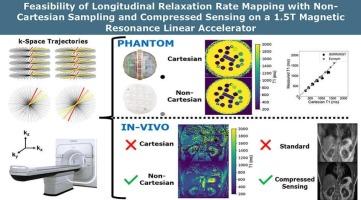
Quantitative T1 mapping is a major building block in several multiparametric magnetic resonance imaging (MRI) protocols intended for adaptive radiation therapy. The implementation of these protocols is challenging in anatomical sites that experience large physiological motion. The purpose of this study was to implement and validate motion-resolved quantitative T1 mapping on a 1.5 T MRI linear accelerator (MR-Linac) combining non-Cartesian k-space sampling trajectories with compressed sensing (CS) reconstruction.

Materials and methods

Four 3-dimensional non-Cartesian k-space trajectories were evaluated: kooshball and stack-of-stars sampling using half- and full-spoke coverage. A variable flip angle acquisition was performed using the spoiled gradient-echo sequence. Gradient delay timing was optimized to minimize trajectory-induced artifacts. Eight CS reconstruction strategies were tested using spatial/spatiotemporal regularization operators. Reconstructions were evaluated and sorted by spatial resolution, bias, and variability. Motion-resolved T1 mapping was validated using two standard phantoms, one healthy volunteer, and one kidney cancer patient using respiratory self-gating and phase-sorted reconstruction.

Results

All non-Cartesian T1 maps demonstrated high repeatability and low longitudinal bias in phantom studies, with coefficients of variation below 3.3%. Spatiotemporal regularization preserved spatial resolution and quantitative accuracy at undersampling factors up to 20-fold. In human subjects, non-Cartesian T1 mapping provided improved accuracy and reduced variability in mobile abdominal tissues compared to Cartesian acquisitions.

Conclusions

Quantitative T1 mapping using non-Cartesian trajectories and CS reconstruction is feasible on a 1.5 T MR-Linac. The proposed approach enables accurate motion-resolved quantitative imaging within clinically practical acquisition times, establishing a foundation for multiparametric MRI in adaptive radiotherapy.
Abstract Image

在1.5 T磁共振直线加速器上非笛卡尔采样和压缩感知纵向松弛率映射的可行性
背景和目的定量T1映射是用于适应性放射治疗的几种多参数磁共振成像(MRI)方案的主要组成部分。这些方案的实施是具有挑战性的解剖部位经历大的生理运动。本研究的目的是在1.5 T MRI线性加速器(MR-Linac)上实现并验证运动分辨定量T1映射,将非笛卡尔k空间采样轨迹与压缩感知(CS)重建相结合。材料和方法评估了四个三维非笛卡尔k空间轨迹:使用半辐和全辐覆盖的kooshball和stack-of-stars采样。利用破坏梯度回波序列进行可变翻转角采集。优化了梯度延迟定时以最小化轨迹引起的伪影。利用空间/时空正则化算子对8种CS重构策略进行了测试。根据空间分辨率、偏差和变异性对重建结果进行评估和分类。采用呼吸自门控和相位分选重建,使用两个标准模型、一个健康志愿者和一个肾癌患者验证运动分辨T1映射。结果所有非笛卡儿T1图在幻影研究中具有高重复性和低纵向偏倚,变异系数低于3.3%。时空正则化在欠采样因子下保留了高达20倍的空间分辨率和定量精度。在人类受试者中,与笛卡尔获取相比,非笛卡尔T1映射提供了更高的准确性和减少了可移动腹部组织的变异性。结论在1.5 T MR-Linac上使用非笛卡尔轨迹和CS重建定量T1映射是可行的。该方法能够在临床实际采集时间内实现精确的运动分辨率定量成像,为适应性放疗中的多参数MRI奠定了基础。
本文章由计算机程序翻译,如有差异,请以英文原文为准。
求助全文
约1分钟内获得全文 求助全文
来源期刊
Physics and Imaging in Radiation Oncology
Physics and Imaging in Radiation Oncology Physics and Astronomy-Radiation
CiteScore
5.30
自引率
18.90%
发文量
93
审稿时长
6 weeks

×
引用
GB/T 7714-2015
复制
MLA
复制
APA
复制
导出至
BibTeX EndNote RefMan NoteFirst NoteExpress
×
提示
您的信息不完整,为了账户安全,请先补充。
现在去补充
×
提示
您因"违规操作"
具体请查看互助需知
我知道了
×
提示
确定
请完成安全验证×
copy
已复制链接
快去分享给好友吧!
我知道了
右上角分享
点击右上角分享
0
联系我们:info@booksci.cn Book学术提供免费学术资源搜索服务,方便国内外学者检索中英文文献。致力于提供最便捷和优质的服务体验。 Copyright © 2023 布克学术 All rights reserved.
京ICP备2023020795号-1
ghs 京公网安备 11010802042870号
Book学术文献互助
Book学术文献互助群
群 号:604180095
Book学术官方微信
小红书


