
Water-enhanced bifunctional metal–acid catalyst for CC bond hydrogenation
IF 4
3区 化学
Q2 CHEMISTRY, PHYSICAL
引用次数: 0
Abstract
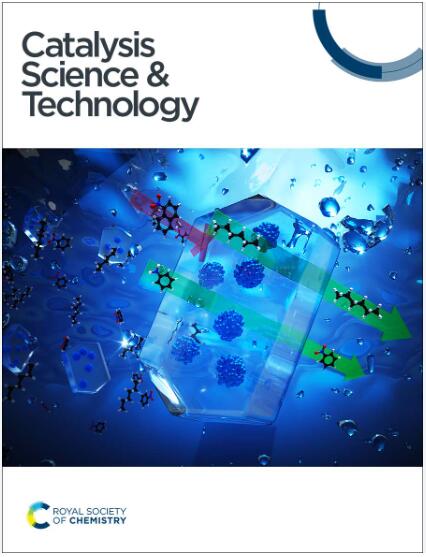
Water-assisted proton shuttling can promote hydrogenation of polar functional groups, and it is generally believed that such an effect can be hardly applied to hydrogenation of CC bonds due to the latter's weak interaction with water. Here, we report density functional theory calculations and metadynamics simulations, through which we show a dynamic bifunctional metal–acid site that can be transformed, when interacting with water, into an active configuration for unexpected water-enhanced proton shuttling to CC bonds. In particular, we investigated B(OH)3 anchored to a Ni catalyst for hydrogenation of cyclohexene in an organic solvent, which showed in experiments an increased rate by 100 times when adding a small amount of water. Metadynamics simulations suggest that a B(OH)3–H2O cluster can form on Ni(111), which promotes the proton transfer in the first hydrogenation step, while the second hydrogenation is still driven by metal-mediated direct H-transfer. The recovery process of B(OH)3–H2O also involves a proton shuttling step. We find that the boric species on the surface serves as an electron reservoir and carries the negative charge to balance the positive charge in the proton transfer steps. This work thus provides fundamental insights into this dynamic transformation process of the metal–acid interface, which can in principle be applied to many other bifunctional systems for hydrogenating non-polar unsaturated groups by engineering the interfacial charge separation.

CC键加氢的水增强双功能金属-酸催化剂
水辅助质子穿梭可以促进极性官能团的氢化,但由于CC键与水的相互作用较弱,一般认为这种作用很难应用于CC键的氢化。在这里,我们报告了密度泛函理论计算和元动力学模拟,通过这些计算,我们展示了一个动态的双功能金属-酸位点,当与水相互作用时,可以转化为一种意想不到的水增强质子穿梭到CC键的活性配置。特别地,我们研究了在有机溶剂中锚定在Ni催化剂上的B(OH)3对环己烯的加氢反应,实验表明,在加入少量水的情况下,其加氢速率提高了100倍。元动力学模拟表明,Ni(111)表面可形成B(OH) 3-H2O簇,促进了第一步加氢过程中的质子转移,而第二步加氢过程仍由金属介导的直接h转移驱动。B(OH) 3-H2O的恢复过程也包括质子穿梭步骤。我们发现,在质子转移步骤中,表面的硼类充当电子储存库并携带负电荷来平衡正电荷。因此,这项工作为金属-酸界面的动态转化过程提供了基本的见解,原则上可以应用于许多其他双功能体系,通过设计界面电荷分离来实现非极性不饱和基团的氢化。
本文章由计算机程序翻译,如有差异,请以英文原文为准。
求助全文
约1分钟内获得全文
求助全文
来源期刊
Catalysis Science & Technology
CHEMISTRY, PHYSICAL-
CiteScore
8.70
自引率
6.00%
发文量
587
审稿时长
1.5 months
期刊介绍:
A multidisciplinary journal focusing on cutting edge research across all fundamental science and technological aspects of catalysis.
Editor-in-chief: Bert Weckhuysen
Impact factor: 5.0
Time to first decision (peer reviewed only): 31 days
 求助内容:
 应助结果提醒方式:


 京公网安备 11010802042870号


