
Sulfated niobia and zirconia catalysts for the synthesis of ethyl levulinate

IF 4 3区 化学 Q2 CHEMISTRY, PHYSICAL
Catalysis Science & Technology Pub Date : 2026-05-19 Epub Date: 2026-04-09 DOI:10.1039/d5cy01343g
Jaime E. Bayona Solano , Ana Julia Avila , Daniel A. Sánchez , Gabriela M. Tonetto
{"title":"Sulfated niobia and zirconia catalysts for the synthesis of ethyl levulinate","authors":"Jaime E. Bayona Solano ,&nbsp;Ana Julia Avila ,&nbsp;Daniel A. Sánchez ,&nbsp;Gabriela M. Tonetto","doi":"10.1039/d5cy01343g","DOIUrl":null,"url":null,"abstract":"<div><div>The esterification of levulinic acid into ethyl levulinate is a key reaction for biomass valorization, and the development of highly active and stable solid acid catalysts is essential to improve process efficiency. In this context, this work evaluates how sulfation strategies affect the acidic properties and catalytic behavior of niobium pentoxide- and zirconium dioxide-based catalysts in levulinic acid esterification with ethanol. Catalysts were synthesized by wet impregnation followed by filtration or evaporation, using sulfuric acid or ammonium sulfate as sulfur sources, and characterized by X-ray diffraction, N<sub>2</sub> physisorption, laser diffraction, potentiometric titration with <em>n</em>-butylamine, and FT-IR with pyridine adsorption. Sulfation modified not only the density and strength of acid sites, but also their Brønsted/Lewis nature, promoting the formation of strong and very strong acid sites, particularly in zirconia-based catalysts. Catalytic tests showed that sulfated zirconia prepared by wet impregnation–evaporation with ammonium sulfate achieved the highest performance, reaching up to 98% conversion at 140 °C. A multiparametric analysis revealed statistically significant correlations between levulinic acid conversion and BET surface area, the number of strong and very strong acid sites, and the relative Brønsted/Lewis acid site concentration, demonstrating that catalytic activity is governed by the generation of strong Brønsted acid sites and their stability under reaction conditions.</div></div>","PeriodicalId":66,"journal":{"name":"Catalysis Science & Technology","volume":"16 9","pages":"Pages 3218-3228"},"PeriodicalIF":4.0000,"publicationDate":"2026-05-19","publicationTypes":"Journal Article","fieldsOfStudy":null,"isOpenAccess":false,"openAccessPdf":"","citationCount":"0","resultStr":null,"platform":"Semanticscholar","paperid":null,"PeriodicalName":"Catalysis Science & Technology","FirstCategoryId":"92","ListUrlMain":"https://www.sciencedirect.com/org/science/article/pii/S2044475326001644","RegionNum":3,"RegionCategory":"化学","ArticlePicture":[],"TitleCN":null,"AbstractTextCN":null,"PMCID":null,"EPubDate":"2026/4/9 0:00:00","PubModel":"Epub","JCR":"Q2","JCRName":"CHEMISTRY, PHYSICAL","Score":null,"Total":0}
引用次数: 0

Abstract

The esterification of levulinic acid into ethyl levulinate is a key reaction for biomass valorization, and the development of highly active and stable solid acid catalysts is essential to improve process efficiency. In this context, this work evaluates how sulfation strategies affect the acidic properties and catalytic behavior of niobium pentoxide- and zirconium dioxide-based catalysts in levulinic acid esterification with ethanol. Catalysts were synthesized by wet impregnation followed by filtration or evaporation, using sulfuric acid or ammonium sulfate as sulfur sources, and characterized by X-ray diffraction, N2 physisorption, laser diffraction, potentiometric titration with n-butylamine, and FT-IR with pyridine adsorption. Sulfation modified not only the density and strength of acid sites, but also their Brønsted/Lewis nature, promoting the formation of strong and very strong acid sites, particularly in zirconia-based catalysts. Catalytic tests showed that sulfated zirconia prepared by wet impregnation–evaporation with ammonium sulfate achieved the highest performance, reaching up to 98% conversion at 140 °C. A multiparametric analysis revealed statistically significant correlations between levulinic acid conversion and BET surface area, the number of strong and very strong acid sites, and the relative Brønsted/Lewis acid site concentration, demonstrating that catalytic activity is governed by the generation of strong Brønsted acid sites and their stability under reaction conditions.

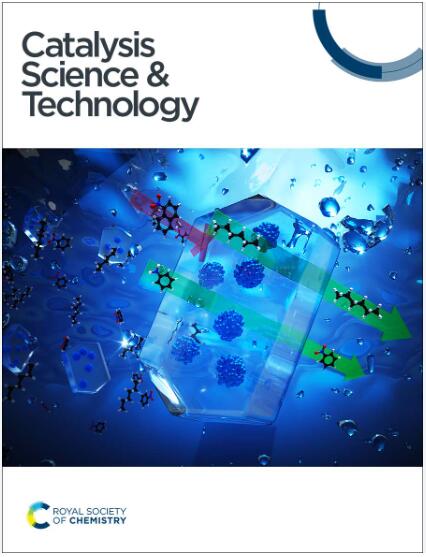
Abstract Image

硫酸氧化铌和氧化锆催化剂合成乙酰丙酸乙酯
乙酰丙酸酯化反应生成乙酰丙酸乙酯是生物质增值的关键反应,开发高效稳定的固体酸催化剂是提高该过程效率的必要条件。在此背景下,本研究评估了硫酸酸化策略如何影响五氧化二铌和二氧化锆基催化剂在乙酰丙酸与乙醇酯化反应中的酸性和催化行为。以硫酸或硫酸铵为硫源,采用湿浸渍-过滤-蒸发法制备催化剂,并通过x射线衍射、N2物理吸附、激光衍射、正丁胺电位滴定和吡啶吸附FT-IR对催化剂进行了表征。硫酸酸化不仅改变了酸位的密度和强度,还改变了它们的Brønsted/Lewis性质,促进了强酸位和强酸位的形成,尤其是在锆基催化剂中。催化实验表明,用硫酸铵湿浸渍蒸发法制备的硫化氧化锆性能最好,在140℃下转化率可达98%。多参数分析表明,乙酰丙酸转化率与BET表面积、强酸和强酸位点数量以及Brønsted/Lewis酸位点的相对浓度之间存在显著的统计学相关性,表明催化活性受强Brønsted酸位点的生成及其在反应条件下的稳定性的影响。
本文章由计算机程序翻译,如有差异,请以英文原文为准。
求助全文
约1分钟内获得全文 求助全文
来源期刊
Catalysis Science & Technology
Catalysis Science & Technology CHEMISTRY, PHYSICAL-
CiteScore
8.70
自引率
6.00%
发文量
587
审稿时长
1.5 months
期刊介绍: A multidisciplinary journal focusing on cutting edge research across all fundamental science and technological aspects of catalysis. Editor-in-chief: Bert Weckhuysen Impact factor: 5.0 Time to first decision (peer reviewed only): 31 days

×
引用
GB/T 7714-2015
复制
MLA
复制
APA
复制
导出至
BibTeX EndNote RefMan NoteFirst NoteExpress
×
提示
您的信息不完整,为了账户安全,请先补充。
现在去补充
×
提示
您因"违规操作"
具体请查看互助需知
我知道了
×
提示
确定
请完成安全验证×
copy
已复制链接
快去分享给好友吧!
我知道了
右上角分享
点击右上角分享
0
联系我们:info@booksci.cn Book学术提供免费学术资源搜索服务,方便国内外学者检索中英文文献。致力于提供最便捷和优质的服务体验。 Copyright © 2023 布克学术 All rights reserved.
京ICP备2023020795号-1
ghs 京公网安备 11010802042870号
Book学术文献互助
Book学术文献互助群
群 号:604180095
Book学术官方微信
小红书


