
Hydrogenation of cinnamaldehyde by platinum supported on 2D and 3D transition metal sulfides

IF 4 3区 化学 Q2 CHEMISTRY, PHYSICAL
Catalysis Science & Technology Pub Date : 2026-05-19 Epub Date: 2026-03-18 DOI:10.1039/d5cy01520k
Ayesha Shafiq , Iryna Danylo , Lukas Kolacny , Berke Sevemez , Jan Luxa , Martin Vesely , Martina Pitinova
{"title":"Hydrogenation of cinnamaldehyde by platinum supported on 2D and 3D transition metal sulfides","authors":"Ayesha Shafiq ,&nbsp;Iryna Danylo ,&nbsp;Lukas Kolacny ,&nbsp;Berke Sevemez ,&nbsp;Jan Luxa ,&nbsp;Martin Vesely ,&nbsp;Martina Pitinova","doi":"10.1039/d5cy01520k","DOIUrl":null,"url":null,"abstract":"<div><div>The selective hydrogenation of cinnamaldehyde (CAL), a model α,β-unsaturated aldehyde, yields valuable products such as cinnamyl alcohol (COL) and hydrocinnamaldehyde (HCAL). Pt-based catalysts supported on transition metal dichalcogenides (MoS<sub>2</sub>, WS<sub>2</sub>, and their composite) in bulk forms and their exfoliated counterparts were synthesized using microwave-assisted and wet impregnation methods. Characterization (SEM/EDS, TEM, XRF, XRD, and BET) confirmed ∼9 wt% Pt loading, preserved layered structures, and well-dispersed nanoparticles. Catalysts based on 2D supports provided finer Pt dispersion (2–6 nm), with microwave synthesis yielding smaller, more uniform particles, especially in the Mo–W composite. Catalytic testing demonstrated that both activity and selectivity were strongly influenced by the support composition and morphology, with the 2D Mo–W composite outperforming MoS<sub>2</sub> and WS<sub>2</sub>. All catalysts predominantly promoted selective CO hydrogenation to COL, while HCAL and HCOL remained minor products. The best performance was achieved with Pt supported on the 2D Mo–W–S composite prepared by microwave-assisted synthesis, delivering 75% CAL conversion with a COL selectivity and yield of 64% and 48%, respectively, achieved within 6 h.</div></div>","PeriodicalId":66,"journal":{"name":"Catalysis Science & Technology","volume":"16 9","pages":"Pages 3190-3205"},"PeriodicalIF":4.0000,"publicationDate":"2026-05-19","publicationTypes":"Journal Article","fieldsOfStudy":null,"isOpenAccess":false,"openAccessPdf":"","citationCount":"0","resultStr":null,"platform":"Semanticscholar","paperid":null,"PeriodicalName":"Catalysis Science & Technology","FirstCategoryId":"92","ListUrlMain":"https://www.sciencedirect.com/org/science/article/pii/S2044475326001619","RegionNum":3,"RegionCategory":"化学","ArticlePicture":[],"TitleCN":null,"AbstractTextCN":null,"PMCID":null,"EPubDate":"2026/3/18 0:00:00","PubModel":"Epub","JCR":"Q2","JCRName":"CHEMISTRY, PHYSICAL","Score":null,"Total":0}
引用次数: 0

Abstract

The selective hydrogenation of cinnamaldehyde (CAL), a model α,β-unsaturated aldehyde, yields valuable products such as cinnamyl alcohol (COL) and hydrocinnamaldehyde (HCAL). Pt-based catalysts supported on transition metal dichalcogenides (MoS2, WS2, and their composite) in bulk forms and their exfoliated counterparts were synthesized using microwave-assisted and wet impregnation methods. Characterization (SEM/EDS, TEM, XRF, XRD, and BET) confirmed ∼9 wt% Pt loading, preserved layered structures, and well-dispersed nanoparticles. Catalysts based on 2D supports provided finer Pt dispersion (2–6 nm), with microwave synthesis yielding smaller, more uniform particles, especially in the Mo–W composite. Catalytic testing demonstrated that both activity and selectivity were strongly influenced by the support composition and morphology, with the 2D Mo–W composite outperforming MoS2 and WS2. All catalysts predominantly promoted selective CO hydrogenation to COL, while HCAL and HCOL remained minor products. The best performance was achieved with Pt supported on the 2D Mo–W–S composite prepared by microwave-assisted synthesis, delivering 75% CAL conversion with a COL selectivity and yield of 64% and 48%, respectively, achieved within 6 h.

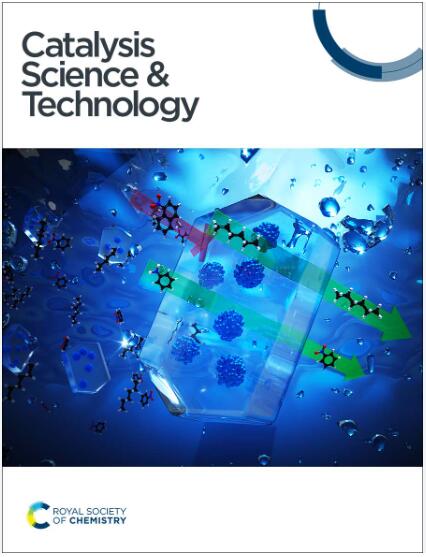
Abstract Image

二维和三维过渡金属硫化物负载铂对肉桂醛的加氢作用
肉桂醛(CAL)是一种α,β-不饱和醛,其选择性加氢反应可生成肉桂醇(COL)和氢肉桂醛(HCAL)等有价值的产物。采用微波辅助和湿浸渍法制备了以过渡金属二硫化物(MoS2、WS2及其复合材料)为载体的体积型和剥离型pt基催化剂。表征(SEM/EDS, TEM, XRF, XRD和BET)证实了~ 9 wt%的Pt负载,保留了层状结构和分散良好的纳米颗粒。基于二维载体的催化剂提供了更细的Pt分散(2-6 nm),微波合成得到更小,更均匀的颗粒,特别是在Mo-W复合材料中。催化测试表明,活性和选择性都受到载体组成和形态的强烈影响,2D Mo-W复合材料的性能优于MoS2和WS2。所有催化剂都主要促进CO选择性加氢生成COL,而HCAL和HCOL则是次要产物。在微波辅助合成的二维Mo-W-S复合材料上负载Pt达到最佳性能,在6 h内CAL转化率为75%,COL选择性为64%,收率为48%。
本文章由计算机程序翻译,如有差异,请以英文原文为准。
求助全文
约1分钟内获得全文 求助全文
来源期刊
Catalysis Science & Technology
Catalysis Science & Technology CHEMISTRY, PHYSICAL-
CiteScore
8.70
自引率
6.00%
发文量
587
审稿时长
1.5 months
期刊介绍: A multidisciplinary journal focusing on cutting edge research across all fundamental science and technological aspects of catalysis. Editor-in-chief: Bert Weckhuysen Impact factor: 5.0 Time to first decision (peer reviewed only): 31 days

×
引用
GB/T 7714-2015
复制
MLA
复制
APA
复制
导出至
BibTeX EndNote RefMan NoteFirst NoteExpress
×
提示
您的信息不完整,为了账户安全,请先补充。
现在去补充
×
提示
您因"违规操作"
具体请查看互助需知
我知道了
×
提示
确定
请完成安全验证×
copy
已复制链接
快去分享给好友吧!
我知道了
右上角分享
点击右上角分享
0
联系我们:info@booksci.cn Book学术提供免费学术资源搜索服务,方便国内外学者检索中英文文献。致力于提供最便捷和优质的服务体验。 Copyright © 2023 布克学术 All rights reserved.
京ICP备2023020795号-1
ghs 京公网安备 11010802042870号
Book学术文献互助
Book学术文献互助群
群 号:604180095
Book学术官方微信
小红书


