
From multifunctional catalysts to smart substrates: adsorption control for efficient light-driven one-pot benzimidazole synthesis over Pd/NH2–Ni–Fe-MOF

IF 4 3区 化学 Q2 CHEMISTRY, PHYSICAL
Catalysis Science & Technology Pub Date : 2026-05-19 Epub Date: 2026-04-13 DOI:10.1039/d6cy00076b
Hurunqing Liu , Lin Ye , Yun Yuan , Quanyuan Wang , Dengrong Sun , Zhaohui Li
{"title":"From multifunctional catalysts to smart substrates: adsorption control for efficient light-driven one-pot benzimidazole synthesis over Pd/NH2–Ni–Fe-MOF","authors":"Hurunqing Liu ,&nbsp;Lin Ye ,&nbsp;Yun Yuan ,&nbsp;Quanyuan Wang ,&nbsp;Dengrong Sun ,&nbsp;Zhaohui Li","doi":"10.1039/d6cy00076b","DOIUrl":null,"url":null,"abstract":"<div><div>Light-driven one-pot tandem/cascade reactions have attracted increasing interest due to their green process and atomic efficiency. In addition to active sites, the adsorption behavior of reaction substrates also plays a critical role on the catalytic process, but is always overlooked. Herein, we report that modulating the reaction substrates to regulate the adsorption behavior of intermediates can effectively facilitate one-pot multi-step reactions. <em>O</em>-Nitroaniline is strategically selected to replace the commonly used <em>o</em>-phenylenediamine for reaction with benzyl alcohol to synthesize benzimidazole in a one-pot process under visible-light irradiation. The use of <em>o</em>-nitroaniline effectively promotes the adsorption of the benzyl alcohol-derived aldehyde intermediate on the catalyst but weakens the adsorption of <em>o</em>-nitroaniline-derived <em>o</em>-phenylenediamine. Thus, the condensation between these two intermediates can proceed smoothly, alleviating the fatal polymerization side reaction of <em>o</em>-phenylenediamine, affording high efficiency in light-driven benzimidazole production. Departing from the conventional catalyst design, this work underscores an effective way to modulate the reaction substrates for accelerated one-pot synthesis, signifying an important contribution to the design of one-pot synthesis systems.</div></div>","PeriodicalId":66,"journal":{"name":"Catalysis Science & Technology","volume":"16 9","pages":"Pages 3336-3342"},"PeriodicalIF":4.0000,"publicationDate":"2026-05-19","publicationTypes":"Journal Article","fieldsOfStudy":null,"isOpenAccess":false,"openAccessPdf":"","citationCount":"0","resultStr":null,"platform":"Semanticscholar","paperid":null,"PeriodicalName":"Catalysis Science & Technology","FirstCategoryId":"92","ListUrlMain":"https://www.sciencedirect.com/org/science/article/pii/S2044475326001620","RegionNum":3,"RegionCategory":"化学","ArticlePicture":[],"TitleCN":null,"AbstractTextCN":null,"PMCID":null,"EPubDate":"2026/4/13 0:00:00","PubModel":"Epub","JCR":"Q2","JCRName":"CHEMISTRY, PHYSICAL","Score":null,"Total":0}
引用次数: 0

Abstract

Light-driven one-pot tandem/cascade reactions have attracted increasing interest due to their green process and atomic efficiency. In addition to active sites, the adsorption behavior of reaction substrates also plays a critical role on the catalytic process, but is always overlooked. Herein, we report that modulating the reaction substrates to regulate the adsorption behavior of intermediates can effectively facilitate one-pot multi-step reactions. O-Nitroaniline is strategically selected to replace the commonly used o-phenylenediamine for reaction with benzyl alcohol to synthesize benzimidazole in a one-pot process under visible-light irradiation. The use of o-nitroaniline effectively promotes the adsorption of the benzyl alcohol-derived aldehyde intermediate on the catalyst but weakens the adsorption of o-nitroaniline-derived o-phenylenediamine. Thus, the condensation between these two intermediates can proceed smoothly, alleviating the fatal polymerization side reaction of o-phenylenediamine, affording high efficiency in light-driven benzimidazole production. Departing from the conventional catalyst design, this work underscores an effective way to modulate the reaction substrates for accelerated one-pot synthesis, signifying an important contribution to the design of one-pot synthesis systems.

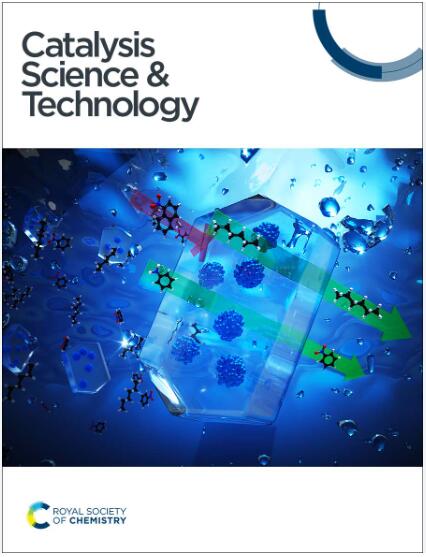
Abstract Image

从多功能催化剂到智能底物:Pd/ NH2-Ni-Fe-MOF上高效光驱动一锅苯并咪唑合成的吸附控制
光驱动的单锅串联/级联反应因其绿色过程和原子效率而越来越受到人们的关注。除活性位点外,反应底物的吸附行为在催化过程中也起着至关重要的作用,但往往被忽视。本文报道了通过调节反应底物来调节中间体的吸附行为可以有效地促进一锅多步反应。战略选择邻硝基苯胺代替常用的邻苯二胺与苯甲醇在可见光照射下一锅法合成苯并咪唑。邻硝基苯胺的使用有效地促进了苯甲醇衍生醛中间体在催化剂上的吸附,但削弱了邻硝基苯胺衍生的邻苯二胺的吸附。因此,这两个中间体之间的缩合可以顺利进行,减轻了致命的邻苯二胺聚合副反应,为光驱动苯并咪唑生产提供了高效率。从传统的催化剂设计出发,本工作强调了一种有效的方法来调节反应底物以加速一锅合成,这对一锅合成系统的设计有重要的贡献。
本文章由计算机程序翻译,如有差异,请以英文原文为准。
求助全文
约1分钟内获得全文 求助全文
来源期刊
Catalysis Science & Technology
Catalysis Science & Technology CHEMISTRY, PHYSICAL-
CiteScore
8.70
自引率
6.00%
发文量
587
审稿时长
1.5 months
期刊介绍: A multidisciplinary journal focusing on cutting edge research across all fundamental science and technological aspects of catalysis. Editor-in-chief: Bert Weckhuysen Impact factor: 5.0 Time to first decision (peer reviewed only): 31 days

×
引用
GB/T 7714-2015
复制
MLA
复制
APA
复制
导出至
BibTeX EndNote RefMan NoteFirst NoteExpress
×
提示
您的信息不完整,为了账户安全,请先补充。
现在去补充
×
提示
您因"违规操作"
具体请查看互助需知
我知道了
×
提示
确定
请完成安全验证×
copy
已复制链接
快去分享给好友吧!
我知道了
右上角分享
点击右上角分享
0
联系我们:info@booksci.cn Book学术提供免费学术资源搜索服务,方便国内外学者检索中英文文献。致力于提供最便捷和优质的服务体验。 Copyright © 2023 布克学术 All rights reserved.
京ICP备2023020795号-1
ghs 京公网安备 11010802042870号
Book学术文献互助
Book学术文献互助群
群 号:604180095
Book学术官方微信
小红书


