
Planar ReN1S1 sites with dual σ-channels drive high-performance CO2 photoreduction

IF 4 3区 化学 Q2 CHEMISTRY, PHYSICAL
Catalysis Science & Technology Pub Date : 2026-05-19 Epub Date: 2026-04-10 DOI:10.1039/d6cy00111d
Hao Sheng , Shaokui Chen , Guocheng Huang , Jialong Lv , Guiting Huang , Wenjun Yang , Ziyan Chen , Shaoyu Wu , Yueling Chen , Jinhong Bi
{"title":"Planar ReN1S1 sites with dual σ-channels drive high-performance CO2 photoreduction","authors":"Hao Sheng ,&nbsp;Shaokui Chen ,&nbsp;Guocheng Huang ,&nbsp;Jialong Lv ,&nbsp;Guiting Huang ,&nbsp;Wenjun Yang ,&nbsp;Ziyan Chen ,&nbsp;Shaoyu Wu ,&nbsp;Yueling Chen ,&nbsp;Jinhong Bi","doi":"10.1039/d6cy00111d","DOIUrl":null,"url":null,"abstract":"<div><div>Although covalent organic frameworks (COFs) provide an adjustable platform for visible-light-driven CO<sub>2</sub> reduction, their practical application is fundamentally limited by the lack of active sites for polarizing the CO bond and the low efficiency of long-range charge transport. Here, we designed an olefin-linked donor–acceptor COF (Py-2CN-COF) and anchored atomically dispersed rhenium (Re) single atoms (SAs) to create a planar ReN<sub>1</sub>S<sub>1</sub> coordination motif that functioned as a dual-channel electron sink. This structure shortened exciton diffusion, reduced the exciton binding energy from 112.28 to 100.26 meV, extended the carrier lifetime from 0.786 to 1.157 ns, and directed photogenerated electrons efficiently to the active sites. The optimized Re<sub>3</sub>-Py-2CN-COF achieved a CO production rate of 119.5 μmol g<sup>−1</sup> h<sup>−1</sup> with 92.3% selectivity under visible light without sacrificial agents, which is a 12.7-fold enhancement over the pristine COF. <em>In situ</em> Fourier transform infrared (FT-IR) spectroscopy unveiled a *CO<sub>2</sub> → *COOH → *CO pathway, and theoretical calculations confirmed that the Re center lowered the adsorption energy of CO<sub>2</sub> from −0.23 to −0.93 eV, extended the CO bond length from 1.17 to 1.23 Å and injected 0.22 e<sup>−</sup> into CO<sub>2</sub>. This work establishes in-plane ReN<sub>1</sub>S<sub>1</sub> coordination as an effective structural strategy to accelerate proton-coupled electron transfer, providing a general design principle for developing highly efficient and selective COF photocatalysts toward sustainable CO<sub>2</sub> valorization.</div></div>","PeriodicalId":66,"journal":{"name":"Catalysis Science & Technology","volume":"16 9","pages":"Pages 3396-3403"},"PeriodicalIF":4.0000,"publicationDate":"2026-05-19","publicationTypes":"Journal Article","fieldsOfStudy":null,"isOpenAccess":false,"openAccessPdf":"","citationCount":"0","resultStr":null,"platform":"Semanticscholar","paperid":null,"PeriodicalName":"Catalysis Science & Technology","FirstCategoryId":"92","ListUrlMain":"https://www.sciencedirect.com/org/science/article/pii/S204447532600167X","RegionNum":3,"RegionCategory":"化学","ArticlePicture":[],"TitleCN":null,"AbstractTextCN":null,"PMCID":null,"EPubDate":"2026/4/10 0:00:00","PubModel":"Epub","JCR":"Q2","JCRName":"CHEMISTRY, PHYSICAL","Score":null,"Total":0}
引用次数: 0

Abstract

Although covalent organic frameworks (COFs) provide an adjustable platform for visible-light-driven CO2 reduction, their practical application is fundamentally limited by the lack of active sites for polarizing the CO bond and the low efficiency of long-range charge transport. Here, we designed an olefin-linked donor–acceptor COF (Py-2CN-COF) and anchored atomically dispersed rhenium (Re) single atoms (SAs) to create a planar ReN1S1 coordination motif that functioned as a dual-channel electron sink. This structure shortened exciton diffusion, reduced the exciton binding energy from 112.28 to 100.26 meV, extended the carrier lifetime from 0.786 to 1.157 ns, and directed photogenerated electrons efficiently to the active sites. The optimized Re3-Py-2CN-COF achieved a CO production rate of 119.5 μmol g−1 h−1 with 92.3% selectivity under visible light without sacrificial agents, which is a 12.7-fold enhancement over the pristine COF. In situ Fourier transform infrared (FT-IR) spectroscopy unveiled a *CO2 → *COOH → *CO pathway, and theoretical calculations confirmed that the Re center lowered the adsorption energy of CO2 from −0.23 to −0.93 eV, extended the CO bond length from 1.17 to 1.23 Å and injected 0.22 e− into CO2. This work establishes in-plane ReN1S1 coordination as an effective structural strategy to accelerate proton-coupled electron transfer, providing a general design principle for developing highly efficient and selective COF photocatalysts toward sustainable CO2 valorization.

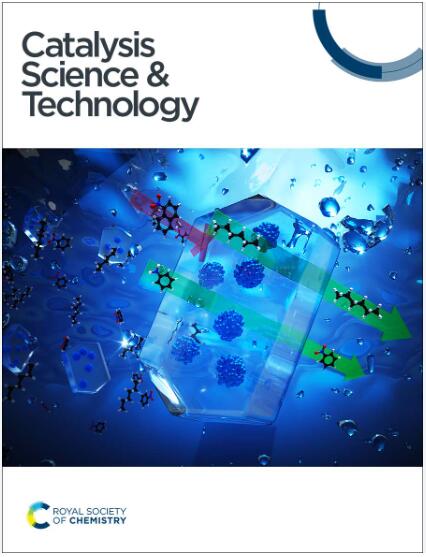
Abstract Image

具有双σ-通道的平面ReN1S1位驱动高性能CO2光还原
虽然共价有机框架(COFs)为可见光驱动的CO2还原提供了一个可调节的平台,但其实际应用从根本上受到CO键极化活性位点的缺乏和远程电荷传输效率低的限制。在这里,我们设计了一个烯烃连接的供体-受体COF (Py-2CN-COF)和锚定的原子分散铼(Re)单原子(SAs),以创建一个平面ReN1S1配位基序,作为双通道电子汇。该结构缩短了激子扩散,将激子结合能从112.28 meV降低到100.26 meV,将载流子寿命从0.786延长到1.157 ns,并有效地将光生电子定向到活性位点。优化后的Re3-Py-2CN-COF在可见光下的CO产率为119.5 μmol g−1 h−1,选择性为92.3%,比原始COF提高了12.7倍。原位傅里叶变换红外光谱(FT-IR)揭示了一条*CO2→*COOH→*CO的途径,理论计算证实,Re中心将CO2的吸附能从- 0.23 eV降低到- 0.93 eV,将CO键长从1.17延长到1.23 Å,并向CO2注入0.22 e−。本研究建立了平面内ReN1S1配位作为加速质子耦合电子转移的有效结构策略,为开发高效、选择性的COF光催化剂以实现CO2的可持续增值提供了一般设计原则。
本文章由计算机程序翻译,如有差异,请以英文原文为准。
求助全文
约1分钟内获得全文 求助全文
来源期刊
Catalysis Science & Technology
Catalysis Science & Technology CHEMISTRY, PHYSICAL-
CiteScore
8.70
自引率
6.00%
发文量
587
审稿时长
1.5 months
期刊介绍: A multidisciplinary journal focusing on cutting edge research across all fundamental science and technological aspects of catalysis. Editor-in-chief: Bert Weckhuysen Impact factor: 5.0 Time to first decision (peer reviewed only): 31 days

×
引用
GB/T 7714-2015
复制
MLA
复制
APA
复制
导出至
BibTeX EndNote RefMan NoteFirst NoteExpress
×
提示
您的信息不完整,为了账户安全,请先补充。
现在去补充
×
提示
您因"违规操作"
具体请查看互助需知
我知道了
×
提示
确定
请完成安全验证×
copy
已复制链接
快去分享给好友吧!
我知道了
右上角分享
点击右上角分享
0
联系我们:info@booksci.cn Book学术提供免费学术资源搜索服务,方便国内外学者检索中英文文献。致力于提供最便捷和优质的服务体验。 Copyright © 2023 布克学术 All rights reserved.
京ICP备2023020795号-1
ghs 京公网安备 11010802042870号
Book学术文献互助
Book学术文献互助群
群 号:604180095
Book学术官方微信
小红书


