Alexander Butwick, Rebecca J Baer, Naghma Farooqi, Vasiliki Tatsis, Olof Stephansson, Kelli Ryckman, Dana R Gossett, Sasha Hernandez, Justin Brandt, Laura Jelliffe-Pawlowski
{"title":"Association Between Severe Perioperative Surgical Morbidity With Cesarean Delivery and Postpartum Readmission.","authors":"Alexander Butwick, Rebecca J Baer, Naghma Farooqi, Vasiliki Tatsis, Olof Stephansson, Kelli Ryckman, Dana R Gossett, Sasha Hernandez, Justin Brandt, Laura Jelliffe-Pawlowski","doi":"10.1097/AOG.0000000000006319","DOIUrl":null,"url":null,"abstract":"<p><strong>Objective: </strong>To evaluate the association between severe perioperative surgical morbidity with cesarean delivery and postpartum readmission.</p><p><strong>Methods: </strong>This was a retrospective cross-sectional study using linked birth certificate and maternal discharge data for patients who underwent cesarean delivery in any California hospital between October 2015 and October 2021. Severe perioperative surgical morbidity is an index characterized by severe surgical complications occurring during hospitalization for cesarean delivery, identified using International Classification of Diseases, Tenth Revision diagnosis and procedure codes for severe surgical complications. The primary outcome was all-cause postpartum readmission within 42 days after hospital discharge. Readmission rates were quantified for patients with and without severe perioperative surgical morbidity, and generalized estimating equations were used to estimate adjusted relative risks (aRRs), adjusted risk differences (aRD), and 95% CIs, accounting for patient- and hospital-level factors. In secondary analysis, the association was assessed separately for prelabor and intrapartum cesarean deliveries.</p><p><strong>Results: </strong>The study population included women who had undergone 703,079 cesarean deliveries. The readmission rate was higher among those with severe perioperative surgical morbidity compared with those without severe perioperative surgical morbidity (469.4/10,000 [95% CI, 428.0-511.0] vs 165.3/10,000 [95% CI, 162.3-168.3]). Severe perioperative surgical morbidity was associated with a twofold increased risk of readmission (aRR 2.22; 95% CI, 2.00-2.46). The aRD for patients with severe perioperative surgical morbidity was an excess of two readmissions (2.5; 95% CI, 2.1-3.0/100 cesarean deliveries) compared with patients without severe perioperative surgical morbidity. Wound infection was the most common diagnosis at readmission among patients with severe perioperative surgical morbidity (77/10,000; 95% CI, 60.5-95.3). The risk of readmission was similar among patients with severe perioperative surgical morbidity and without severe perioperative surgical morbidity who underwent intrapartum cesarean delivery (aRR 2.35; 95% CI, 2.09-2.65) and prelabor cesarean delivery (aRR 2.03; 95% CI, 1.72-2.40).</p><p><strong>Conclusion: </strong>Nearly 1 in 20 patients undergoing cesarean delivery who experience severe perioperative surgical morbidity undergoes postpartum readmission, with a twofold increased readmission risk at 42 days after discharge. Patients with severe perioperative surgical morbidity may benefit from targeted follow-up to reduce postpartum admission.</p>","PeriodicalId":19483,"journal":{"name":"Obstetrics and gynecology","volume":" ","pages":"525-533"},"PeriodicalIF":5.1000,"publicationDate":"2026-10-01","publicationTypes":"Journal Article","fieldsOfStudy":null,"isOpenAccess":false,"openAccessPdf":"","citationCount":"0","resultStr":null,"platform":"Semanticscholar","paperid":null,"PeriodicalName":"Obstetrics and gynecology","FirstCategoryId":"3","ListUrlMain":"https://doi.org/10.1097/AOG.0000000000006319","RegionNum":2,"RegionCategory":"医学","ArticlePicture":[],"TitleCN":null,"AbstractTextCN":null,"PMCID":null,"EPubDate":"2026/5/15 0:00:00","PubModel":"Epub","JCR":"Q1","JCRName":"OBSTETRICS & GYNECOLOGY","Score":null,"Total":0}
引用次数: 0
Abstract
Objective: To evaluate the association between severe perioperative surgical morbidity with cesarean delivery and postpartum readmission.
Methods: This was a retrospective cross-sectional study using linked birth certificate and maternal discharge data for patients who underwent cesarean delivery in any California hospital between October 2015 and October 2021. Severe perioperative surgical morbidity is an index characterized by severe surgical complications occurring during hospitalization for cesarean delivery, identified using International Classification of Diseases, Tenth Revision diagnosis and procedure codes for severe surgical complications. The primary outcome was all-cause postpartum readmission within 42 days after hospital discharge. Readmission rates were quantified for patients with and without severe perioperative surgical morbidity, and generalized estimating equations were used to estimate adjusted relative risks (aRRs), adjusted risk differences (aRD), and 95% CIs, accounting for patient- and hospital-level factors. In secondary analysis, the association was assessed separately for prelabor and intrapartum cesarean deliveries.
Results: The study population included women who had undergone 703,079 cesarean deliveries. The readmission rate was higher among those with severe perioperative surgical morbidity compared with those without severe perioperative surgical morbidity (469.4/10,000 [95% CI, 428.0-511.0] vs 165.3/10,000 [95% CI, 162.3-168.3]). Severe perioperative surgical morbidity was associated with a twofold increased risk of readmission (aRR 2.22; 95% CI, 2.00-2.46). The aRD for patients with severe perioperative surgical morbidity was an excess of two readmissions (2.5; 95% CI, 2.1-3.0/100 cesarean deliveries) compared with patients without severe perioperative surgical morbidity. Wound infection was the most common diagnosis at readmission among patients with severe perioperative surgical morbidity (77/10,000; 95% CI, 60.5-95.3). The risk of readmission was similar among patients with severe perioperative surgical morbidity and without severe perioperative surgical morbidity who underwent intrapartum cesarean delivery (aRR 2.35; 95% CI, 2.09-2.65) and prelabor cesarean delivery (aRR 2.03; 95% CI, 1.72-2.40).
Conclusion: Nearly 1 in 20 patients undergoing cesarean delivery who experience severe perioperative surgical morbidity undergoes postpartum readmission, with a twofold increased readmission risk at 42 days after discharge. Patients with severe perioperative surgical morbidity may benefit from targeted follow-up to reduce postpartum admission.
期刊介绍:
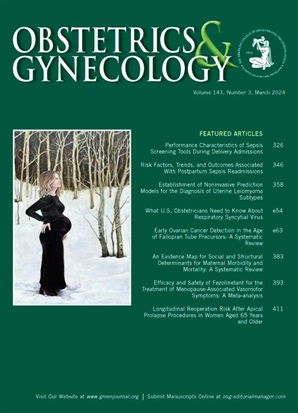
"Obstetrics & Gynecology," affectionately known as "The Green Journal," is the official publication of the American College of Obstetricians and Gynecologists (ACOG). Since its inception in 1953, the journal has been dedicated to advancing the clinical practice of obstetrics and gynecology, as well as related fields. The journal's mission is to promote excellence in these areas by publishing a diverse range of articles that cover translational and clinical topics.
"Obstetrics & Gynecology" provides a platform for the dissemination of evidence-based research, clinical guidelines, and expert opinions that are essential for the continuous improvement of women's health care. The journal's content is designed to inform and educate obstetricians, gynecologists, and other healthcare professionals, ensuring that they stay abreast of the latest developments and best practices in their field.

 求助内容:
 应助结果提醒方式:


 京公网安备 11010802042870号


