{"title":"[The therapeutic effect of <i>magnolia officinalis</i> on blood stasis in <i>Sheng Nong's Herbal Classic</i>].","authors":"C Z Jin, Y H Jin","doi":"10.3760/cma.j.cn112155-20250518-00079","DOIUrl":null,"url":null,"abstract":"<p><p>The efficacy of Hou po in treating blood stasis can be traced back to <i>Sheng Nong's Herbal Classic.</i> However, its relative explanations of medical principles in later generations are scarcely seen and most of them were based on its pungent and warm nature. This paper examined the descriptions of the therapeutic effects of <i>Magnolia officinalis</i>(Hou po) in traditional Chinese materia medica literature throughout its history, analysed the symptoms and pathogenesis of blood stasis in traditional Chinese medicine and referred to other herbs listed in <i>Sheng Nong's Herbal Classic</i> used for treating blood stasis. It was found that <i>Magnolia officinalis</i>(Hou po) has two features to treat blood stasis. One is the internal effect that its pungent and warm nature can promote in the circulation of qi and blood without causing stagnation. Another is that its dispersive and surface-relieving effect can disperse wind, cold and dampness. Exploration of the medical efficacy of <i>Magnolia officinalis</i>(Hou po) in treating blood stasis in <i>Sheng Nong's Herbal Classic</i> can justify its efficacy in treating blood stasis, make up a deficiency in relative research and also provide reference for clinical application of Hou po.</p>","PeriodicalId":35995,"journal":{"name":"中华医史杂志","volume":"56 2","pages":"116-119"},"PeriodicalIF":0.0000,"publicationDate":"2026-03-28","publicationTypes":"Journal Article","fieldsOfStudy":null,"isOpenAccess":false,"openAccessPdf":"","citationCount":"0","resultStr":null,"platform":"Semanticscholar","paperid":null,"PeriodicalName":"中华医史杂志","FirstCategoryId":"1090","ListUrlMain":"https://doi.org/10.3760/cma.j.cn112155-20250518-00079","RegionNum":0,"RegionCategory":null,"ArticlePicture":[],"TitleCN":null,"AbstractTextCN":null,"PMCID":null,"EPubDate":"","PubModel":"","JCR":"Q4","JCRName":"Medicine","Score":null,"Total":0}
引用次数: 0
Abstract
The efficacy of Hou po in treating blood stasis can be traced back to Sheng Nong's Herbal Classic. However, its relative explanations of medical principles in later generations are scarcely seen and most of them were based on its pungent and warm nature. This paper examined the descriptions of the therapeutic effects of Magnolia officinalis(Hou po) in traditional Chinese materia medica literature throughout its history, analysed the symptoms and pathogenesis of blood stasis in traditional Chinese medicine and referred to other herbs listed in Sheng Nong's Herbal Classic used for treating blood stasis. It was found that Magnolia officinalis(Hou po) has two features to treat blood stasis. One is the internal effect that its pungent and warm nature can promote in the circulation of qi and blood without causing stagnation. Another is that its dispersive and surface-relieving effect can disperse wind, cold and dampness. Exploration of the medical efficacy of Magnolia officinalis(Hou po) in treating blood stasis in Sheng Nong's Herbal Classic can justify its efficacy in treating blood stasis, make up a deficiency in relative research and also provide reference for clinical application of Hou po.
期刊介绍:
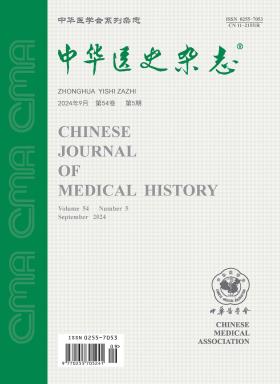
The Chinese Journal of Medical History is the only professional academic journal on medical history in the country. The first publication was named "Journal of Medical History" and was designated as a quarterly publication. In 2009, it was changed from quarterly to bimonthly.
The Chinese Journal of Medical History has columns such as special articles, reviews, expert talks, medical history treatises, literature research, forums and debates, historical accounts, figures, short essays, graduate forums, lectures, historical materials, medical history, and book reviews.
Chinese Journal of Medical History has been included in the US Medline online database.

 求助内容:
 应助结果提醒方式:


 京公网安备 11010802042870号


