
Mapping transitional care models after ICU discharge for ECMO survivors: A scoping review
引用次数: 0
Abstract
Introduction
ECMO survivors frequently develop post-intensive-care syndrome (PICS) with cognitive, psychological, and functional sequelae. Transitional care seeks to bridge ICU discharge and community recovery but remains variably structured, timed, and evaluated.
Objectives and methodology
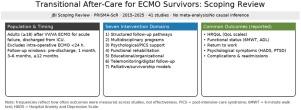
To map transitional care models for ECMO survivors after ICU discharge, describing what is implemented, when (timing), and which outcomes are measured. Scoping review (JBI), reported per PRISMA-ScR. Databases: MEDLINE/PubMed, B-On, Web of Science (January 2015–June 2025). Grey literature: Google Scholar, OpenGrey, ELSO, OSF, ClinicalTrials.gov. Keywords and MeSH terms used: Extracorporeal Membrane Oxygenation [MeSH], Aftercare [MeSH], post-intensive care syndrome [MeSH], Critical Care [MeSH], Transitional Care [MeSH]. Eligibility: adults (≥18) on VV/VA ECMO with post-ICU data; excluded intra-operative ECMO < 24 h and studies without extractable ECMO-specific outcomes.
Results
Search retrieved 4101 studies, screening identified 740 records; 41 were included; 699 were excluded (duplicates; non-ECMO or intra-operative ECMO; no transitional intervention; no ECMO-specific outcomes). Seven domains were identified: structured follow-up pathways (n = 12); multidisciplinary interventions (n = 10); psychological/PICS support (n = 7); functional rehabilitation (n = 6); educational/organizational training (n = 5); telemonitoring/digital follow-up (n = 3); palliative/survivorship models (n = 2). Follow-up timings: pre-discharge; ∼1 month; 3–6 months; ≥12 months. Common outcomes: HRQoL, functional status (e.g., 6MWT/ADL), return to work, psychological symptoms (e.g., anxiety/depression/PTSD), readmissions/complications. Designs were predominantly observational/qualitative; trials with comparators were infrequent.
Discussion
Emerging concepts—ECMO survivorship, digital follow-up pathways—are not yet indexed in MeSH. Heterogeneity in structures, timing, and instruments limits comparability. Limitations include reliance on descriptive designs, variable reporting, and potential overlap across reviews.
Conclusions
This scoping review identified seven domains of transitional care for ECMO survivors after ICU discharge. However, the implementation of these domains and the outcome measures used to evaluate them were heterogeneous and inconsistently reported across studies, highlighting the need for more robust, outcome-focused research.
绘制ECMO幸存者ICU出院后的过渡护理模式:范围综述。
ECMO幸存者经常出现重症监护后综合征(PICS),伴有认知、心理和功能后遗症。过渡性护理旨在连接ICU出院和社区康复,但仍有不同的结构、时间和评估。目的和方法:绘制ICU出院后ECMO幸存者的过渡护理模式,描述实施的内容、时间(时间)和测量的结果。范围审查(JBI),根据PRISMA-ScR报告。数据库:MEDLINE/PubMed, B-On, Web of Science(2015年1月- 2025年6月)。灰色文献:谷歌Scholar, OpenGrey, ELSO, OSF, ClinicalTrials.gov。关键词:体外膜氧合[MeSH],术后护理[MeSH],重症监护后综合征[MeSH],重症监护[MeSH],过渡护理[MeSH]。资格:成人(≥18岁)接受VV/VA ECMO,并有icu后数据;排除术中ECMO结果:检索到4101项研究,筛选确定740例记录;纳入41例;699例被排除(重复;非ECMO或术中ECMO;无过渡性干预;无ECMO特异性结局)。确定了七个领域:结构化随访途径(n = 12);多学科干预(n = 10);心理/PICS支持(n = 7);功能康复(n = 6);教育/组织培训(n = 5);远程监控/数字随访(n = 3);姑息/生存模型(n = 2)。随访时间:预出院;∼1个月;3 - 6个月;≥12个月。常见结局:HRQoL、功能状态(如6MWT/ADL)、重返工作岗位、心理症状(如焦虑/抑郁/PTSD)、再入院/并发症。设计以观察性/定性为主;与比较物的试验很少。讨论:新兴概念- ecmo生存,数字随访途径-尚未在MeSH中索引。结构、时间和仪器的异质性限制了可比性。限制包括对描述性设计的依赖,可变报告,以及审查之间潜在的重叠。结论:本综述确定了ICU出院后ECMO幸存者的7个过渡护理领域。然而,这些领域的实施和用于评估它们的结果测量是异质的,并且在研究中报告的结果不一致,这突出表明需要更强大的、以结果为中心的研究。
本文章由计算机程序翻译,如有差异,请以英文原文为准。
求助全文
约1分钟内获得全文
求助全文

 求助内容:
求助内容: 应助结果提醒方式:

 京公网安备 11010802042870号


