Shuqi Zheng, Xiangyu Zhao, Kai Liu, Hongyan Xu, Wei Gao
{"title":"[Analysis of a child with Oculocutaneous albinism due to compound heterozygous variants of OCA2 gene].","authors":"Shuqi Zheng, Xiangyu Zhao, Kai Liu, Hongyan Xu, Wei Gao","doi":"10.3760/cma.j.cn511374-20250830-00518","DOIUrl":null,"url":null,"abstract":"<p><strong>Objective: </strong>To explore the genetic etiology of a child with Oculocutaneous albinism (OCA).</p><p><strong>Methods: </strong>A child diagnosed with OCA at Linyi People's Hospital in December 2020 was selected as study subject. Clinical data were retrospectively analyzed. Whole exome sequencing (WES) was carried out for the child. Based on WES data, potential pathogenic variants and copy number variation (CNV) were screened. Candidate variants were validated by Sanger sequencing and quantitative real-time polymerase chain reaction (qPCR). Bioinformatics tools were employed to predict the structural and functional impacts of the variant. This study was approved by the Medical Ethics Committee of th hospital (Ethics No.: YX200082).</p><p><strong>Results: </strong>WES revealed that the child has harbored compound heterozygous variants of the OCA2 gene, namely c.2323G>A (p.G775Ser) and c.exon3_19del. Sanger sequencing and qPCR confirmed that the variants were inherited from his father and mother, respectively. Based on the guidelines from American College of Medical Genetics and Genomics (ACMG), the c.2323G>A variant was classified as likely pathogenic (PM1+PM3+PM2_Supporting+PP3+PP4), whilst the c.exon3_19del variant was classified as pathogenic (PVS1+PM2_Supporting+PP4). Structural modeling of the truncated protein by SWISS-MODEL software predicted that the c.exon3_19del variant can significantly alter the protein structure and is likely to impair its function.</p><p><strong>Conclusion: </strong>The compound heterozygous variants c.2323G>A (p.G775S) and c.exon3_19del of the OCA2 gene probably underlay the pathogenesis of OCA in this patient. Above finding has enriched the mutational spectrum of the OCA2 gene. CNV analysis based on WES data can serve as a complementary strategy for screening conventional variant types, enabling accurate determination of the origin and size of genomic fragments.</p>","PeriodicalId":39319,"journal":{"name":"中华医学遗传学杂志","volume":"43 6","pages":"460-465"},"PeriodicalIF":0.0000,"publicationDate":"2026-06-10","publicationTypes":"Journal Article","fieldsOfStudy":null,"isOpenAccess":false,"openAccessPdf":"","citationCount":"0","resultStr":null,"platform":"Semanticscholar","paperid":null,"PeriodicalName":"中华医学遗传学杂志","FirstCategoryId":"3","ListUrlMain":"https://doi.org/10.3760/cma.j.cn511374-20250830-00518","RegionNum":0,"RegionCategory":null,"ArticlePicture":[],"TitleCN":null,"AbstractTextCN":null,"PMCID":null,"EPubDate":"","PubModel":"","JCR":"Q4","JCRName":"Medicine","Score":null,"Total":0}
引用次数: 0
Abstract
Objective: To explore the genetic etiology of a child with Oculocutaneous albinism (OCA).
Methods: A child diagnosed with OCA at Linyi People's Hospital in December 2020 was selected as study subject. Clinical data were retrospectively analyzed. Whole exome sequencing (WES) was carried out for the child. Based on WES data, potential pathogenic variants and copy number variation (CNV) were screened. Candidate variants were validated by Sanger sequencing and quantitative real-time polymerase chain reaction (qPCR). Bioinformatics tools were employed to predict the structural and functional impacts of the variant. This study was approved by the Medical Ethics Committee of th hospital (Ethics No.: YX200082).
Results: WES revealed that the child has harbored compound heterozygous variants of the OCA2 gene, namely c.2323G>A (p.G775Ser) and c.exon3_19del. Sanger sequencing and qPCR confirmed that the variants were inherited from his father and mother, respectively. Based on the guidelines from American College of Medical Genetics and Genomics (ACMG), the c.2323G>A variant was classified as likely pathogenic (PM1+PM3+PM2_Supporting+PP3+PP4), whilst the c.exon3_19del variant was classified as pathogenic (PVS1+PM2_Supporting+PP4). Structural modeling of the truncated protein by SWISS-MODEL software predicted that the c.exon3_19del variant can significantly alter the protein structure and is likely to impair its function.
Conclusion: The compound heterozygous variants c.2323G>A (p.G775S) and c.exon3_19del of the OCA2 gene probably underlay the pathogenesis of OCA in this patient. Above finding has enriched the mutational spectrum of the OCA2 gene. CNV analysis based on WES data can serve as a complementary strategy for screening conventional variant types, enabling accurate determination of the origin and size of genomic fragments.
期刊介绍:
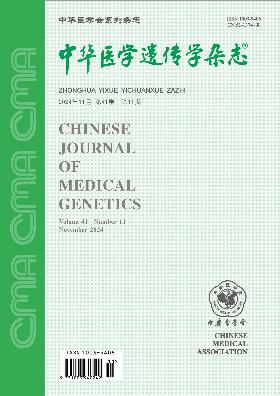
Chinese Journal of Medical Genetics is a medical journal, founded in 1984, under the supervision of the China Association for Science and Technology, sponsored by the Chinese Medical Association (hosted by Sichuan University), and is now a monthly magazine, which attaches importance to academic orientation, adheres to the scientific, scholarly, advanced, and innovative, and has a certain degree of influence in the industry.
Chinese Journal of Medical Genetics is a journal of Peking University, and is now included in Peking University Journal (Chinese Journal of Humanities and Social Sciences), CSCD Source Journals of Chinese Science Citation Database (with extended version), Statistical Source Journals (China Science and Technology Dissertation Outstanding Journals), Zhi.com (in Chinese), Wipu (in Chinese), Wanfang (in Chinese), CA Chemical Abstracts (U.S.), JST (Japan Science and Technology Science and Technology), and JST (Japan Science and Technology Science and Technology Research Center). ), JST (Japan Science and Technology Agency), Pж (AJ) Abstracts Journal (Russia), Copernicus Index (Poland), Cambridge Scientific Abstracts, Abstracts and Citation Database, Abstracts Magazine, Medical Abstracts, and so on.

 求助内容:
 应助结果提醒方式:


 京公网安备 11010802042870号


