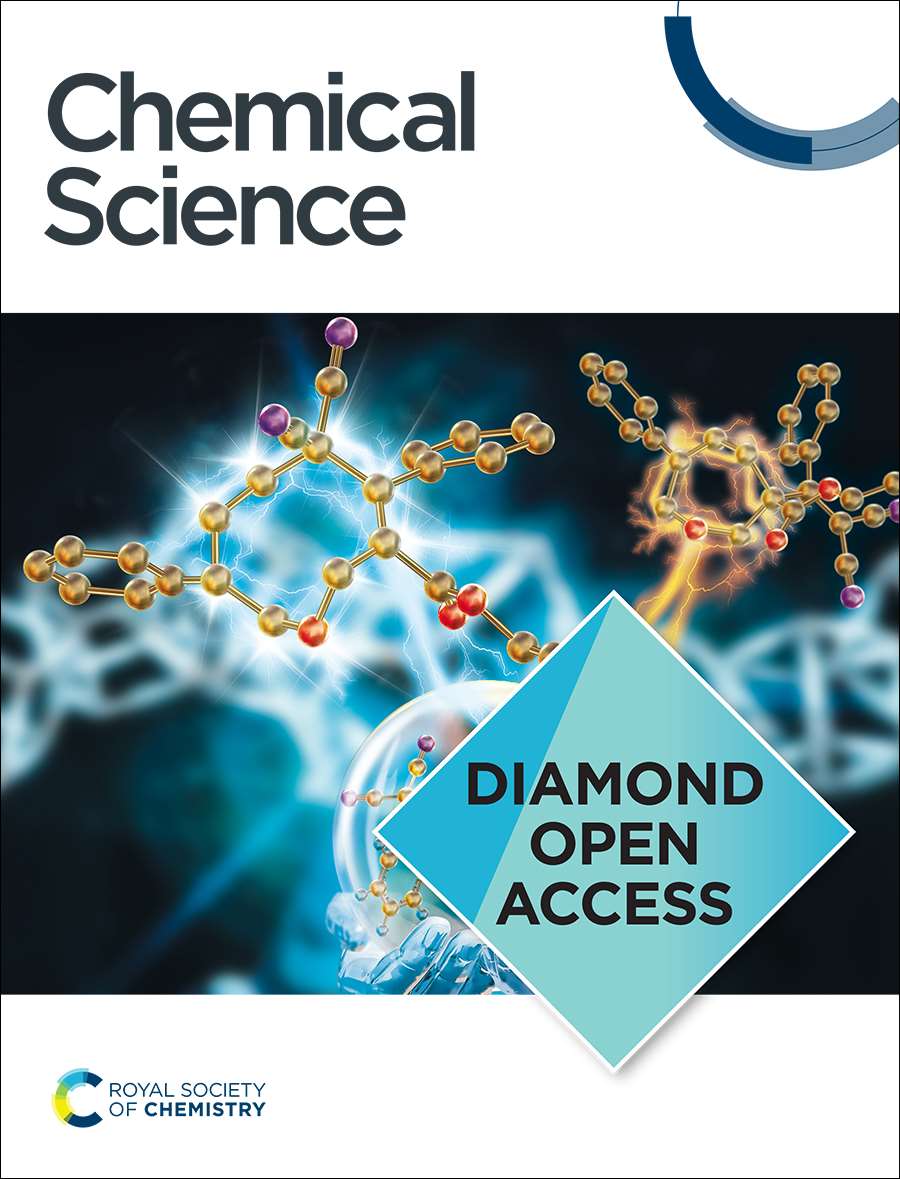
{"title":"Rational regulation of the torsion angle of covalent organic frameworks for enhanced CO<sub>2</sub> photoreduction to ethane.","authors":"Yun Ma, Qian Zhang, Hao Chen, Huiyong Wang, Yunjing Deng, Yingying Guo, Shuaiqi Gao, Jianji Wang","doi":"10.1039/d5sc09241h","DOIUrl":null,"url":null,"abstract":"<p><p>Light-driven CO<sub>2</sub> reduction to hydrocarbon fuels is a green and sustainable technology to alleviate global warming while producing high value-added chemicals. However, highly efficient production of ethane (C<sub>2</sub>H<sub>6</sub>) remains a great challenge due to insufficient electron deliverability and sluggish C-C coupling kinetics. Herein, a series of β-ketoenamine linked Tp-COFs-Mo with different torsion angles were designed and synthesized for the photocatalytic CO<sub>2</sub> reduction reaction to C<sub>2</sub>H<sub>6</sub>. It was disclosed that these Tp-COFs-Mo had identical structural active sites of Mo-N<sub>3</sub>O, while different torsion angles significantly affected their photocatalytic performance. Significantly, TpPa-COF-Mo exhibited a remarkable C<sub>2</sub>H<sub>6</sub> production rate of 262.6 µmol g<sup>-1</sup> h<sup>-1</sup> and a high C<sub>2</sub>H<sub>6</sub> electron selectivity of 91.8%, which exceeds that of the most COF-, POP-, and MOF-based photocatalysts reported previously. Mechanism studies revealed that the smaller torsion angle of TpPa-COF-Mo led to electron accumulation within the layers and stronger electron capturing capacity of Mo sites, which improved separation and transfer of photogenerated electrons along the intralayer, enhanced *H adsorption, and reduced the energy barrier for the formation of *CHOCO intermediate species, thus promoting the efficient conversion of CO<sub>2</sub> to C<sub>2</sub>H<sub>6</sub>. This work opens a new pathway to design efficient COF catalysts by optimizing the torsion angle of COFs.</p>","PeriodicalId":9909,"journal":{"name":"Chemical Science","volume":" ","pages":""},"PeriodicalIF":7.4000,"publicationDate":"2026-05-05","publicationTypes":"Journal Article","fieldsOfStudy":null,"isOpenAccess":false,"openAccessPdf":"https://www.ncbi.nlm.nih.gov/pmc/articles/PMC13142704/pdf/","citationCount":"0","resultStr":null,"platform":"Semanticscholar","paperid":null,"PeriodicalName":"Chemical Science","FirstCategoryId":"92","ListUrlMain":"https://doi.org/10.1039/d5sc09241h","RegionNum":1,"RegionCategory":"化学","ArticlePicture":[],"TitleCN":null,"AbstractTextCN":null,"PMCID":null,"EPubDate":"","PubModel":"","JCR":"Q1","JCRName":"CHEMISTRY, MULTIDISCIPLINARY","Score":null,"Total":0}
引用次数: 0
Abstract
Light-driven CO2 reduction to hydrocarbon fuels is a green and sustainable technology to alleviate global warming while producing high value-added chemicals. However, highly efficient production of ethane (C2H6) remains a great challenge due to insufficient electron deliverability and sluggish C-C coupling kinetics. Herein, a series of β-ketoenamine linked Tp-COFs-Mo with different torsion angles were designed and synthesized for the photocatalytic CO2 reduction reaction to C2H6. It was disclosed that these Tp-COFs-Mo had identical structural active sites of Mo-N3O, while different torsion angles significantly affected their photocatalytic performance. Significantly, TpPa-COF-Mo exhibited a remarkable C2H6 production rate of 262.6 µmol g-1 h-1 and a high C2H6 electron selectivity of 91.8%, which exceeds that of the most COF-, POP-, and MOF-based photocatalysts reported previously. Mechanism studies revealed that the smaller torsion angle of TpPa-COF-Mo led to electron accumulation within the layers and stronger electron capturing capacity of Mo sites, which improved separation and transfer of photogenerated electrons along the intralayer, enhanced *H adsorption, and reduced the energy barrier for the formation of *CHOCO intermediate species, thus promoting the efficient conversion of CO2 to C2H6. This work opens a new pathway to design efficient COF catalysts by optimizing the torsion angle of COFs.
期刊介绍:
Chemical Science is a journal that encompasses various disciplines within the chemical sciences. Its scope includes publishing ground-breaking research with significant implications for its respective field, as well as appealing to a wider audience in related areas. To be considered for publication, articles must showcase innovative and original advances in their field of study and be presented in a manner that is understandable to scientists from diverse backgrounds. However, the journal generally does not publish highly specialized research.

 求助内容:
求助内容: 应助结果提醒方式:

 京公网安备 11010802042870号


