{"title":"Developing a low-cost nitrate and DOC sensor for natural water samples","authors":"Heinke Paulsen, Christof Hübner, Markus Weiler","doi":"10.1186/s12302-026-01397-6","DOIUrl":null,"url":null,"abstract":"<div><p>Nitrate continues to be a major threat to drinking water resources, but rapid changes in concentrations cannot be addressed by standard laboratory approaches. This study introduces a low-cost optical sensor for real-time, in-situ monitoring of nitrate (NO<sub>3</sub><sup>−</sup>) and dissolved organic carbon (DOC) concentrations in natural water samples (soil water, groundwater and river water). Utilizing absorbance and fluorescence at specific wavelengths with LEDs and photodiodes, this sensor system offers an alternative to expensive and complex laboratory or in-situ spectrometer methods and is suited to be paired with flux measurements (e.g., lysimeters) to assess trends and dynamics. Rather than relying on costly xenon lamps and spectrometers, and therefore external power supply, our system consists of three modules that use only LEDs and photodiodes and are optimized for detection at the specific UVA, UVC and red wavelengths. This configuration enables measurements on a broad variety of samples including laboratory standards, groundwater, stream water, and soil water extracts. Initial tests with laboratory nitrate standard solutions up to 100 mg/l achieved high accuracy, with a linear model exhibiting an R<sup>2</sup> of 0.99 and mean absolute error (MAE—average magnitude of errors in a set of predictions) of 2.63 mg/l. Although the sensor's accuracy does not fully match that of traditional laboratory analyses like ion chromatography or photogrammetric approaches, it maintains good predictive capabilities with R<sup>2</sup> values exceeding 0.9 and MAE of 4.2 mg/l NO<sub>3</sub><sup>−</sup> for a sample mixture of groundwater, stream water and soil water with concentrations up to 66 mg/l NO<sub>3</sub><sup>−</sup>. DOC can be predicted with a MAE of 2.2 mg/l. Challenges such as the interference of DOC and turbidity with the nitrate absorbance signal, intense calibration procedures and site-specific variability remain, necessitating further refinement. Nevertheless, this sensor system provides a significant step toward accessible, continuous water quality monitoring and lays the foundation for linking nitrate concentrations to in-situ fluxes. These advancements are crucial for enhancing nutrient management and environmental protection practices.</p></div>","PeriodicalId":546,"journal":{"name":"Environmental Sciences Europe","volume":"38 1","pages":""},"PeriodicalIF":6.0000,"publicationDate":"2026-05-07","publicationTypes":"Journal Article","fieldsOfStudy":null,"isOpenAccess":false,"openAccessPdf":"https://link.springer.com/content/pdf/10.1186/s12302-026-01397-6.pdf","citationCount":"0","resultStr":null,"platform":"Semanticscholar","paperid":null,"PeriodicalName":"Environmental Sciences Europe","FirstCategoryId":"93","ListUrlMain":"https://link.springer.com/article/10.1186/s12302-026-01397-6","RegionNum":3,"RegionCategory":"环境科学与生态学","ArticlePicture":[],"TitleCN":null,"AbstractTextCN":null,"PMCID":null,"EPubDate":"","PubModel":"","JCR":"Q1","JCRName":"ENVIRONMENTAL SCIENCES","Score":null,"Total":0}
引用次数: 0
Abstract
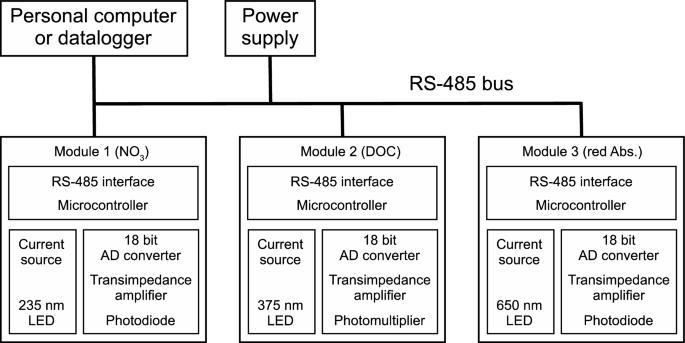
Nitrate continues to be a major threat to drinking water resources, but rapid changes in concentrations cannot be addressed by standard laboratory approaches. This study introduces a low-cost optical sensor for real-time, in-situ monitoring of nitrate (NO3−) and dissolved organic carbon (DOC) concentrations in natural water samples (soil water, groundwater and river water). Utilizing absorbance and fluorescence at specific wavelengths with LEDs and photodiodes, this sensor system offers an alternative to expensive and complex laboratory or in-situ spectrometer methods and is suited to be paired with flux measurements (e.g., lysimeters) to assess trends and dynamics. Rather than relying on costly xenon lamps and spectrometers, and therefore external power supply, our system consists of three modules that use only LEDs and photodiodes and are optimized for detection at the specific UVA, UVC and red wavelengths. This configuration enables measurements on a broad variety of samples including laboratory standards, groundwater, stream water, and soil water extracts. Initial tests with laboratory nitrate standard solutions up to 100 mg/l achieved high accuracy, with a linear model exhibiting an R2 of 0.99 and mean absolute error (MAE—average magnitude of errors in a set of predictions) of 2.63 mg/l. Although the sensor's accuracy does not fully match that of traditional laboratory analyses like ion chromatography or photogrammetric approaches, it maintains good predictive capabilities with R2 values exceeding 0.9 and MAE of 4.2 mg/l NO3− for a sample mixture of groundwater, stream water and soil water with concentrations up to 66 mg/l NO3−. DOC can be predicted with a MAE of 2.2 mg/l. Challenges such as the interference of DOC and turbidity with the nitrate absorbance signal, intense calibration procedures and site-specific variability remain, necessitating further refinement. Nevertheless, this sensor system provides a significant step toward accessible, continuous water quality monitoring and lays the foundation for linking nitrate concentrations to in-situ fluxes. These advancements are crucial for enhancing nutrient management and environmental protection practices.
期刊介绍:
ESEU is an international journal, focusing primarily on Europe, with a broad scope covering all aspects of environmental sciences, including the main topic regulation.
ESEU will discuss the entanglement between environmental sciences and regulation because, in recent years, there have been misunderstandings and even disagreement between stakeholders in these two areas. ESEU will help to improve the comprehension of issues between environmental sciences and regulation.
ESEU will be an outlet from the German-speaking (DACH) countries to Europe and an inlet from Europe to the DACH countries regarding environmental sciences and regulation.
Moreover, ESEU will facilitate the exchange of ideas and interaction between Europe and the DACH countries regarding environmental regulatory issues.
Although Europe is at the center of ESEU, the journal will not exclude the rest of the world, because regulatory issues pertaining to environmental sciences can be fully seen only from a global perspective.

 求助内容:
求助内容: 应助结果提醒方式:

 京公网安备 11010802042870号


