{"title":"Lifted formulations for the Target Visitation problem","authors":"Ali Balma","doi":"10.1007/s10479-026-07168-z","DOIUrl":null,"url":null,"abstract":"<div><p>In the present paper, we address the target visitation problem, aiming to deliver first-aid medicine and necessary food to regions (called targets) suffering from natural disasters or conflicts. In addition, it has many applications for security and surveillance purposes. It consists of planning the tour of an unmanned aerial vehicle, which visits each target once. The objective considers the mutual priorities between the targets and the respective distances. From a theoretical point of view, the problem combines the traveling salesman and the linear ordering problems. We present formulations adapted and lifted from the literature of the traveling salesman. We enhance two particular models. We apply the lifting technique to the first model, which is related to a well-known node-based formulation. We further strengthen it by carrying out a partial projection of an existing multi-commodity flow formulation of the traveling salesman problem in an extended space. Alternatively, we perform a partial Reformulation-Linearization Technique to the same multicommodity flow-based model and obtain a stronger new formulation. For the latter, we develop a solution approach based on a cutting-plane fashion that successfully provided optimal solutions to all benchmark instances for the first time.</p></div>","PeriodicalId":8215,"journal":{"name":"Annals of Operations Research","volume":"360 2-3","pages":"879 - 914"},"PeriodicalIF":4.1000,"publicationDate":"2026-04-11","publicationTypes":"Journal Article","fieldsOfStudy":null,"isOpenAccess":false,"openAccessPdf":"","citationCount":"0","resultStr":null,"platform":"Semanticscholar","paperid":null,"PeriodicalName":"Annals of Operations Research","FirstCategoryId":"91","ListUrlMain":"https://link.springer.com/article/10.1007/s10479-026-07168-z","RegionNum":3,"RegionCategory":"管理学","ArticlePicture":[],"TitleCN":null,"AbstractTextCN":null,"PMCID":null,"EPubDate":"","PubModel":"","JCR":"Q1","JCRName":"OPERATIONS RESEARCH & MANAGEMENT SCIENCE","Score":null,"Total":0}
引用次数: 0
Abstract
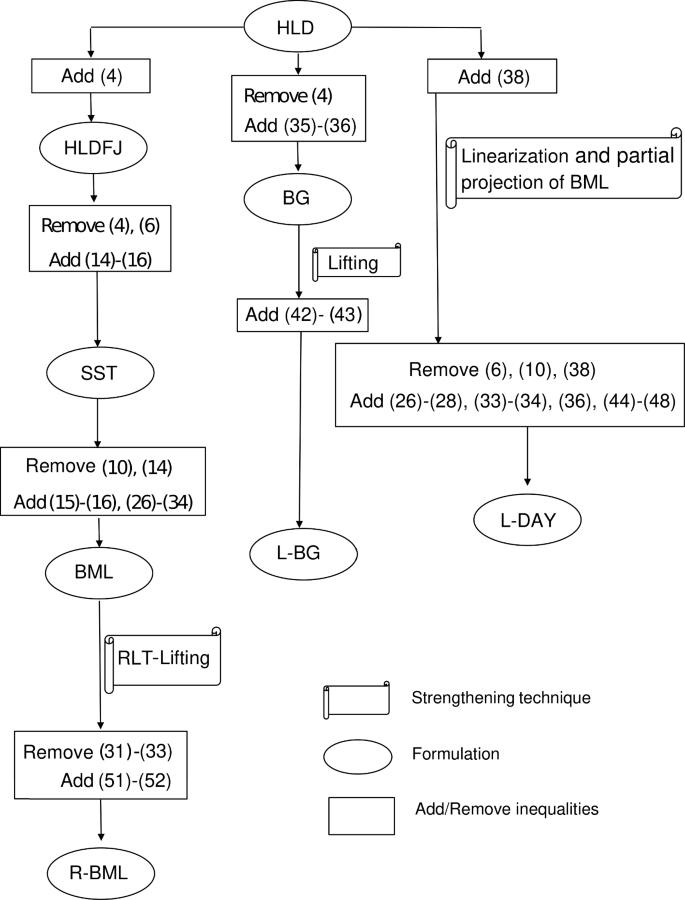
In the present paper, we address the target visitation problem, aiming to deliver first-aid medicine and necessary food to regions (called targets) suffering from natural disasters or conflicts. In addition, it has many applications for security and surveillance purposes. It consists of planning the tour of an unmanned aerial vehicle, which visits each target once. The objective considers the mutual priorities between the targets and the respective distances. From a theoretical point of view, the problem combines the traveling salesman and the linear ordering problems. We present formulations adapted and lifted from the literature of the traveling salesman. We enhance two particular models. We apply the lifting technique to the first model, which is related to a well-known node-based formulation. We further strengthen it by carrying out a partial projection of an existing multi-commodity flow formulation of the traveling salesman problem in an extended space. Alternatively, we perform a partial Reformulation-Linearization Technique to the same multicommodity flow-based model and obtain a stronger new formulation. For the latter, we develop a solution approach based on a cutting-plane fashion that successfully provided optimal solutions to all benchmark instances for the first time.
期刊介绍:
The Annals of Operations Research publishes peer-reviewed original articles dealing with key aspects of operations research, including theory, practice, and computation. The journal publishes full-length research articles, short notes, expositions and surveys, reports on computational studies, and case studies that present new and innovative practical applications.
In addition to regular issues, the journal publishes periodic special volumes that focus on defined fields of operations research, ranging from the highly theoretical to the algorithmic and the applied. These volumes have one or more Guest Editors who are responsible for collecting the papers and overseeing the refereeing process.

 求助内容:
求助内容: 应助结果提醒方式:

 京公网安备 11010802042870号


