{"title":"Super Active Region NOAA 13 664/13 697/13 723 of Solar Cycle 25 and Its Impact on Space Weather","authors":"M. N. Pasechnik, N. N. Kondrashova, S. N. Osipov","doi":"10.3103/S0884591326030037","DOIUrl":null,"url":null,"abstract":"<p>The temporal and spatial evolution and flare activity of the active region (AR) NOAA 13 664 and its impact on space weather have been analyzed. This AR was one of the largest and most active solar regions observed in the current, 25th solar cycle. The region appeared in the southern hemisphere of the solar disk on May 1, 2024. Its structure changed very rapidly: the number of sunspots was growing and the AR area increased. On May 6, a new small AR NOAA 13 668 formed on the eastern side of the AR. During the day, these two regions merged, resulting in the formation of a large-scale sunspot group 13 664/13 668 with a unique complexity structure. Starting on May 7, it had a multipolar magnetic field configuration Hale class βγδ. On May 8, solar flares of magnitude X1.0, M8.7, and M9.9 occurred in the AR, triggering coronal mass ejections (CMEs). Several large CMEs reached Earth on May 10, causing an extreme geomagnetic storm with bright auroras observed up to 18.1° north latitude. The storm lasted from May 10 to 12, causing a variety of space weather effects, and was given the highest category of G5. On May 11, it peaked with –412 nT Dst index, making it the strongest storm since 2003. In total, during the active region’s first pass across the Sun’s disk from May 1 to 15, it produced 48 C-class, 55 M-class, and 12 X-class flares. On May 14, AR13664 passed beyond the solar disk edge, and it appeared on the side of the Sun facing Earth and was renumbered as NOAA 13 697 on May 29. It was smaller in size and consisted of fewer spots, but its magnetic component remained Hale class βγδ. From May 31 to June 1, the AR produced three X-flares: X1.1, X1.4, and X1.0. Each of them was accompanied by CMEs that reduced the power of shortwave transmissions on all frequencies below 30 MHz. On June 8, radiation from the M9.8 flare ionized the Earth’s upper atmosphere, causing a deep shortwave radio blackout in the western Pacific Ocean. The flare also produced a moderate S2 radiation storm. During its second pass across the Sun’s disk from May 27 to June 10, AR produced 127 C-class flares, 30 M-class flares, and six X-class flares. On June 24, AR13 664/13 697 returned to view for the third time. It was renumbered NOAA 13 723. AR had already fragmented to a fraction of its former size, but its magnetic field remained Hale class βγδ. On June 23, the AR produced an M9.3 flare, the CME from which caused a moderate shortwave radio blackout in Western Europe and Africa. On June 25, the AR produced another M1.0 flare. The number of sunspots in AR gradually decreased and, starting on June 29, it had a Hale class of β. In total, AR13 723 produced 23 C-class flares and two M-class flares during its third pass across the Sun’s disk from June 24 to July 6. On May 9, 2024, spectrograms of the X2.3 class flare were recorded with the Ernest Gurtovenko Horizontal Solar Telescope of the Main Astronomical Observatory in Kyiv. The motion direction features and changes in the line-of-sight velocities of chromospheric and photospheric matter in one of nodes flare were analyzed. It was concluded that they were associated with the passage of chromospheric condensation and waves that were formed during the pulsed release of energy as a result of magnetic reconnections in the upper layers of the AR atmosphere. By studying the evolution of this hyperactive region NOAA 13 664/13 697/13 723 and its impact on Earth in detail, the authors are improving the ability to predict abrupt changes in solar activity and warn of the extreme space weather events they cause, such as extreme geomagnetic storms that affect people’s life quality.</p>","PeriodicalId":681,"journal":{"name":"Kinematics and Physics of Celestial Bodies","volume":"42 3","pages":"101 - 120"},"PeriodicalIF":0.4000,"publicationDate":"2026-05-08","publicationTypes":"Journal Article","fieldsOfStudy":null,"isOpenAccess":false,"openAccessPdf":"","citationCount":"0","resultStr":null,"platform":"Semanticscholar","paperid":null,"PeriodicalName":"Kinematics and Physics of Celestial Bodies","FirstCategoryId":"101","ListUrlMain":"https://link.springer.com/article/10.3103/S0884591326030037","RegionNum":4,"RegionCategory":"物理与天体物理","ArticlePicture":[],"TitleCN":null,"AbstractTextCN":null,"PMCID":null,"EPubDate":"","PubModel":"","JCR":"Q4","JCRName":"ASTRONOMY & ASTROPHYSICS","Score":null,"Total":0}
引用次数: 0
Abstract
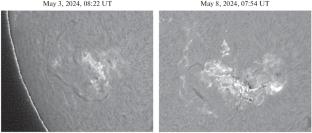
The temporal and spatial evolution and flare activity of the active region (AR) NOAA 13 664 and its impact on space weather have been analyzed. This AR was one of the largest and most active solar regions observed in the current, 25th solar cycle. The region appeared in the southern hemisphere of the solar disk on May 1, 2024. Its structure changed very rapidly: the number of sunspots was growing and the AR area increased. On May 6, a new small AR NOAA 13 668 formed on the eastern side of the AR. During the day, these two regions merged, resulting in the formation of a large-scale sunspot group 13 664/13 668 with a unique complexity structure. Starting on May 7, it had a multipolar magnetic field configuration Hale class βγδ. On May 8, solar flares of magnitude X1.0, M8.7, and M9.9 occurred in the AR, triggering coronal mass ejections (CMEs). Several large CMEs reached Earth on May 10, causing an extreme geomagnetic storm with bright auroras observed up to 18.1° north latitude. The storm lasted from May 10 to 12, causing a variety of space weather effects, and was given the highest category of G5. On May 11, it peaked with –412 nT Dst index, making it the strongest storm since 2003. In total, during the active region’s first pass across the Sun’s disk from May 1 to 15, it produced 48 C-class, 55 M-class, and 12 X-class flares. On May 14, AR13664 passed beyond the solar disk edge, and it appeared on the side of the Sun facing Earth and was renumbered as NOAA 13 697 on May 29. It was smaller in size and consisted of fewer spots, but its magnetic component remained Hale class βγδ. From May 31 to June 1, the AR produced three X-flares: X1.1, X1.4, and X1.0. Each of them was accompanied by CMEs that reduced the power of shortwave transmissions on all frequencies below 30 MHz. On June 8, radiation from the M9.8 flare ionized the Earth’s upper atmosphere, causing a deep shortwave radio blackout in the western Pacific Ocean. The flare also produced a moderate S2 radiation storm. During its second pass across the Sun’s disk from May 27 to June 10, AR produced 127 C-class flares, 30 M-class flares, and six X-class flares. On June 24, AR13 664/13 697 returned to view for the third time. It was renumbered NOAA 13 723. AR had already fragmented to a fraction of its former size, but its magnetic field remained Hale class βγδ. On June 23, the AR produced an M9.3 flare, the CME from which caused a moderate shortwave radio blackout in Western Europe and Africa. On June 25, the AR produced another M1.0 flare. The number of sunspots in AR gradually decreased and, starting on June 29, it had a Hale class of β. In total, AR13 723 produced 23 C-class flares and two M-class flares during its third pass across the Sun’s disk from June 24 to July 6. On May 9, 2024, spectrograms of the X2.3 class flare were recorded with the Ernest Gurtovenko Horizontal Solar Telescope of the Main Astronomical Observatory in Kyiv. The motion direction features and changes in the line-of-sight velocities of chromospheric and photospheric matter in one of nodes flare were analyzed. It was concluded that they were associated with the passage of chromospheric condensation and waves that were formed during the pulsed release of energy as a result of magnetic reconnections in the upper layers of the AR atmosphere. By studying the evolution of this hyperactive region NOAA 13 664/13 697/13 723 and its impact on Earth in detail, the authors are improving the ability to predict abrupt changes in solar activity and warn of the extreme space weather events they cause, such as extreme geomagnetic storms that affect people’s life quality.
期刊介绍:
Kinematics and Physics of Celestial Bodies is an international peer reviewed journal that publishes original regular and review papers on positional and theoretical astronomy, Earth’s rotation and geodynamics, dynamics and physics of bodies of the Solar System, solar physics, physics of stars and interstellar medium, structure and dynamics of the Galaxy, extragalactic astronomy, atmospheric optics and astronomical climate, instruments and devices, and mathematical processing of astronomical information. The journal welcomes manuscripts from all countries in the English or Russian language.

 求助内容:
求助内容: 应助结果提醒方式:

 京公网安备 11010802042870号


