{"title":"Development of a Reliable Numerical Model for a Process of Band Extrusion for Ceramic Roofing Tiles to Improve Durability of Forming Tools","authors":"M. Hawryluk, J. Marzec, L. Madej, K. Perzynski","doi":"10.1134/S1029959925600028","DOIUrl":null,"url":null,"abstract":"<p>The specifics of the ceramic industry processes result in high pressures acting on the set of forming tools, leading to intense wear, which directly affects production costs and increases environmental impact. Therefore, the analysis of improving the efficiency of the technological stage of clay band extrusion in the production process of ceramic roofing tiles, using a combination of laboratory, industrial, and numerical studies, is the subject of this work. Extensive laboratory and industrial studies on the operational durability of clay band forming tools demonstrated that the dominant mechanism of destruction is tribological wear, particularly intense abrasive wear. The work also emphasizes the need to enhance the interpretation of research results through the use of computer-aided design techniques for technology development. As part of the research, a comprehensive numerical model was developed, incorporating the definition of a constitutive model based on the Drucker-Prager equation, a rheological model of the studied material, and initial and boundary conditions reflecting the specifics of the extrusion process. A key aspect was developing the rheological model in a tabular form and based on the Hansel-Spittel equation. The friction conditions based on specially designed laboratory tests were also determined. The identification of the flow stress model parameters was carried out using inverse analysis techniques. The reliability of the proposed material model, as well as the model for the entire technological stage, was verified by comparing the calculation results with measurement results. The obtained numerical simulation results preliminarily indicate the correctness of the conducted research, as both the shape of the extruded band and the preliminary results of stress distributions in the formed mass and on the tools are acceptably consistent with experimental observations. Such a numerical model for simulating band extrusion in the production process of ceramic roofing tiles will enable a comprehensive and more in-depth analysis of tool wear, especially over a longer operational period. However, further verification of the modeling results is necessary, followed by additional research aimed at fine-tuning the numerical model to fully reflect the specifics of the studied process. It should be emphasized that the developed numerical model represents one of the first approaches to addressing this type of issue concerning the process of clay band extrusion through forming tools.</p>","PeriodicalId":726,"journal":{"name":"Physical Mesomechanics","volume":"29 2","pages":"251 - 273"},"PeriodicalIF":2.0000,"publicationDate":"2026-05-04","publicationTypes":"Journal Article","fieldsOfStudy":null,"isOpenAccess":false,"openAccessPdf":"","citationCount":"0","resultStr":null,"platform":"Semanticscholar","paperid":null,"PeriodicalName":"Physical Mesomechanics","FirstCategoryId":"88","ListUrlMain":"https://link.springer.com/article/10.1134/S1029959925600028","RegionNum":4,"RegionCategory":"材料科学","ArticlePicture":[],"TitleCN":null,"AbstractTextCN":null,"PMCID":null,"EPubDate":"","PubModel":"","JCR":"Q2","JCRName":"MATERIALS SCIENCE, CHARACTERIZATION & TESTING","Score":null,"Total":0}
引用次数: 0
Abstract
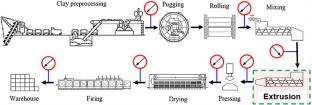
The specifics of the ceramic industry processes result in high pressures acting on the set of forming tools, leading to intense wear, which directly affects production costs and increases environmental impact. Therefore, the analysis of improving the efficiency of the technological stage of clay band extrusion in the production process of ceramic roofing tiles, using a combination of laboratory, industrial, and numerical studies, is the subject of this work. Extensive laboratory and industrial studies on the operational durability of clay band forming tools demonstrated that the dominant mechanism of destruction is tribological wear, particularly intense abrasive wear. The work also emphasizes the need to enhance the interpretation of research results through the use of computer-aided design techniques for technology development. As part of the research, a comprehensive numerical model was developed, incorporating the definition of a constitutive model based on the Drucker-Prager equation, a rheological model of the studied material, and initial and boundary conditions reflecting the specifics of the extrusion process. A key aspect was developing the rheological model in a tabular form and based on the Hansel-Spittel equation. The friction conditions based on specially designed laboratory tests were also determined. The identification of the flow stress model parameters was carried out using inverse analysis techniques. The reliability of the proposed material model, as well as the model for the entire technological stage, was verified by comparing the calculation results with measurement results. The obtained numerical simulation results preliminarily indicate the correctness of the conducted research, as both the shape of the extruded band and the preliminary results of stress distributions in the formed mass and on the tools are acceptably consistent with experimental observations. Such a numerical model for simulating band extrusion in the production process of ceramic roofing tiles will enable a comprehensive and more in-depth analysis of tool wear, especially over a longer operational period. However, further verification of the modeling results is necessary, followed by additional research aimed at fine-tuning the numerical model to fully reflect the specifics of the studied process. It should be emphasized that the developed numerical model represents one of the first approaches to addressing this type of issue concerning the process of clay band extrusion through forming tools.
期刊介绍:
The journal provides an international medium for the publication of theoretical and experimental studies and reviews related in the physical mesomechanics and also solid-state physics, mechanics, materials science, geodynamics, non-destructive testing and in a large number of other fields where the physical mesomechanics may be used extensively. Papers dealing with the processing, characterization, structure and physical properties and computational aspects of the mesomechanics of heterogeneous media, fracture mesomechanics, physical mesomechanics of materials, mesomechanics applications for geodynamics and tectonics, mesomechanics of smart materials and materials for electronics, non-destructive testing are viewed as suitable for publication.

 求助内容:
求助内容: 应助结果提醒方式:

 京公网安备 11010802042870号


