M. Danilaev, S. Karandashov, V. Kuklin, I. Sidorov, A. Enskaya
{"title":"Calculating the Effective Mechanical Properties of Polymer Composites with Dispersed Particles Based on the Particle Size Distribution","authors":"M. Danilaev, S. Karandashov, V. Kuklin, I. Sidorov, A. Enskaya","doi":"10.1134/S1029959924602215","DOIUrl":null,"url":null,"abstract":"<p>Development of adequate mathematic models of the mechanical properties of polymer composites with dispersed particles (PCDP) requires their verification. The following reasons complicate the verification of these mathematical models: lack of information on the mechanical properties of the transition layer at the boundary between the modified particle and the polymer; lack of information on the mechanical properties of the agglomerates that inevitably appear during the preparation of the PCDP. This study suggests a mathematical model for calculating effective mechanical properties (bulk modulus, shear modulus, Young’s modulus, and Poisson’s ratio) of the PCDP with encapsulated particles and verification of this model using PCDP samples with inclusions—nearly spherical dispersed aluminum oxide (Al<sub>2</sub>O<sub>3</sub>) particles that are not encapsulated and the particles encapsulated in a thin polymer shell. Equations for calculating the effective mechanical characteristics of these PCDPs are obtained. As demonstrated, the proposed model reliably provides the values of the bulk modulus, shear modulus, Young’s modulus and Poisson’s ratio of PCDPs with a small relative volume of dispersed submicron particles in the matrix.</p>","PeriodicalId":726,"journal":{"name":"Physical Mesomechanics","volume":"29 2","pages":"224 - 239"},"PeriodicalIF":2.0000,"publicationDate":"2026-05-04","publicationTypes":"Journal Article","fieldsOfStudy":null,"isOpenAccess":false,"openAccessPdf":"","citationCount":"0","resultStr":null,"platform":"Semanticscholar","paperid":null,"PeriodicalName":"Physical Mesomechanics","FirstCategoryId":"88","ListUrlMain":"https://link.springer.com/article/10.1134/S1029959924602215","RegionNum":4,"RegionCategory":"材料科学","ArticlePicture":[],"TitleCN":null,"AbstractTextCN":null,"PMCID":null,"EPubDate":"","PubModel":"","JCR":"Q2","JCRName":"MATERIALS SCIENCE, CHARACTERIZATION & TESTING","Score":null,"Total":0}
引用次数: 0
Abstract
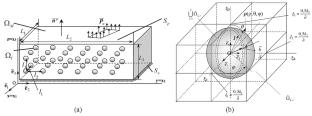
Development of adequate mathematic models of the mechanical properties of polymer composites with dispersed particles (PCDP) requires their verification. The following reasons complicate the verification of these mathematical models: lack of information on the mechanical properties of the transition layer at the boundary between the modified particle and the polymer; lack of information on the mechanical properties of the agglomerates that inevitably appear during the preparation of the PCDP. This study suggests a mathematical model for calculating effective mechanical properties (bulk modulus, shear modulus, Young’s modulus, and Poisson’s ratio) of the PCDP with encapsulated particles and verification of this model using PCDP samples with inclusions—nearly spherical dispersed aluminum oxide (Al2O3) particles that are not encapsulated and the particles encapsulated in a thin polymer shell. Equations for calculating the effective mechanical characteristics of these PCDPs are obtained. As demonstrated, the proposed model reliably provides the values of the bulk modulus, shear modulus, Young’s modulus and Poisson’s ratio of PCDPs with a small relative volume of dispersed submicron particles in the matrix.
期刊介绍:
The journal provides an international medium for the publication of theoretical and experimental studies and reviews related in the physical mesomechanics and also solid-state physics, mechanics, materials science, geodynamics, non-destructive testing and in a large number of other fields where the physical mesomechanics may be used extensively. Papers dealing with the processing, characterization, structure and physical properties and computational aspects of the mesomechanics of heterogeneous media, fracture mesomechanics, physical mesomechanics of materials, mesomechanics applications for geodynamics and tectonics, mesomechanics of smart materials and materials for electronics, non-destructive testing are viewed as suitable for publication.

 求助内容:
求助内容: 应助结果提醒方式:

 京公网安备 11010802042870号


