Giacomo Fantino, Antonio Vetro’, Marco Torchiano, Federica Cappelluti
{"title":"Beyond syntax: enhancing automated documentation with data differences","authors":"Giacomo Fantino, Antonio Vetro’, Marco Torchiano, Federica Cappelluti","doi":"10.1007/s10515-026-00623-y","DOIUrl":null,"url":null,"abstract":"<div><p>Modern software development automation is mostly based on AI, covering every aspect of code production and maintenance, throughout the entire software development lifecycle, from requirements and code writing to testing and maintenance. Code commenting is no exception. Automated code comment generation methods rely on static syntactic and lexical features of source code. However, these approaches frequently underperform in data-centric software applications, where understanding the effect of code on data is essential. We explore an execution-aware extension to automatic documentation generation. In this exploratory work, we aim at capturing post-execution data transformations (i.e., <i>semantic data differences)</i> that reveal the code’s effect on data, and use it as a complementary signal alongside existing code representations to automate explanatory comments for data wrangling code. We build a curated dataset of Python notebooks from Kaggle and apply a lightweight execution tracer to extract structured descriptions of runtime data transformations. We define a formal grammar for capturing these effects and integrate them into a multimodal encoder-decoder model using co-attention mechanisms. Multiple training strategies are explored to assess the impact of this new modality on comment generation. Our evaluation reveals that models incorporating this modality performed competitively with code-only baselines. Notably, in cases where no observable data transformation occurred, the presence of symbolic <span>\\(\\langle \\mathsf {no\\_diff} \\rangle\\)</span> signals led to improved robustness and higher comment quality, as measured by both automatic and human evaluation metrics. However, we did not observe improvements in comment quality in semantically rich scenarios, suggesting possible paths of improvement for future research direction. Qualitative analysis of generated comments supports this pattern, indicating that the modality helps stabilize comments by reducing unnecessary or speculative details in neutral cases, but does not provide yet consistent guidance when meaningful data transformations occur. These trends are less pronounced on a larger, noisier extended test set, suggesting sensitivity to comment–code alignment. Our study demonstrates the feasibility and potential of using execution-derived feedback as a complementary signal in automated comment generation. While the current approach is limited by dataset size and modality noise, it demonstrates that post-execution state changes can guide more context-aware and stable code summarization. This suggests a promising direction for execution-sensitive models in assisting data-centric software development and its documentation.</p></div>","PeriodicalId":55414,"journal":{"name":"Automated Software Engineering","volume":"33 3","pages":""},"PeriodicalIF":3.1000,"publicationDate":"2026-05-04","publicationTypes":"Journal Article","fieldsOfStudy":null,"isOpenAccess":false,"openAccessPdf":"https://link.springer.com/content/pdf/10.1007/s10515-026-00623-y.pdf","citationCount":"0","resultStr":null,"platform":"Semanticscholar","paperid":null,"PeriodicalName":"Automated Software Engineering","FirstCategoryId":"94","ListUrlMain":"https://link.springer.com/article/10.1007/s10515-026-00623-y","RegionNum":2,"RegionCategory":"计算机科学","ArticlePicture":[],"TitleCN":null,"AbstractTextCN":null,"PMCID":null,"EPubDate":"","PubModel":"","JCR":"Q3","JCRName":"COMPUTER SCIENCE, SOFTWARE ENGINEERING","Score":null,"Total":0}
引用次数: 0
Abstract
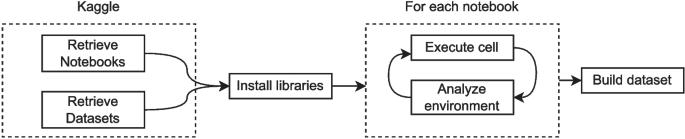
Modern software development automation is mostly based on AI, covering every aspect of code production and maintenance, throughout the entire software development lifecycle, from requirements and code writing to testing and maintenance. Code commenting is no exception. Automated code comment generation methods rely on static syntactic and lexical features of source code. However, these approaches frequently underperform in data-centric software applications, where understanding the effect of code on data is essential. We explore an execution-aware extension to automatic documentation generation. In this exploratory work, we aim at capturing post-execution data transformations (i.e., semantic data differences) that reveal the code’s effect on data, and use it as a complementary signal alongside existing code representations to automate explanatory comments for data wrangling code. We build a curated dataset of Python notebooks from Kaggle and apply a lightweight execution tracer to extract structured descriptions of runtime data transformations. We define a formal grammar for capturing these effects and integrate them into a multimodal encoder-decoder model using co-attention mechanisms. Multiple training strategies are explored to assess the impact of this new modality on comment generation. Our evaluation reveals that models incorporating this modality performed competitively with code-only baselines. Notably, in cases where no observable data transformation occurred, the presence of symbolic \(\langle \mathsf {no\_diff} \rangle\) signals led to improved robustness and higher comment quality, as measured by both automatic and human evaluation metrics. However, we did not observe improvements in comment quality in semantically rich scenarios, suggesting possible paths of improvement for future research direction. Qualitative analysis of generated comments supports this pattern, indicating that the modality helps stabilize comments by reducing unnecessary or speculative details in neutral cases, but does not provide yet consistent guidance when meaningful data transformations occur. These trends are less pronounced on a larger, noisier extended test set, suggesting sensitivity to comment–code alignment. Our study demonstrates the feasibility and potential of using execution-derived feedback as a complementary signal in automated comment generation. While the current approach is limited by dataset size and modality noise, it demonstrates that post-execution state changes can guide more context-aware and stable code summarization. This suggests a promising direction for execution-sensitive models in assisting data-centric software development and its documentation.
期刊介绍:
This journal details research, tutorial papers, survey and accounts of significant industrial experience in the foundations, techniques, tools and applications of automated software engineering technology. This includes the study of techniques for constructing, understanding, adapting, and modeling software artifacts and processes.
Coverage in Automated Software Engineering examines both automatic systems and collaborative systems as well as computational models of human software engineering activities. In addition, it presents knowledge representations and artificial intelligence techniques applicable to automated software engineering, and formal techniques that support or provide theoretical foundations. The journal also includes reviews of books, software, conferences and workshops.

 求助内容:
求助内容: 应助结果提醒方式:

 京公网安备 11010802042870号


