Jianbin Xu, Cheng Huang, Yutong Zeng, Jianguo Zhao, Tao Leng, Pin Yang
{"title":"Measuring security posture of NAS third-party packages ecosystem: an empirical analysis","authors":"Jianbin Xu, Cheng Huang, Yutong Zeng, Jianguo Zhao, Tao Leng, Pin Yang","doi":"10.1007/s10515-026-00615-y","DOIUrl":null,"url":null,"abstract":"<div>\n \n <p>Network-Attached Storage (NAS) devices are essential in the IoT ecosystem, widely used for enterprise data exchange and personal cloud storage. Managed via web-based interfaces and network file-sharing protocols, they are increasingly integrated with cloud services, making them vulnerable to cyber threats. While previous research has focused on NAS firmware and public port security, the security of NAS third-party packages remains largely unexplored. These packages, integrated through web services and APIs, introduce new attack surfaces. To address this gap, we propose NASScanner, an analysis framework for automated package collection, preprocessing, and security assessment. Using NASScanner, we conducted the first large-scale security measurement of NAS third-party packages, analyzing 1,489 packages—the largest dataset of its kind. Our study examined third-party component security, attack mitigation measures, and sensitive information exposure. Leveraging LLM-powered binary analysis (BinaryAI) performs semantic-level function similarity detection, enabling accurate identification of insecure third-party components. Our findings reveal critical security concerns: ① Extensive vulnerabilities. 689 packages contain 36,162 vulnerabilities linked to 4,167 distinct CVEs. ② Low mitigation implementation. Only 22.3% of packages employ Position Independent Executable for security. ③ Sensitive data exposure. 45.87% of packages risk data leaks, with 23,821 instances of direct exposure on the open internet. Our findings highlight significant security risks in NAS third-party packages and provide valuable insights to enhance NAS device security.</p>\n </div>","PeriodicalId":55414,"journal":{"name":"Automated Software Engineering","volume":"33 3","pages":""},"PeriodicalIF":3.1000,"publicationDate":"2026-05-04","publicationTypes":"Journal Article","fieldsOfStudy":null,"isOpenAccess":false,"openAccessPdf":"","citationCount":"0","resultStr":null,"platform":"Semanticscholar","paperid":null,"PeriodicalName":"Automated Software Engineering","FirstCategoryId":"94","ListUrlMain":"https://link.springer.com/article/10.1007/s10515-026-00615-y","RegionNum":2,"RegionCategory":"计算机科学","ArticlePicture":[],"TitleCN":null,"AbstractTextCN":null,"PMCID":null,"EPubDate":"","PubModel":"","JCR":"Q3","JCRName":"COMPUTER SCIENCE, SOFTWARE ENGINEERING","Score":null,"Total":0}
引用次数: 0
Abstract
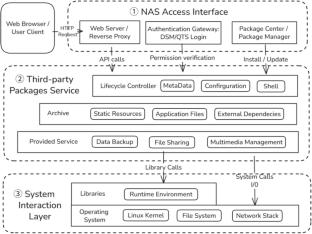
Network-Attached Storage (NAS) devices are essential in the IoT ecosystem, widely used for enterprise data exchange and personal cloud storage. Managed via web-based interfaces and network file-sharing protocols, they are increasingly integrated with cloud services, making them vulnerable to cyber threats. While previous research has focused on NAS firmware and public port security, the security of NAS third-party packages remains largely unexplored. These packages, integrated through web services and APIs, introduce new attack surfaces. To address this gap, we propose NASScanner, an analysis framework for automated package collection, preprocessing, and security assessment. Using NASScanner, we conducted the first large-scale security measurement of NAS third-party packages, analyzing 1,489 packages—the largest dataset of its kind. Our study examined third-party component security, attack mitigation measures, and sensitive information exposure. Leveraging LLM-powered binary analysis (BinaryAI) performs semantic-level function similarity detection, enabling accurate identification of insecure third-party components. Our findings reveal critical security concerns: ① Extensive vulnerabilities. 689 packages contain 36,162 vulnerabilities linked to 4,167 distinct CVEs. ② Low mitigation implementation. Only 22.3% of packages employ Position Independent Executable for security. ③ Sensitive data exposure. 45.87% of packages risk data leaks, with 23,821 instances of direct exposure on the open internet. Our findings highlight significant security risks in NAS third-party packages and provide valuable insights to enhance NAS device security.
期刊介绍:
This journal details research, tutorial papers, survey and accounts of significant industrial experience in the foundations, techniques, tools and applications of automated software engineering technology. This includes the study of techniques for constructing, understanding, adapting, and modeling software artifacts and processes.
Coverage in Automated Software Engineering examines both automatic systems and collaborative systems as well as computational models of human software engineering activities. In addition, it presents knowledge representations and artificial intelligence techniques applicable to automated software engineering, and formal techniques that support or provide theoretical foundations. The journal also includes reviews of books, software, conferences and workshops.

 求助内容:
求助内容: 应助结果提醒方式:

 京公网安备 11010802042870号


