A. V. Korchuganov, D. S. Kryzhevich, A. S. Grigoriev, O. A. Berezikov, K. P. Zolnikov
{"title":"Phase Transformations in Two–Phase Fe95Ni05 Alloys with Gradient–Grained Structure under Shock Loading","authors":"A. V. Korchuganov, D. S. Kryzhevich, A. S. Grigoriev, O. A. Berezikov, K. P. Zolnikov","doi":"10.1134/S1029959924602227","DOIUrl":null,"url":null,"abstract":"<p>A molecular dynamics study of structural and phase changes in bcc single crystals and Fe<sub>95</sub>Ni<sub>05</sub> samples with a two–phase gradient–grained structure under shock loading was performed. Grains of the simulated samples with the fcc lattice contained lamellas with a bcc structure and had a pronounced texture. It was shown that the shock wave profile splits into three fronts, which form three zones with characteristic structural rearrangements: elastic, plastic, and plastic/phase. Differences in the velocities of the three fronts lead to a change in the sizes of the formed zones during shock wave propagation. Thus, the size of the plastic change zone increases due to the lag of the plastic/phase rearrangement front. An increase in the grain size gradient of the sample due to smaller grains leads to a significant decrease in the size of the plastic zone. This behavior is due to the suppression of dislocation nucleation in small grains. It is shown that the orientation of the bcc lattice relative to the direction of the shock loading significantly affects the intensity of phase transformations. When the shock wave propagates along the [110] crystallographic direction, the most active phase transitions occur than for the [111] and [112] orientations. Release waves also initiate phase transformations behind the front of their propagation.</p>","PeriodicalId":726,"journal":{"name":"Physical Mesomechanics","volume":"29 2","pages":"182 - 196"},"PeriodicalIF":2.0000,"publicationDate":"2026-05-04","publicationTypes":"Journal Article","fieldsOfStudy":null,"isOpenAccess":false,"openAccessPdf":"","citationCount":"0","resultStr":null,"platform":"Semanticscholar","paperid":null,"PeriodicalName":"Physical Mesomechanics","FirstCategoryId":"88","ListUrlMain":"https://link.springer.com/article/10.1134/S1029959924602227","RegionNum":4,"RegionCategory":"材料科学","ArticlePicture":[],"TitleCN":null,"AbstractTextCN":null,"PMCID":null,"EPubDate":"","PubModel":"","JCR":"Q2","JCRName":"MATERIALS SCIENCE, CHARACTERIZATION & TESTING","Score":null,"Total":0}
引用次数: 0
Abstract
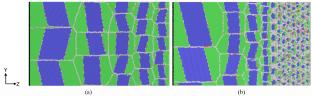
A molecular dynamics study of structural and phase changes in bcc single crystals and Fe95Ni05 samples with a two–phase gradient–grained structure under shock loading was performed. Grains of the simulated samples with the fcc lattice contained lamellas with a bcc structure and had a pronounced texture. It was shown that the shock wave profile splits into three fronts, which form three zones with characteristic structural rearrangements: elastic, plastic, and plastic/phase. Differences in the velocities of the three fronts lead to a change in the sizes of the formed zones during shock wave propagation. Thus, the size of the plastic change zone increases due to the lag of the plastic/phase rearrangement front. An increase in the grain size gradient of the sample due to smaller grains leads to a significant decrease in the size of the plastic zone. This behavior is due to the suppression of dislocation nucleation in small grains. It is shown that the orientation of the bcc lattice relative to the direction of the shock loading significantly affects the intensity of phase transformations. When the shock wave propagates along the [110] crystallographic direction, the most active phase transitions occur than for the [111] and [112] orientations. Release waves also initiate phase transformations behind the front of their propagation.
期刊介绍:
The journal provides an international medium for the publication of theoretical and experimental studies and reviews related in the physical mesomechanics and also solid-state physics, mechanics, materials science, geodynamics, non-destructive testing and in a large number of other fields where the physical mesomechanics may be used extensively. Papers dealing with the processing, characterization, structure and physical properties and computational aspects of the mesomechanics of heterogeneous media, fracture mesomechanics, physical mesomechanics of materials, mesomechanics applications for geodynamics and tectonics, mesomechanics of smart materials and materials for electronics, non-destructive testing are viewed as suitable for publication.

 求助内容:
求助内容: 应助结果提醒方式:

 京公网安备 11010802042870号


