{"title":"Structure and Properties of Ion-Plasma Coatings Based on Transition Metals and Their Nitrides Deposited on the Surface of Beryllium","authors":"N. V. Semenchuk, O. S. Novitskaya","doi":"10.1134/S1029959925600260","DOIUrl":null,"url":null,"abstract":"<p>The microstructure, phase composition, and tribological properties of coatings deposited on beryllium bronze to enhance its wear resistance were investigated. Composite and gradient Cu - Ti coatings, as well as single-layer and multilayer TiN and CrN / TiN coatings, were examined. It was found that composite and gradient Cu - Ti coatings exhibit a multiphase structure with either a uniform or gradient titanium distribution across the coating cross-section, depending on the ion-plasma spraying parameters. Multilayer CrN / TiN coatings displayed a well-defined layer periodicity, with individual layer thicknesses of 250 nm (16-layer coating) and 125 nm (32-layer coating). The single-layer TiN coating featured a columnar microstructure and had a total thickness of 4 μm. To enhance the adhesion of TiN and CrN coatings to the substrate, a Cu - Ti interlayer was applied, reducing interfacial stresses and improving bond strength. Scratch tests confirmed good adhesion for all coatings, with the coatings sustaining loads ranging from 10 N (single-layer and 16-layer coatings) up to 30 N (CrN coating with a Cu - Ti interlayer). Tribological tests revealed that most coatings wear via a microabrasive friction mechanism, except for the composite and gradient Cu - Ti coatings, which fail through an adhesive-brittle mechanism. The 32 - layer CrN / TiN coating and the coatings with a Cu - Ti interlayer exhibited the highest wear resistance. The findings demonstrate that multilayer architectures and Cu - Ti interlayers significantly enhance the mechanical and tribological properties of beryllium bronze coatings, making them promising for high-load and high-wear applications.</p>","PeriodicalId":726,"journal":{"name":"Physical Mesomechanics","volume":"29 2","pages":"240 - 250"},"PeriodicalIF":2.0000,"publicationDate":"2026-05-04","publicationTypes":"Journal Article","fieldsOfStudy":null,"isOpenAccess":false,"openAccessPdf":"","citationCount":"0","resultStr":null,"platform":"Semanticscholar","paperid":null,"PeriodicalName":"Physical Mesomechanics","FirstCategoryId":"88","ListUrlMain":"https://link.springer.com/article/10.1134/S1029959925600260","RegionNum":4,"RegionCategory":"材料科学","ArticlePicture":[],"TitleCN":null,"AbstractTextCN":null,"PMCID":null,"EPubDate":"","PubModel":"","JCR":"Q2","JCRName":"MATERIALS SCIENCE, CHARACTERIZATION & TESTING","Score":null,"Total":0}
引用次数: 0
Abstract
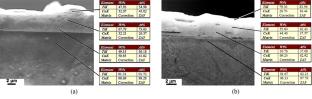
The microstructure, phase composition, and tribological properties of coatings deposited on beryllium bronze to enhance its wear resistance were investigated. Composite and gradient Cu - Ti coatings, as well as single-layer and multilayer TiN and CrN / TiN coatings, were examined. It was found that composite and gradient Cu - Ti coatings exhibit a multiphase structure with either a uniform or gradient titanium distribution across the coating cross-section, depending on the ion-plasma spraying parameters. Multilayer CrN / TiN coatings displayed a well-defined layer periodicity, with individual layer thicknesses of 250 nm (16-layer coating) and 125 nm (32-layer coating). The single-layer TiN coating featured a columnar microstructure and had a total thickness of 4 μm. To enhance the adhesion of TiN and CrN coatings to the substrate, a Cu - Ti interlayer was applied, reducing interfacial stresses and improving bond strength. Scratch tests confirmed good adhesion for all coatings, with the coatings sustaining loads ranging from 10 N (single-layer and 16-layer coatings) up to 30 N (CrN coating with a Cu - Ti interlayer). Tribological tests revealed that most coatings wear via a microabrasive friction mechanism, except for the composite and gradient Cu - Ti coatings, which fail through an adhesive-brittle mechanism. The 32 - layer CrN / TiN coating and the coatings with a Cu - Ti interlayer exhibited the highest wear resistance. The findings demonstrate that multilayer architectures and Cu - Ti interlayers significantly enhance the mechanical and tribological properties of beryllium bronze coatings, making them promising for high-load and high-wear applications.
期刊介绍:
The journal provides an international medium for the publication of theoretical and experimental studies and reviews related in the physical mesomechanics and also solid-state physics, mechanics, materials science, geodynamics, non-destructive testing and in a large number of other fields where the physical mesomechanics may be used extensively. Papers dealing with the processing, characterization, structure and physical properties and computational aspects of the mesomechanics of heterogeneous media, fracture mesomechanics, physical mesomechanics of materials, mesomechanics applications for geodynamics and tectonics, mesomechanics of smart materials and materials for electronics, non-destructive testing are viewed as suitable for publication.

 求助内容:
求助内容: 应助结果提醒方式:

 京公网安备 11010802042870号


