
Myotendinous Junction development and repair
IF 5.9
1区 医学
Q1 ORTHOPEDICS
Journal of Orthopaedic Translation
Pub Date : 2026-05-01
Epub Date: 2026-04-27
DOI:10.1016/j.jot.2026.101097
引用次数: 0
Abstract
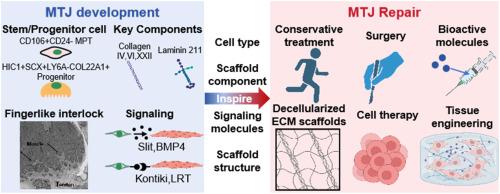
The myotendinous junction (MTJ) is the critical interface connecting muscle to tendon, enabling force transmission for movement and serving as the primary site of muscle injuries. Despite research into MTJ repair, treatment outcomes are suboptimal, partly due to the absence of a comprehensive synthesis of its structural components, cellular diversity, and developmental mechanisms, which impedes the rational selection of materials, cells, and regulatory factors for effective regeneration. This review synthesizes current knowledge on the cytoskeletal and extracellular matrix (ECM) architecture of the MTJ, the cell types involved in its development and repair, and the key molecular regulators governing its formation. We describe the hierarchical architecture of the MTJ and the key molecular complexes that mediate the mechanical connection between the muscle and the tendon. We also describe the roles of Col22a1-expressing muscle nuclei and various resident stem/progenitor cells in MTJ maintenance and healing. We discuss essential regulatory signaling pathways, including Slit, LRT, and BMP4. Furthermore, we evaluate existing MTJ repair strategies. Based on a review of MTJ development and injury repair, we observe that current treatment approaches largely fail to incorporate key insights from MTJ development, particularly regarding stem/progenitor cells and regulatory signals. Therefore, we propose that tissue engineering techniques, by integrating MTJ-resident stem/progenitor cells such as CD106+CD24−muscle-tendon progenitors (MTPs) and Hic1+Col22a1+ progenitors, key MTJ developmental regulatory signals like Slit, Lrt, and BMP4, as well as MTJ decellularized ECM scaffolds or biomimetic 3D-printed scaffolds, will substantially enhance the efficacy of MTJ repair therapies.
The Translational Potential of this Article
This review summarizes MTJ development across molecular linkages, signaling regulation, cellular composition, and tissue architecture, while assessing MTJ injury repair in terms of efficacy, mechanisms, limitations, and translational paths. Key barriers of MTJ repair include: conventional treatments (conservative and surgical) lacking high-quality data, RCTs, and unified guidelines for diverse patients; emerging approaches (bioactive factors, cell therapies, decellularized ECM scaffolds, tissue engineering) stuck at proof-of-concept or small-animal stages, without large-animal validation. It proposes establishing standardized cohorts, protocols, and parameters for conventional methods; accelerating large-animal safety/efficacy testing for emerging approaches to speed translation; constructing MTJ organoids based on key developmental cells and cues to provide a rapid drug testing platform for MTJ injury, thereby accelerating clinical translation; and integrating MTJ regulatory signals and stem/progenitor cells to enhance emerging therapy outcomes.
肌腱连接处的发育和修复
肌腱连接处(myotenous junction, MTJ)是连接肌肉与肌腱的关键界面,是实现运动力传递的重要部位,也是肌肉损伤的主要部位。尽管对MTJ修复进行了研究,但治疗效果并不理想,部分原因是缺乏对其结构成分、细胞多样性和发育机制的全面综合,这阻碍了材料、细胞和调节因子的合理选择,以实现有效的再生。本文综述了MTJ的细胞骨架和细胞外基质(ECM)结构、参与其发育和修复的细胞类型以及控制其形成的关键分子调控因子的最新知识。我们描述了MTJ的层次结构和介导肌肉和肌腱之间机械连接的关键分子复合物。我们还描述了表达col22a1的肌核和各种驻留干/祖细胞在MTJ维持和愈合中的作用。我们讨论了必不可少的调控信号通路,包括Slit、LRT和BMP4。此外,我们评估了现有的MTJ修复策略。基于对MTJ发育和损伤修复的回顾,我们观察到目前的治疗方法在很大程度上未能纳入MTJ发育的关键见解,特别是关于干细胞/祖细胞和调节信号。因此,我们提出组织工程技术,通过整合MTJ-驻地干细胞/祖细胞,如CD106+CD24−肌腱祖细胞(MTPs)和Hic1+Col22a1+祖细胞,关键MTJ发育调节信号如Slit, Lrt和BMP4,以及MTJ脱细胞ECM支架或仿生3d打印支架,将大大提高MTJ修复治疗的疗效。本文综述了MTJ在分子联系、信号调节、细胞组成和组织结构方面的发展,同时从MTJ损伤修复的功效、机制、局限性和翻译途径等方面进行了评估。MTJ修复的主要障碍包括:常规治疗(保守和手术)缺乏高质量的数据、随机对照试验和针对不同患者的统一指南;新兴方法(生物活性因子、细胞疗法、去细胞化ECM支架、组织工程)停留在概念验证或小动物阶段,没有大型动物验证。它建议为常规方法建立标准化的队列、协议和参数;加快大型动物安全性/有效性测试,以加快新方法的翻译速度;构建基于关键发育细胞和线索的MTJ类器官,为MTJ损伤提供快速药物检测平台,从而加速临床转化;整合MTJ调节信号和干细胞/祖细胞以提高新兴治疗效果。
本文章由计算机程序翻译,如有差异,请以英文原文为准。
求助全文
约1分钟内获得全文
求助全文
来源期刊
Journal of Orthopaedic Translation
Medicine-Orthopedics and Sports Medicine
CiteScore
11.80
自引率
13.60%
发文量
91
审稿时长
29 days
期刊介绍:
The Journal of Orthopaedic Translation (JOT) is the official peer-reviewed, open access journal of the Chinese Speaking Orthopaedic Society (CSOS) and the International Chinese Musculoskeletal Research Society (ICMRS). It is published quarterly, in January, April, July and October, by Elsevier.
 求助内容:
求助内容: 应助结果提醒方式:

 京公网安备 11010802042870号


