
Relationships between spectral and biological diversity depend on season and habitat type
IF 4.5
Q2 ENVIRONMENTAL SCIENCES
Remote Sensing Applications-Society and Environment
Pub Date : 2026-04-01
Epub Date: 2026-04-28
DOI:10.1016/j.rsase.2026.102039
引用次数: 0
Abstract
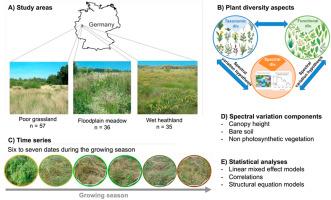
Remote sensing is increasingly used to monitor biodiversity, with spectral diversity—pixel-to-pixel variation in spectral reflectance—serving as a key proxy for taxonomic and functional diversity. However, seasonal dynamics and ecological drivers underlying spectral–biological diversity relationships remain less understood. This study examines seasonal patterns across three temperate open habitats in Germany—a nutrient-poor grassland, wet heathland, and floodplain meadow. We monitored 130 1 m2 plots over three seasons, measuring taxonomic diversity (Shannon, Simpson, inverse Simpson, Pielou's evenness, and species richness), functional diversity (functional dispersion, richness, evenness, divergence, Rao's Q), and four spectral diversity indices (average angle dissimilarity, coefficient of variation of whole spectra and optical traits, RaoQ) across narrow 166 wavelength regions, along with vegetation parameters. Data were collected on six to seven dates during the growing season using a field spectrometer to capture seasonal and trait variation. We employed linear mixed-effects and structural equation models to evaluate how spectral diversity reflects biodiversity over time and across habitats. Results suggested that these relationships vary across habitats and seasons. Vegetation structure — especially non-photosynthetic vegetation (NPV; senescent/litter) and canopy height — are linked to spectral and biological diversity through context-dependent pathways that vary across habitats and seasons. NPV was positively associated with spectral diversity in the grassland and floodplain, whereas canopy height showed temporally variable effects, enhancing functional diversity mid-season but exhibiting weaker or negative relationships in the heathland. These findings highlight that links between spectral and biological diversity are context dependent and vary with vegetation structure and season.
光谱和生物多样性之间的关系取决于季节和生境类型
遥感越来越多地用于监测生物多样性,光谱多样性(光谱反射率在像素间的变化)是分类和功能多样性的关键指标。然而,季节性动态和生态驱动因素背后的光谱-生物多样性关系仍然知之甚少。这项研究考察了德国三个温带开放栖息地的季节模式——营养贫乏的草原、潮湿的石南荒原和洪泛平原草甸。在3个季节对130个1 m2样地进行监测,测量了166个狭窄波长区域的分类多样性(Shannon、Simpson、inverse Simpson、Pielou均匀度和物种丰富度)、功能多样性(功能色散、丰富度、均匀度、散度、Rao’s Q)和4个光谱多样性指数(平均角度不相似度、全光谱和光学性状变异系数、RaoQ)以及植被参数。利用野外光谱仪收集了生长季节六到七个日期的数据,以捕捉季节和性状变化。我们采用线性混合效应和结构方程模型来评估光谱多样性如何随时间和不同栖息地反映生物多样性。结果表明,这些关系因栖息地和季节而异。植被结构——尤其是非光合植被(NPV;衰老/凋落物)和冠层高度——通过不同生境和季节的环境依赖途径与光谱和生物多样性联系在一起。在草地和洪泛平原,NPV与光谱多样性呈正相关,而冠层高度则表现出时间变化的效应,在季中增强了功能多样性,而在石楠地则表现出较弱或负相关。这些发现强调了光谱和生物多样性之间的联系依赖于环境,并随着植被结构和季节的变化而变化。
本文章由计算机程序翻译,如有差异,请以英文原文为准。
求助全文
约1分钟内获得全文
求助全文
来源期刊

CiteScore
8.00
自引率
8.50%
发文量
204
审稿时长
65 days
期刊介绍:
The journal ''Remote Sensing Applications: Society and Environment'' (RSASE) focuses on remote sensing studies that address specific topics with an emphasis on environmental and societal issues - regional / local studies with global significance. Subjects are encouraged to have an interdisciplinary approach and include, but are not limited by: " -Global and climate change studies addressing the impact of increasing concentrations of greenhouse gases, CO2 emission, carbon balance and carbon mitigation, energy system on social and environmental systems -Ecological and environmental issues including biodiversity, ecosystem dynamics, land degradation, atmospheric and water pollution, urban footprint, ecosystem management and natural hazards (e.g. earthquakes, typhoons, floods, landslides) -Natural resource studies including land-use in general, biomass estimation, forests, agricultural land, plantation, soils, coral reefs, wetland and water resources -Agriculture, food production systems and food security outcomes -Socio-economic issues including urban systems, urban growth, public health, epidemics, land-use transition and land use conflicts -Oceanography and coastal zone studies, including sea level rise projections, coastlines changes and the ocean-land interface -Regional challenges for remote sensing application techniques, monitoring and analysis, such as cloud screening and atmospheric correction for tropical regions -Interdisciplinary studies combining remote sensing, household survey data, field measurements and models to address environmental, societal and sustainability issues -Quantitative and qualitative analysis that documents the impact of using remote sensing studies in social, political, environmental or economic systems
 求助内容:
求助内容: 应助结果提醒方式:

 京公网安备 11010802042870号


