
Data-driven landscape scenicness mapping for continental-scale onshore wind resource assessment
IF 9.6
Q1 COMPUTER SCIENCE, ARTIFICIAL INTELLIGENCE
引用次数: 0
Abstract
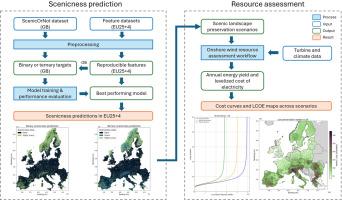
Visual impacts on scenic landscapes dominate public opposition to onshore wind turbines. Yet wind resource assessments often overlook landscape scenicness due to limited data availability. This study introduces a scalable machine learning framework for generating continental scenicness layers, trained on crowdsourced scenicness ratings from Great Britain and achieving high predictive performance. The resulting scenicness maps are integrated into an onshore wind resource assessment under three landscape preservation scenarios across 29 European countries. We show that prioritizing scenic landscapes in planning can reduce wind generation potential in certain countries by over 60%. However, it only modestly affects the continental median levelized costs of electricity (57 €/MWh and 54 €/MWh under low and high preservation scenarios), while substantially increasing regional costs in scenic mountainous regions such as the Alps and Norway. These findings demonstrate how data-driven approaches can enable socially aware and large-scale energy system planning.
基于数据驱动的陆地风力资源评价景观景观制图
对风景景观的视觉影响是公众反对陆上风力涡轮机的主要原因。然而,由于数据有限,风资源评估往往忽略了景观景观。本研究引入了一个可扩展的机器学习框架,用于生成大陆风景层,该框架接受了来自英国的众包风景评级的训练,并实现了高预测性能。在29个欧洲国家的三种景观保护方案下,将得到的景观地图整合到陆上风能资源评估中。我们的研究表明,在规划中优先考虑风景景观可以使某些国家的风力发电潜力降低60%以上。然而,它对大陆平均电力成本的影响不大(在低和高保护情景下分别为57欧元/兆瓦时和54欧元/兆瓦时),而在阿尔卑斯山和挪威等风景秀丽的山区,区域成本则大幅增加。这些发现证明了数据驱动的方法如何能够实现具有社会意识的大规模能源系统规划。
本文章由计算机程序翻译,如有差异,请以英文原文为准。
求助全文
约1分钟内获得全文
求助全文
来源期刊

Energy and AI
Engineering-Engineering (miscellaneous)
CiteScore
16.50
自引率
0.00%
发文量
64
审稿时长
56 days
 求助内容:
求助内容: 应助结果提醒方式:

 京公网安备 11010802042870号


