Xuanzheng Zhou, Yunchen Zhang, Yaping Sun, Wenjie Lv, Huiping Shao, Tao Lin
{"title":"Finite element simulation of the slurry printing process in material extrusion additive manufacturing","authors":"Xuanzheng Zhou, Yunchen Zhang, Yaping Sun, Wenjie Lv, Huiping Shao, Tao Lin","doi":"10.1007/s12289-026-02015-9","DOIUrl":null,"url":null,"abstract":"<div>\n \n <p>In this study, the material extrusion-based additive manufacturing process of TiC steel-bonded carbide slurries with solid contents ranging from 44 to 52 vol% was simulated using ANSYS Polyflow. The flow behavior, including shear stress and viscosity distribution within the barrel and nozzle, was analyzed to evaluate printability. The results show that printability initially improves with increasing solid content, peaking at 50 vol%, after which it declines. Simulation results were validated experimentally, showing good agreement. Optimal printing performance and product precision were achieved when the outlet viscosity ranged from 90 to 132 Pa·s at a printing speed of 10 mm/s. This study demonstrates that numerical simulation is an effective tool for optimizing printing parameters and improving print quality in material extrusion additive manufacturing.</p>\n </div>","PeriodicalId":591,"journal":{"name":"International Journal of Material Forming","volume":"19 2","pages":""},"PeriodicalIF":2.6000,"publicationDate":"2026-04-29","publicationTypes":"Journal Article","fieldsOfStudy":null,"isOpenAccess":false,"openAccessPdf":"","citationCount":"0","resultStr":null,"platform":"Semanticscholar","paperid":null,"PeriodicalName":"International Journal of Material Forming","FirstCategoryId":"88","ListUrlMain":"https://link.springer.com/article/10.1007/s12289-026-02015-9","RegionNum":3,"RegionCategory":"材料科学","ArticlePicture":[],"TitleCN":null,"AbstractTextCN":null,"PMCID":null,"EPubDate":"","PubModel":"","JCR":"Q2","JCRName":"ENGINEERING, MANUFACTURING","Score":null,"Total":0}
引用次数: 0
Abstract
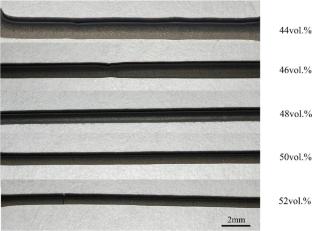
In this study, the material extrusion-based additive manufacturing process of TiC steel-bonded carbide slurries with solid contents ranging from 44 to 52 vol% was simulated using ANSYS Polyflow. The flow behavior, including shear stress and viscosity distribution within the barrel and nozzle, was analyzed to evaluate printability. The results show that printability initially improves with increasing solid content, peaking at 50 vol%, after which it declines. Simulation results were validated experimentally, showing good agreement. Optimal printing performance and product precision were achieved when the outlet viscosity ranged from 90 to 132 Pa·s at a printing speed of 10 mm/s. This study demonstrates that numerical simulation is an effective tool for optimizing printing parameters and improving print quality in material extrusion additive manufacturing.
期刊介绍:
The Journal publishes and disseminates original research in the field of material forming. The research should constitute major achievements in the understanding, modeling or simulation of material forming processes. In this respect ‘forming’ implies a deliberate deformation of material.
The journal establishes a platform of communication between engineers and scientists, covering all forming processes, including sheet forming, bulk forming, powder forming, forming in near-melt conditions (injection moulding, thixoforming, film blowing etc.), micro-forming, hydro-forming, thermo-forming, incremental forming etc. Other manufacturing technologies like machining and cutting can be included if the focus of the work is on plastic deformations.
All materials (metals, ceramics, polymers, composites, glass, wood, fibre reinforced materials, materials in food processing, biomaterials, nano-materials, shape memory alloys etc.) and approaches (micro-macro modelling, thermo-mechanical modelling, numerical simulation including new and advanced numerical strategies, experimental analysis, inverse analysis, model identification, optimization, design and control of forming tools and machines, wear and friction, mechanical behavior and formability of materials etc.) are concerned.

 求助内容:
求助内容: 应助结果提醒方式:

 京公网安备 11010802042870号


