Lauren Hunt, Maria Teresa Tancredi, Meredith T. Niles, Jennifer Jo Thompson
{"title":"Navigating the adoption spectrum: how U.S. farmers manage longevity, entirety, variability and complementarity of cover crops","authors":"Lauren Hunt, Maria Teresa Tancredi, Meredith T. Niles, Jennifer Jo Thompson","doi":"10.1007/s10460-026-10885-7","DOIUrl":null,"url":null,"abstract":"<div><p>Understanding how farmers adopt conservation farming practices is critical for advancing agricultural sustainability, yet adoption is often treated as a binary outcome. This binary view risks underestimating commitment by mislabeling adaptive management as disadoption, while overestimating environmental benefits by equating small trials with whole-farm adoption. To expand our understanding of adoption, we apply a multidimensional framework – capturing longevity, entirety, variability, and complementarity – to examine how farmers make decisions about cover crops as a focal conservation practice. Drawing on in-depth interviews with 86 farmers across nine U.S. states, we show that adoption is not a linear or uniform process, but a dynamic navigation of trade-offs. Farmers frequently described trialing and partial implementation as strategic resilience mechanisms, discontinuity as a response to shifting constraints rather than failure, and simplification or selective integration of practices as pathways to long-term viability. Complementary practices were often adopted to enhance ecological and economic synergies, reflecting systems-oriented decision-making rather than isolated practice uptake. Our findings advance understanding of adoption by demonstrating that binary adoption metrics fail to capture the lived reality of management. These insights have direct implications for refining cost-share program efficacy, interpreting ecological outcomes, and designing policies that support durable, whole-farm conservation strategies.</p></div>","PeriodicalId":7683,"journal":{"name":"Agriculture and Human Values","volume":"43 2","pages":""},"PeriodicalIF":4.3000,"publicationDate":"2026-04-28","publicationTypes":"Journal Article","fieldsOfStudy":null,"isOpenAccess":false,"openAccessPdf":"","citationCount":"0","resultStr":null,"platform":"Semanticscholar","paperid":null,"PeriodicalName":"Agriculture and Human Values","FirstCategoryId":"90","ListUrlMain":"https://link.springer.com/article/10.1007/s10460-026-10885-7","RegionNum":2,"RegionCategory":"社会学","ArticlePicture":[],"TitleCN":null,"AbstractTextCN":null,"PMCID":null,"EPubDate":"","PubModel":"","JCR":"Q1","JCRName":"AGRICULTURE, MULTIDISCIPLINARY","Score":null,"Total":0}
引用次数: 0
Abstract
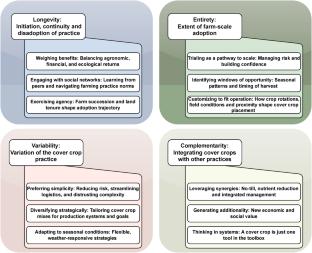
Understanding how farmers adopt conservation farming practices is critical for advancing agricultural sustainability, yet adoption is often treated as a binary outcome. This binary view risks underestimating commitment by mislabeling adaptive management as disadoption, while overestimating environmental benefits by equating small trials with whole-farm adoption. To expand our understanding of adoption, we apply a multidimensional framework – capturing longevity, entirety, variability, and complementarity – to examine how farmers make decisions about cover crops as a focal conservation practice. Drawing on in-depth interviews with 86 farmers across nine U.S. states, we show that adoption is not a linear or uniform process, but a dynamic navigation of trade-offs. Farmers frequently described trialing and partial implementation as strategic resilience mechanisms, discontinuity as a response to shifting constraints rather than failure, and simplification or selective integration of practices as pathways to long-term viability. Complementary practices were often adopted to enhance ecological and economic synergies, reflecting systems-oriented decision-making rather than isolated practice uptake. Our findings advance understanding of adoption by demonstrating that binary adoption metrics fail to capture the lived reality of management. These insights have direct implications for refining cost-share program efficacy, interpreting ecological outcomes, and designing policies that support durable, whole-farm conservation strategies.
期刊介绍:
Agriculture and Human Values is the journal of the Agriculture, Food, and Human Values Society. The Journal, like the Society, is dedicated to an open and free discussion of the values that shape and the structures that underlie current and alternative visions of food and agricultural systems.
To this end the Journal publishes interdisciplinary research that critically examines the values, relationships, conflicts and contradictions within contemporary agricultural and food systems and that addresses the impact of agricultural and food related institutions, policies, and practices on human populations, the environment, democratic governance, and social equity.

 求助内容:
求助内容: 应助结果提醒方式:

 京公网安备 11010802042870号


