Activation of nociceptin receptor attenuates methamphetamine motivation and relapse in rats: Involvement of phosphorylated CREB and Akt in the nucleus accumbens.
{"title":"Activation of nociceptin receptor attenuates methamphetamine motivation and relapse in rats: Involvement of phosphorylated CREB and Akt in the nucleus accumbens.","authors":"Yu-Jia Cai, Fang-Min Wang, Miao-Jun Lai, Yi-Ying Zhou, Ding-Ding Zhuang, Man-Qing Wu, Hui-Zhen Liu, Wen-Wen Shen, Wen-Hua Zhou","doi":"10.13294/j.aps.2026.0027","DOIUrl":null,"url":null,"abstract":"<p><p>Accumulating evidence has highlighted the functional role of the endogenous nociceptin/orphanin FQ peptide (N/OFQ) and its nociceptin opioid receptor (NOP) in alcohol and cocaine reward. However, the effects of NOP agonists on methamphetamine (MAP) reinforcement, motivation, and relapse remain uncertain. In this study, we evaluated the effects of Ro 64-6198, a selective NOP agonist, on MAP reinforcement, motivation, and relapse in rats. Rats underwent a fixed-ratio 1 (FR1) training to establish stable MAP intravenous self-administration (0.05 mg/kg/infusion) for 12 days, and the motivation for MAP was quantified using a progressive-ratio (PR) schedule, while the relapse was assessed through cue- and MAP-primed reinstatement after abstinence. Western blot analysis was employed to measure the relative expression of phosphorylated CREB, ERK, and Akt in the nucleus accumbens (NAc) following drug priming. Acute treatment of Ro 64-6198 (1 mg/kg) significantly reduced the motivated behavior for MAP under PR testing (<i>P</i> < 0.05 <i>vs.</i> vehicle). Ro 64-6198 at doses of 0.3 and 1 mg/kg could suppress the drug-seeking behavior induced by extinction or cues, respectively (<i>P</i> < 0.05), whereas only the higher dose (1 mg/kg) could attenuate MAP primed drug-seeking (<i>P</i> < 0.05). These behavioral effects were related to the upregulated phosphorylation of CREB and Akt in the NAc. Our results provide preclinical evidence that NOP activation disrupts multiple addiction-relevant behaviors, positioning Ro 64-6198 as a potential therapeutic candidate for treating MAP use disorders.</p>","PeriodicalId":7134,"journal":{"name":"生理学报","volume":"78 2","pages":"413-424"},"PeriodicalIF":0.0000,"publicationDate":"2026-04-25","publicationTypes":"Journal Article","fieldsOfStudy":null,"isOpenAccess":false,"openAccessPdf":"","citationCount":"0","resultStr":null,"platform":"Semanticscholar","paperid":null,"PeriodicalName":"生理学报","FirstCategoryId":"1087","ListUrlMain":"https://doi.org/10.13294/j.aps.2026.0027","RegionNum":0,"RegionCategory":null,"ArticlePicture":[],"TitleCN":null,"AbstractTextCN":null,"PMCID":null,"EPubDate":"","PubModel":"","JCR":"Q3","JCRName":"Medicine","Score":null,"Total":0}
引用次数: 0
Abstract
Accumulating evidence has highlighted the functional role of the endogenous nociceptin/orphanin FQ peptide (N/OFQ) and its nociceptin opioid receptor (NOP) in alcohol and cocaine reward. However, the effects of NOP agonists on methamphetamine (MAP) reinforcement, motivation, and relapse remain uncertain. In this study, we evaluated the effects of Ro 64-6198, a selective NOP agonist, on MAP reinforcement, motivation, and relapse in rats. Rats underwent a fixed-ratio 1 (FR1) training to establish stable MAP intravenous self-administration (0.05 mg/kg/infusion) for 12 days, and the motivation for MAP was quantified using a progressive-ratio (PR) schedule, while the relapse was assessed through cue- and MAP-primed reinstatement after abstinence. Western blot analysis was employed to measure the relative expression of phosphorylated CREB, ERK, and Akt in the nucleus accumbens (NAc) following drug priming. Acute treatment of Ro 64-6198 (1 mg/kg) significantly reduced the motivated behavior for MAP under PR testing (P < 0.05 vs. vehicle). Ro 64-6198 at doses of 0.3 and 1 mg/kg could suppress the drug-seeking behavior induced by extinction or cues, respectively (P < 0.05), whereas only the higher dose (1 mg/kg) could attenuate MAP primed drug-seeking (P < 0.05). These behavioral effects were related to the upregulated phosphorylation of CREB and Akt in the NAc. Our results provide preclinical evidence that NOP activation disrupts multiple addiction-relevant behaviors, positioning Ro 64-6198 as a potential therapeutic candidate for treating MAP use disorders.
期刊介绍:
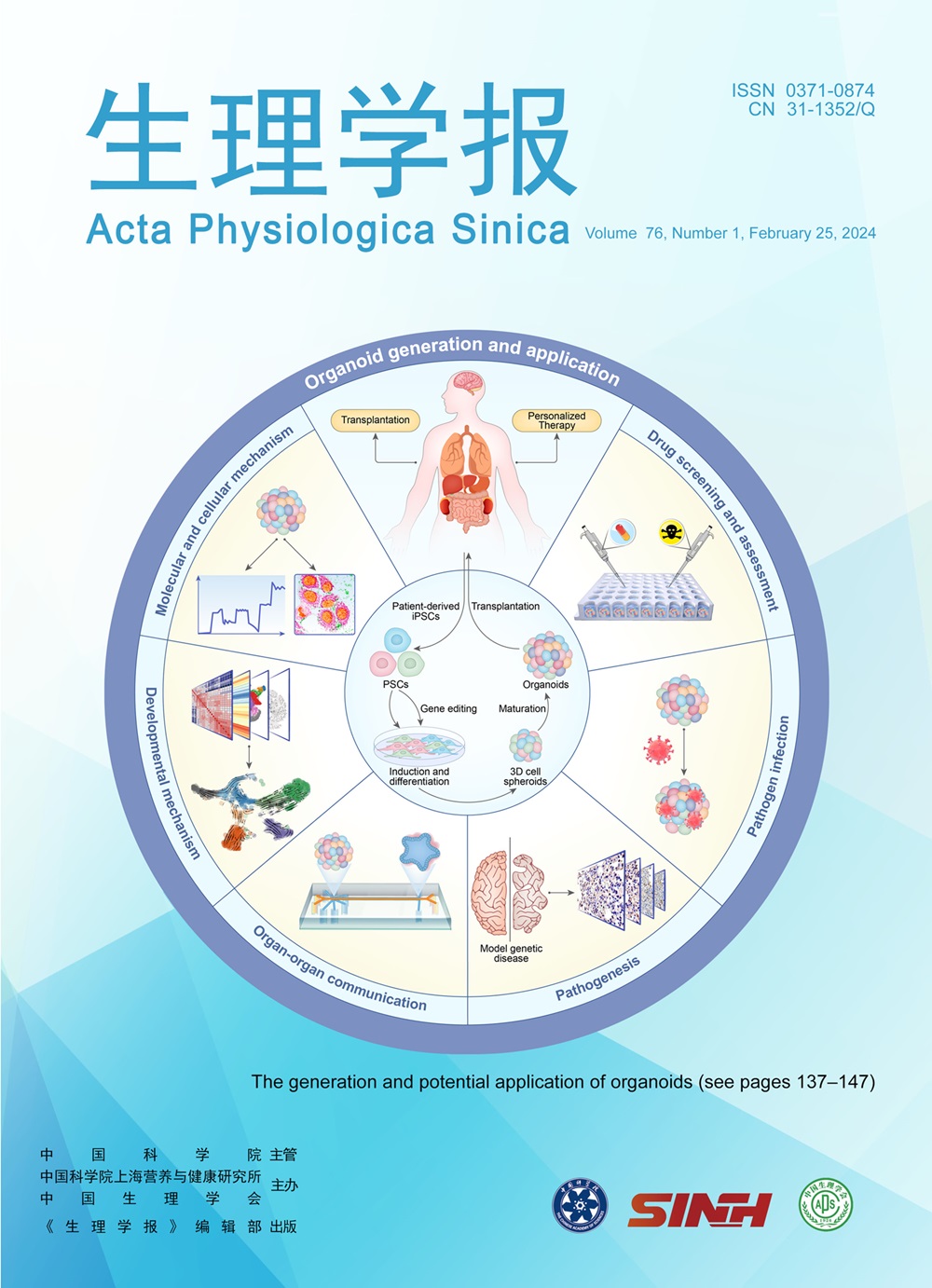
Acta Physiologica Sinica (APS) is sponsored by the Chinese Association for Physiological Sciences and Shanghai Institutes of Biological Sciences, Chinese Academy of Sciences (CAS), and is published bimonthly by the Science Press, China. APS publishes original research articles in the field of physiology as well as research contributions from other biomedical disciplines and proceedings of conferences and symposia of physiological sciences. Besides “Original Research Articles”, the journal also provides columns as “Brief Review”, “Rapid Communication”, “Experimental Technique”, and “Letter to the Editor”. Articles are published in either Chinese or English according to authors’ submission.

 求助内容:
 应助结果提醒方式:


 京公网安备 11010802042870号


