FTDP-17T Mutations Promote Formation of Phosphorylated FTDP-17T TAU Oligomers That Cause Degeneration of Dopaminergic and Hippocampal Neurons via Activating ER Stress and Mitochondrial Pro-apoptotic Cascades
{"title":"FTDP-17T Mutations Promote Formation of Phosphorylated FTDP-17T TAU Oligomers That Cause Degeneration of Dopaminergic and Hippocampal Neurons via Activating ER Stress and Mitochondrial Pro-apoptotic Cascades","authors":"Hung-Li Wang, Yi-Hsin Weng, Ching-Chi Chiu, Wan-Shia Chen, Shu-Yu Liu, Tu-Hsueh Yeh","doi":"10.1007/s11064-026-04761-3","DOIUrl":null,"url":null,"abstract":"<div><p>Heterozygous missense mutations of TAU cause frontotemporal dementia with parkinsonism linked to chromosome 17 with tau pathology (FTDP-17T). FTDP-17T neurodegeneration of hippocampal and substantia nigra dopaminergic cells causes dementia and parkinsonism motor deficits. FTDP-17T cellular model of mutant TAU-expressing differentiated dopaminergic or hippocampal neurons was utilized to test hypothesis that FTDP-17T (R5H), (N279K), (K298E), (P301S), (K317M) and (G389R) TAUs located in different domains of TAU cause neurodegeneration with the same pathomechanism. (R5H), (N279K), (K298E), (P301S), (K317M) and (G389R) TAUs caused degeneration of dopaminergic or hippocampal neurons via mutation-induced gain-of-neurotoxicity. (R5H), (N279K), (K298E), (P301S), (K317M) and (G389R) mutations promoted Ser<sup>202</sup>/Ser<sup>396</sup>/Ser<sup>404</sup> phosphorylations of TAU and formation of phospho-FTDP-17T TAU<sup>Ser202/Ser396/Ser404</sup> oligomers in dopaminergic or hippocampal neurons. GSK-3β inhibitor AR-A014418 completely blocked (R5H), (N279K), (K298E), (P301S), (K317M) and (G389R) TAUs-induced neurotoxicity by preventing (R5H), (N279K), (K298E), (P301S), (K317M) and (G389R) mutations-augmented Ser<sup>202</sup>/Ser<sup>396</sup>/Ser<sup>404</sup> phosphorylations and genesis of phospho-FTDP-17T TAU<sup>Ser202/Ser396/Ser404</sup> oligomers. Phospho-(R5H), phospho-(N279K), phospho-(K298E), phospho-(P301S), phospho-(K317M) or phospho-(G389R) TAU<sup>Ser202/Ser396/Ser404</sup> oligomers were found in ER of dopaminergic or hippocampal neurons and activated ER stress, UPR and ER stress apoptotic signaling. Overexpression of mitochondrial phospho-FTDP-17T TAU<sup>Ser202/Ser396/Ser404</sup> oligomers caused mitochondrial malfunction via depolarizing mitochondrial membrane potential and oxidative damage by increasing ROS. Phospho-FTDP-17T TAU<sup>Ser202/Ser396/Ser404</sup> oligomers-evoked upregulation of Noxa, Bim or Puma and mitochondrial defect and oxidative stress excited mitochondrial pro-apoptotic pathway. Our results suggest that shared pathomechanism underlying FTDP-17T (R5H), (N279K), (K298E), (P301S), (K317M) and (G389R) TAUs-induced neurotoxicity is mutation-augmented GSK-3β-mediated Ser<sup>202</sup>/Ser<sup>396</sup>/Ser<sup>404</sup> phosphorylations and generation of phospho-FTDP-17T TAU<sup>Ser202/Ser396/Ser404</sup> oligomers, which cause neurodegeneration by stimulating ER stress and mitochondrial pro-apoptotic cascades.</p></div>","PeriodicalId":719,"journal":{"name":"Neurochemical Research","volume":"51 3","pages":""},"PeriodicalIF":3.8000,"publicationDate":"2026-04-27","publicationTypes":"Journal Article","fieldsOfStudy":null,"isOpenAccess":false,"openAccessPdf":"","citationCount":"0","resultStr":null,"platform":"Semanticscholar","paperid":null,"PeriodicalName":"Neurochemical Research","FirstCategoryId":"3","ListUrlMain":"https://link.springer.com/article/10.1007/s11064-026-04761-3","RegionNum":3,"RegionCategory":"医学","ArticlePicture":[],"TitleCN":null,"AbstractTextCN":null,"PMCID":null,"EPubDate":"","PubModel":"","JCR":"Q2","JCRName":"BIOCHEMISTRY & MOLECULAR BIOLOGY","Score":null,"Total":0}
引用次数: 0
Abstract
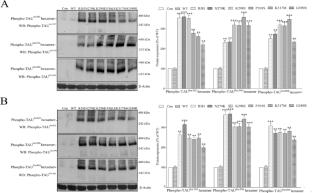
Heterozygous missense mutations of TAU cause frontotemporal dementia with parkinsonism linked to chromosome 17 with tau pathology (FTDP-17T). FTDP-17T neurodegeneration of hippocampal and substantia nigra dopaminergic cells causes dementia and parkinsonism motor deficits. FTDP-17T cellular model of mutant TAU-expressing differentiated dopaminergic or hippocampal neurons was utilized to test hypothesis that FTDP-17T (R5H), (N279K), (K298E), (P301S), (K317M) and (G389R) TAUs located in different domains of TAU cause neurodegeneration with the same pathomechanism. (R5H), (N279K), (K298E), (P301S), (K317M) and (G389R) TAUs caused degeneration of dopaminergic or hippocampal neurons via mutation-induced gain-of-neurotoxicity. (R5H), (N279K), (K298E), (P301S), (K317M) and (G389R) mutations promoted Ser202/Ser396/Ser404 phosphorylations of TAU and formation of phospho-FTDP-17T TAUSer202/Ser396/Ser404 oligomers in dopaminergic or hippocampal neurons. GSK-3β inhibitor AR-A014418 completely blocked (R5H), (N279K), (K298E), (P301S), (K317M) and (G389R) TAUs-induced neurotoxicity by preventing (R5H), (N279K), (K298E), (P301S), (K317M) and (G389R) mutations-augmented Ser202/Ser396/Ser404 phosphorylations and genesis of phospho-FTDP-17T TAUSer202/Ser396/Ser404 oligomers. Phospho-(R5H), phospho-(N279K), phospho-(K298E), phospho-(P301S), phospho-(K317M) or phospho-(G389R) TAUSer202/Ser396/Ser404 oligomers were found in ER of dopaminergic or hippocampal neurons and activated ER stress, UPR and ER stress apoptotic signaling. Overexpression of mitochondrial phospho-FTDP-17T TAUSer202/Ser396/Ser404 oligomers caused mitochondrial malfunction via depolarizing mitochondrial membrane potential and oxidative damage by increasing ROS. Phospho-FTDP-17T TAUSer202/Ser396/Ser404 oligomers-evoked upregulation of Noxa, Bim or Puma and mitochondrial defect and oxidative stress excited mitochondrial pro-apoptotic pathway. Our results suggest that shared pathomechanism underlying FTDP-17T (R5H), (N279K), (K298E), (P301S), (K317M) and (G389R) TAUs-induced neurotoxicity is mutation-augmented GSK-3β-mediated Ser202/Ser396/Ser404 phosphorylations and generation of phospho-FTDP-17T TAUSer202/Ser396/Ser404 oligomers, which cause neurodegeneration by stimulating ER stress and mitochondrial pro-apoptotic cascades.
期刊介绍:
Neurochemical Research is devoted to the rapid publication of studies that use neurochemical methodology in research on nervous system structure and function. The journal publishes original reports of experimental and clinical research results, perceptive reviews of significant problem areas in the neurosciences, brief comments of a methodological or interpretive nature, and research summaries conducted by leading scientists whose works are not readily available in English.

 求助内容:
求助内容: 应助结果提醒方式:

 京公网安备 11010802042870号


