
Turn-on fluorescence switching and radical formation of a dual-functional negative photochromic dimethyldihydropyrene
IF 7.4
1区 化学
Q1 CHEMISTRY, MULTIDISCIPLINARY
引用次数: 0
Abstract
High-contrast fluorescent switchable systems are highly coveted dyes for bioimaging. Here, we report a molecular system that integrates reversible fluorescence modulation and, in addition, radical formation in a series of covalently linked triphenylamine(TPA)-dimethyldihydropyrene(DHP) photochromic systems. The DHP units having different substitutions directly alter the electron-density of the photochromic unit, thereby regulating electronic communication TPA. Photoinduced ring opening of the DHP core activates a charge transfer pathway, resulting in a dramatic enhancement of fluorescence, as reflected in the enhancement of quantum yield from 0.01 to 0.31. The emission can be reversibly turned-off by ultraviolet irradiation or heating. Importantly, the bright state is accessed using visible light, making this negative photochromic system particularly attractive for bioimaging applications. Beyond emission control, irradiation of the same molecule at 370 nm in chloroform generates a long-lived radical. The coexistence of controlled fluorescence switching and radical formation highlights the potential of this design strategy to create multifunctional molecular systems. Such bifunctional platforms open new opportunities for accessing optical readout and chemical activity on demand within a single molecular scaffold.双功能负光致变色二甲基二氢芘的开启荧光开关和自由基形成
高对比度可切换荧光系统是生物成像非常令人垂涎的染料。在这里,我们报道了一个分子系统,集成了可逆荧光调制,此外,自由基形成在一系列共价连接的三苯胺(TPA)-二甲基二氢芘(DHP)光致变色系统。具有不同取代的DHP单元直接改变光致变色单元的电子密度,从而调节电子通信TPA。光诱导DHP核开环激活电荷转移途径,导致荧光显著增强,量子产率从0.01提高到0.31。这种辐射可以通过紫外线照射或加热可逆地关闭。重要的是,使用可见光访问明亮状态,使这种负光致变色系统对生物成像应用特别有吸引力。在释放控制之外,在氯仿中辐照同一分子370 nm产生长寿命的自由基。可控荧光开关和自由基形成的共存突出了这种设计策略创建多功能分子系统的潜力。这种双功能平台为在单个分子支架内按需获取光学读数和化学活性提供了新的机会。
本文章由计算机程序翻译,如有差异,请以英文原文为准。
求助全文
约1分钟内获得全文
求助全文
来源期刊
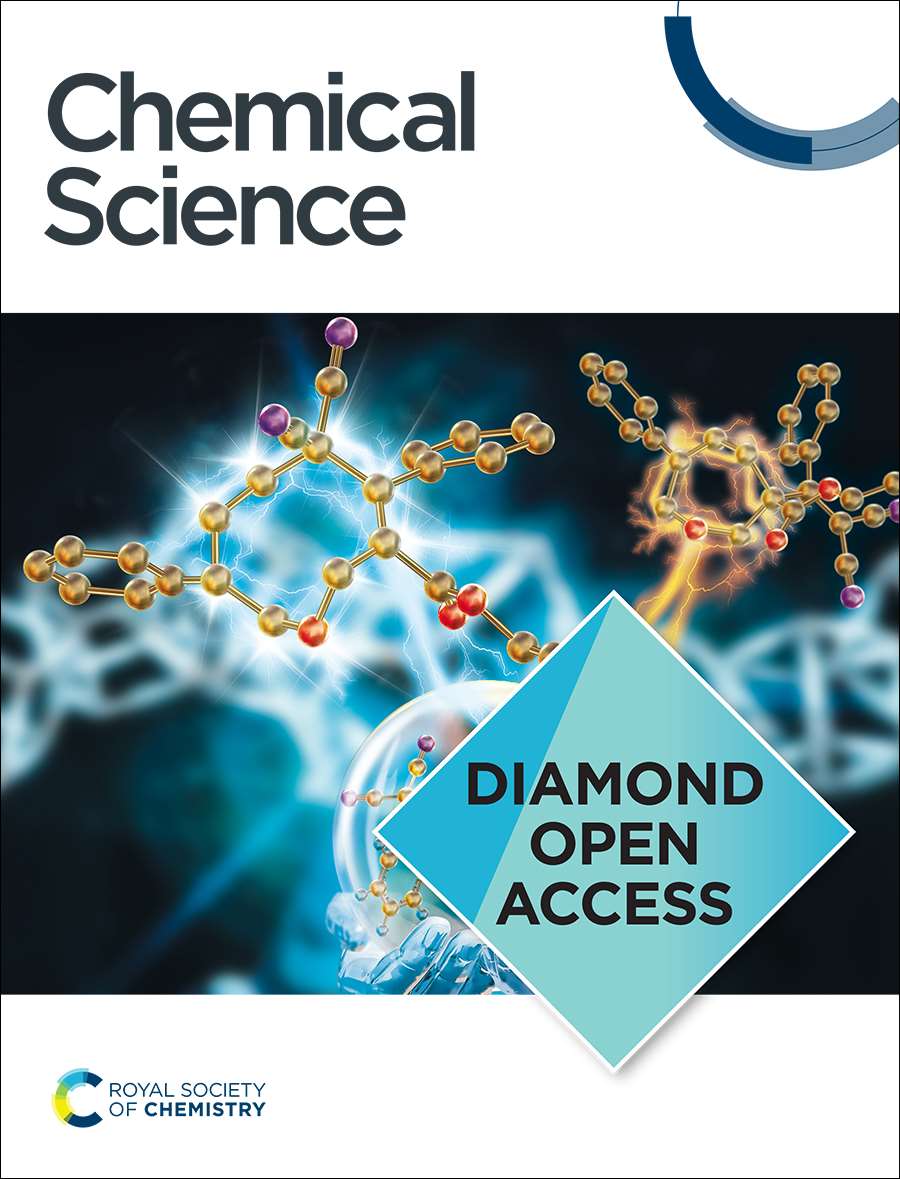
Chemical Science
CHEMISTRY, MULTIDISCIPLINARY-
CiteScore
14.40
自引率
4.80%
发文量
1352
审稿时长
2.1 months
期刊介绍:
Chemical Science is a journal that encompasses various disciplines within the chemical sciences. Its scope includes publishing ground-breaking research with significant implications for its respective field, as well as appealing to a wider audience in related areas. To be considered for publication, articles must showcase innovative and original advances in their field of study and be presented in a manner that is understandable to scientists from diverse backgrounds. However, the journal generally does not publish highly specialized research.
 求助内容:
求助内容: 应助结果提醒方式:

 京公网安备 11010802042870号


