
NOEM: efficient and scalable finite element method enabled by reusable neural operators

IF 18.3 Q1 COMPUTER SCIENCE, INTERDISCIPLINARY APPLICATIONS
Weihang Ouyang, Yeonjong Shin, Si-Wei Liu, Lu Lu
{"title":"NOEM: efficient and scalable finite element method enabled by reusable neural operators","authors":"Weihang Ouyang, Yeonjong Shin, Si-Wei Liu, Lu Lu","doi":"10.1038/s43588-026-00974-2","DOIUrl":null,"url":null,"abstract":"The finite element method (FEM) is a well-established numerical method for solving partial differential equations (PDEs). However, its mesh-based nature gives rise to substantial computational costs, especially for complex multiscale simulations. Emerging machine learning-based methods provide data-driven solutions to PDEs, yet they present challenges, including high training cost and low model reusability. Here we propose the neural-operator element method (NOEM) by synergistically combining FEM with operator learning to address these challenges. NOEM leverages neural operators to simulate subdomains that require fine meshes in FEM. In each subdomain, a neural operator is used to build a single element, namely, a neural-operator element (NOE). NOEs are then integrated with standard finite elements to represent the entire solution through the variational framework. Thereby, NOEM does not necessitate dense meshing and offers efficient simulations. We demonstrate the accuracy, efficiency and scalability of NOEM by performing systematic theoretical analysis and numerical experiments, such as nonlinear PDEs, multiscale problems, PDEs on complex geometries and discontinuous coefficient fields. The authors propose a method that unifies finite element methods and machine learning by using neural operators as elements to model complex subdomains, yielding an efficient and scalable numerical framework with highly reusable machine learning models.","PeriodicalId":74246,"journal":{"name":"Nature computational science","volume":"6 4","pages":"417-429"},"PeriodicalIF":18.3000,"publicationDate":"2026-04-28","publicationTypes":"Journal Article","fieldsOfStudy":null,"isOpenAccess":false,"openAccessPdf":"","citationCount":"0","resultStr":null,"platform":"Semanticscholar","paperid":null,"PeriodicalName":"Nature computational science","FirstCategoryId":"1085","ListUrlMain":"https://www.nature.com/articles/s43588-026-00974-2","RegionNum":0,"RegionCategory":null,"ArticlePicture":[],"TitleCN":null,"AbstractTextCN":null,"PMCID":null,"EPubDate":"","PubModel":"","JCR":"Q1","JCRName":"COMPUTER SCIENCE, INTERDISCIPLINARY APPLICATIONS","Score":null,"Total":0}
引用次数: 0

Abstract

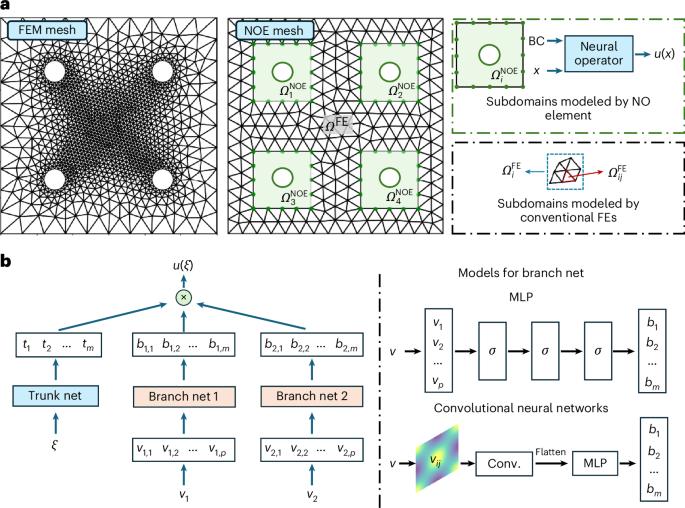
The finite element method (FEM) is a well-established numerical method for solving partial differential equations (PDEs). However, its mesh-based nature gives rise to substantial computational costs, especially for complex multiscale simulations. Emerging machine learning-based methods provide data-driven solutions to PDEs, yet they present challenges, including high training cost and low model reusability. Here we propose the neural-operator element method (NOEM) by synergistically combining FEM with operator learning to address these challenges. NOEM leverages neural operators to simulate subdomains that require fine meshes in FEM. In each subdomain, a neural operator is used to build a single element, namely, a neural-operator element (NOE). NOEs are then integrated with standard finite elements to represent the entire solution through the variational framework. Thereby, NOEM does not necessitate dense meshing and offers efficient simulations. We demonstrate the accuracy, efficiency and scalability of NOEM by performing systematic theoretical analysis and numerical experiments, such as nonlinear PDEs, multiscale problems, PDEs on complex geometries and discontinuous coefficient fields. The authors propose a method that unifies finite element methods and machine learning by using neural operators as elements to model complex subdomains, yielding an efficient and scalable numerical framework with highly reusable machine learning models.
Abstract Image

NOEM:由可重复使用的神经算子实现的高效和可扩展的有限元方法
有限元法是求解偏微分方程的一种行之有效的数值方法。然而,其基于网格的性质导致了大量的计算成本,特别是对于复杂的多尺度模拟。新兴的基于机器学习的方法为pde提供了数据驱动的解决方案,但它们也面临着挑战,包括高培训成本和低模型可重用性。在这里,我们提出了神经算子单元法(NOEM),通过协同结合有限元和算子学习来解决这些挑战。NOEM利用神经算子来模拟有限元中需要精细网格的子域。在每个子域中,使用神经算子构建单个元素,即神经算子元素(NOE)。然后将noe与标准有限元相结合,通过变分框架表示整个解。因此,NOEM不需要密集的网格划分,并提供有效的模拟。通过对非线性偏微分方程、多尺度问题、复杂几何和不连续系数场的偏微分方程进行系统的理论分析和数值实验,证明了NOEM的准确性、效率和可扩展性。作者提出了一种结合有限元方法和机器学习的方法,通过使用神经算子作为元素来建模复杂的子域,从而产生具有高度可重用机器学习模型的高效可扩展数值框架。
本文章由计算机程序翻译,如有差异,请以英文原文为准。
求助全文
约1分钟内获得全文 求助全文
来源期刊
CiteScore
11.70
自引率
0.00%
发文量
0
×
引用
GB/T 7714-2015
复制
MLA
复制
APA
复制
导出至
BibTeX EndNote RefMan NoteFirst NoteExpress
×
提示
您的信息不完整,为了账户安全,请先补充。
现在去补充
×
提示
您因"违规操作"
具体请查看互助需知
我知道了
×
提示
确定
请完成安全验证×
copy
已复制链接
快去分享给好友吧!
我知道了
右上角分享
点击右上角分享
0
联系我们:info@booksci.cn Book学术提供免费学术资源搜索服务,方便国内外学者检索中英文文献。致力于提供最便捷和优质的服务体验。 Copyright © 2023 布克学术 All rights reserved.
京ICP备2023020795号-1
ghs 京公网安备 11010802042870号
Book学术文献互助
Book学术文献互助群
群 号:604180095
Book学术官方微信
小红书



