Koon Mook Kang, Abigail L. Vargas, Wei Zhu, Inna Sokolenko, Dali Liu, Richard B. Silverman
{"title":"Inactivation of ornithine aminotransferase by (1R,4S)-4-Amino-3-(trifluoromethyl)cyclopent-2-ene-1-carboxylic acid via a stable quinonoid intermediate","authors":"Koon Mook Kang, Abigail L. Vargas, Wei Zhu, Inna Sokolenko, Dali Liu, Richard B. Silverman","doi":"10.1007/s00044-026-03538-1","DOIUrl":null,"url":null,"abstract":"<div><p>Ornithine aminotransferase (OAT), a pyridoxal 5’-phosphate (PLP)-dependent enzyme, is a key contributor to glutamine supply in cancer cells, suggesting its therapeutic potential for hepatocellular carcinoma (HCC), the most common form of liver cancer. To identify an initial set of OAT inactivators, we have tested inactivators of γ-aminobutyric acid aminotransferase (GABA-AT), a homologous PLP-dependent enzyme, with human OAT (<i>h</i>OAT) and identified several co-inactivators. Among the active molecules, (1<i>R</i>,4<i>S</i>)-4-amino-3-(trifluoromethyl)cyclopent-2-ene-1-carboxylic acid (<b>2</b>) has not been thoroughly investigated for its time-dependent kinetics and mechanistic pathways with OAT. In this study, we evaluated the time-dependent inactivation of <i>h</i>OAT by <b>2</b> and investigated the underlying mechanism, primarily based on X-ray crystallography. The results demonstrated that <b>2</b> acts as a time-dependent OAT inactivator with an inactivation efficiency (<i>k</i><sub>inact</sub>/<i>K</i><sub>I</sub> = 5.1 min<sup>−1</sup>mM<sup>−1</sup>) approximately 30-fold higher than that for GABA-AT (<i>k</i><sub>inact</sub>/<i>K</i><sub>I</sub> = 0.17 min<sup>−1</sup>mM<sup>−1</sup>) and, notably, revealed an inactivation pathway that proceeds via a stable quinonoid intermediate, as evidenced by the UV-Vis spectroscopy.</p><div><figure><div><div><picture><source><img></source></picture><span>The alternative text for this image may have been generated using AI.</span></div></div></figure></div></div>","PeriodicalId":699,"journal":{"name":"Medicinal Chemistry Research","volume":"35 4","pages":"792 - 803"},"PeriodicalIF":3.5000,"publicationDate":"2026-03-15","publicationTypes":"Journal Article","fieldsOfStudy":null,"isOpenAccess":false,"openAccessPdf":"https://link.springer.com/content/pdf/10.1007/s00044-026-03538-1.pdf","citationCount":"0","resultStr":null,"platform":"Semanticscholar","paperid":null,"PeriodicalName":"Medicinal Chemistry Research","FirstCategoryId":"3","ListUrlMain":"https://link.springer.com/article/10.1007/s00044-026-03538-1","RegionNum":4,"RegionCategory":"医学","ArticlePicture":[],"TitleCN":null,"AbstractTextCN":null,"PMCID":null,"EPubDate":"","PubModel":"","JCR":"Q3","JCRName":"CHEMISTRY, MEDICINAL","Score":null,"Total":0}
引用次数: 0
Abstract
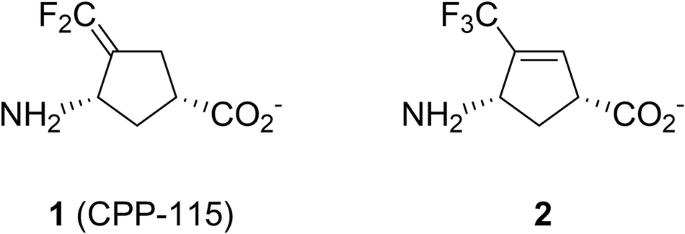
Ornithine aminotransferase (OAT), a pyridoxal 5’-phosphate (PLP)-dependent enzyme, is a key contributor to glutamine supply in cancer cells, suggesting its therapeutic potential for hepatocellular carcinoma (HCC), the most common form of liver cancer. To identify an initial set of OAT inactivators, we have tested inactivators of γ-aminobutyric acid aminotransferase (GABA-AT), a homologous PLP-dependent enzyme, with human OAT (hOAT) and identified several co-inactivators. Among the active molecules, (1R,4S)-4-amino-3-(trifluoromethyl)cyclopent-2-ene-1-carboxylic acid (2) has not been thoroughly investigated for its time-dependent kinetics and mechanistic pathways with OAT. In this study, we evaluated the time-dependent inactivation of hOAT by 2 and investigated the underlying mechanism, primarily based on X-ray crystallography. The results demonstrated that 2 acts as a time-dependent OAT inactivator with an inactivation efficiency (kinact/KI = 5.1 min−1mM−1) approximately 30-fold higher than that for GABA-AT (kinact/KI = 0.17 min−1mM−1) and, notably, revealed an inactivation pathway that proceeds via a stable quinonoid intermediate, as evidenced by the UV-Vis spectroscopy.
The alternative text for this image may have been generated using AI.
期刊介绍:
Medicinal Chemistry Research (MCRE) publishes papers on a wide range of topics, favoring research with significant, new, and up-to-date information. Although the journal has a demanding peer review process, MCRE still boasts rapid publication, due in part, to the length of the submissions. The journal publishes significant research on various topics, many of which emphasize the structure-activity relationships of molecular biology.

 求助内容:
求助内容: 应助结果提醒方式:

 京公网安备 11010802042870号


