Yoonsu Kim, Minjung Cho, Yunju Woo, Jihyeon Park, Ji Sun Lim, Jeong Soon Lee, Jisun Oh
{"title":"Oral administration of evening primrose leaf extract improves cognitive impairment in 5xFAD transgenic mice","authors":"Yoonsu Kim, Minjung Cho, Yunju Woo, Jihyeon Park, Ji Sun Lim, Jeong Soon Lee, Jisun Oh","doi":"10.1007/s10068-026-02124-w","DOIUrl":null,"url":null,"abstract":"<div><p>This study investigated the cognitive benefits of <i>Oenothera biennis L.</i> (evening primrose) leaf (EPL) ethanolic extract in 5xFAD mice, a transgenic model of Alzheimer's disease (AD). Starting at two months of age, mice orally received EPL extract (100 or 200 mg/kg BW per administration), three times per week for 14 weeks. Cognitive performance was assessed using the passive avoidance, Morris water maze, and Y-maze tasks. EPL-treated mice showed significant improvements in associative and spatial learning and memory, although working memory was unaffected. EPL also reduced plasma levels of pro-inflammatory mediators, including tumor necrosis factor-alpha (TNFα) and nitric oxide, and suppressed <i>TNFα</i>, <i>interleukin-6</i> mRNA, and cyclooxygenase-2 expression in the brain. Histological analysis revealed reduced amyloid-beta (Aβ) plaque accumulation in AD-vulnerable hippocampal regions. These results suggest that chronic EPL supplementation may alleviate neuroinflammation and Aβ burden while enhancing cognitive function, highlighting its potential as a natural dietary intervention for AD prevention or management.</p></div>","PeriodicalId":566,"journal":{"name":"Food Science and Biotechnology","volume":"35 6","pages":"1601 - 1610"},"PeriodicalIF":3.1000,"publicationDate":"2026-04-15","publicationTypes":"Journal Article","fieldsOfStudy":null,"isOpenAccess":false,"openAccessPdf":"","citationCount":"0","resultStr":null,"platform":"Semanticscholar","paperid":null,"PeriodicalName":"Food Science and Biotechnology","FirstCategoryId":"97","ListUrlMain":"https://link.springer.com/article/10.1007/s10068-026-02124-w","RegionNum":3,"RegionCategory":"农林科学","ArticlePicture":[],"TitleCN":null,"AbstractTextCN":null,"PMCID":null,"EPubDate":"","PubModel":"","JCR":"Q3","JCRName":"FOOD SCIENCE & TECHNOLOGY","Score":null,"Total":0}
引用次数: 0
Abstract
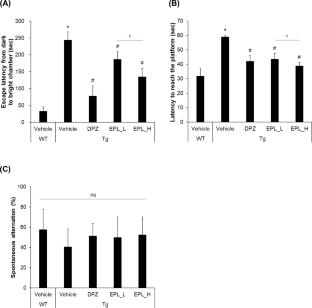
This study investigated the cognitive benefits of Oenothera biennis L. (evening primrose) leaf (EPL) ethanolic extract in 5xFAD mice, a transgenic model of Alzheimer's disease (AD). Starting at two months of age, mice orally received EPL extract (100 or 200 mg/kg BW per administration), three times per week for 14 weeks. Cognitive performance was assessed using the passive avoidance, Morris water maze, and Y-maze tasks. EPL-treated mice showed significant improvements in associative and spatial learning and memory, although working memory was unaffected. EPL also reduced plasma levels of pro-inflammatory mediators, including tumor necrosis factor-alpha (TNFα) and nitric oxide, and suppressed TNFα, interleukin-6 mRNA, and cyclooxygenase-2 expression in the brain. Histological analysis revealed reduced amyloid-beta (Aβ) plaque accumulation in AD-vulnerable hippocampal regions. These results suggest that chronic EPL supplementation may alleviate neuroinflammation and Aβ burden while enhancing cognitive function, highlighting its potential as a natural dietary intervention for AD prevention or management.
期刊介绍:
The FSB journal covers food chemistry and analysis for compositional and physiological activity changes, food hygiene and toxicology, food microbiology and biotechnology, and food engineering involved in during and after food processing through physical, chemical, and biological ways. Consumer perception and sensory evaluation on processed foods are accepted only when they are relevant to the laboratory research work. As a general rule, manuscripts dealing with analysis and efficacy of extracts from natural resources prior to the processing or without any related food processing may not be considered within the scope of the journal. The FSB journal does not deal with only local interest and a lack of significant scientific merit. The main scope of our journal is seeking for human health and wellness through constructive works and new findings in food science and biotechnology field.

 求助内容:
求助内容: 应助结果提醒方式:

 京公网安备 11010802042870号


